What are the differences between peafowl and the phoenix?
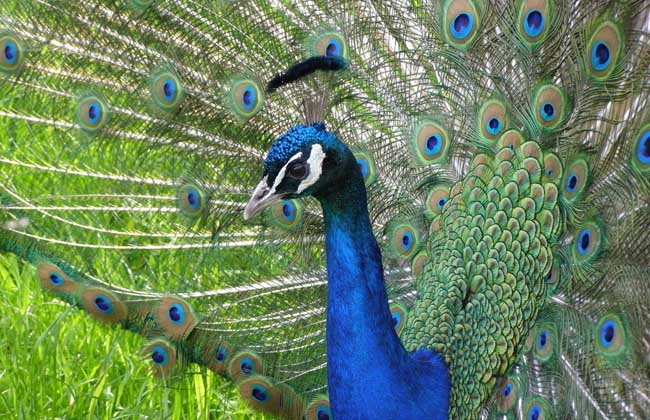
Peafowl is the collective name for two species of birds in the family Phasianidae, order Galliformes, with extremely gorgeous plumage, also known as yueniao, nanke, and other names. The phoenix is the king of all birds in ancient legend; the male is called "feng" and the female is called "huang", collectively known as the phoenix, also called danniao, huoniao, kuanji, weifeng, and other names. It is often used to symbolize auspiciousness and has been an important element of Chinese culture since ancient times. Now let us take a look at the differences between peafowl and the phoenix!
The peafowl has a tail train up to 150 cm long, in vivid metallic green, mainly composed of the upper tail coverts, which are extremely long and have iridescent "eyespots" at the tips surrounded by blue and bronze. During the courtship display, the male peafowl raises the tail beneath the train, thereby lifting the train and bringing it forward. At the climax of the courtship display, the tail feathers quiver, shimmer and glow, and produce a rattling sound. The image of the phoenix, like that of the dragon, became more and more complex over time, ultimately having a swan's head, a unicorn's rump, a snake's neck, a fish's tail, dragon patterns, a turtle's body, a swallow's chin, and a chicken's beak, with a body like a mandarin duck, wings like a roc, and legs like a red-crowned crane. It is a divine creature formed from a combination of many kinds of birds.
Peafowl are mainly found in the East Indies of Southeast Asia and in South Asia in India, Myanmar, Java, and other places, living among high-mountain trees. They mainly live in hilly forests, dry semi-desertified grasslands, scrub, and deciduous forest areas, and especially like to live near water. The image of the phoenix, like that of the dragon, became more and more complex over time, ultimately having a swan's head, a unicorn's rump, a snake's neck, a fish's tail, dragon patterns, a turtle's body, a swallow's chin, and a chicken's beak, with a body like a mandarin duck, wings like a roc, and legs like a red-crowned crane. It is a divine creature formed from a combination of many kinds of birds.
There are three kinds of peafowl: the green peafowl and the Indian peafowl belong to this genus, while the Congo peafowl forms its own genus. The Indian peafowl also has two variant forms, the white peafowl and the black peafowl. According to ancient records, the phoenix had many different categories, with various conflicting accounts, many of which are embellishments and strained interpretations added by people after the Qin and Han dynasties. Besides the three kinds, feng, huang, and luan, those well known to people also include the xuanniao, zhuque, and jinwu, and among the more famous ones there are also alternative names or kinds such as yuezhuo, yuanchu, junyi, susuang, yiniao, he, chun, hu, yan, yan, and kunji, and some accounts even classify the roc, Dijiang (Dihong), and the Chongming bird under the phoenix.
The peafowl is regarded as the king of all birds, the most beautiful ornamental creature, and a symbol of auspiciousness, goodness, beauty, and nobility, with special ornamental value, and its feathers are used to make various handicrafts. The phoenix, as a flying bird combining reality and ideal, after a long historical evolution has become a symbol of bringing good fortune and welcoming auspiciousness and of driving away evil and averting disaster. In a sense, it is a symbol of the spiritual ideas of the Chinese nation and an embodiment of aesthetic form. After thousands of years of evolution, the art of phoenix patterns is still constantly creating new forms today.