How to Adjust the Float for Bloodworm Fishing? A Detailed Guide to Practical Float Adjustment Techniques
How to adjust the float for bloodworm fishing? Float adjustment means setting the balance point where the float meets the water surface by adding or removing weight from the sinker in the rig. Influenced by different angling philosophies and different understandings of floats, there are many float adjustment methods, each with its own rationale, and it is hard to say which method is right and which is wrong. However, when fishing in waters with different conditions or for different fish species, if the float adjustment method you are used to using does not work, adapting in time is the best policy.
Adjusting the Float Without Bait
Adjusting the float without bait can also be called empty-hook float adjustment. When adjusting the float, apart from not attaching bait to the hooks, everything else is the same as adjusting with bait. The guiding idea behind this float adjustment method is to ignore bait weight and, when fishing, let at least one bait ball rest on the bottom. This float adjustment method is commonly used by competitive fishing enthusiasts. Its advantage is that it combines sensitivity and dullness, balancing offense and defense, and it has a certain effect against hook-shy fish. Of course, this float adjustment method is only invincible when fishing for crucian carp in competitive ponds; when fishing for other species in natural waters, it wins about as often as it loses and has no absolute advantage. Whether adjusting with bait or without bait, it must be done on the premise that both hooks do not touch the bottom. Once a hook touches the bottom, the float setting obtained will be inaccurate, and beginners must pay special attention to this point.
How to Adjust the Float With Bait
When adjusting the float, attach bait to both hooks, and control the length of the water line so that the bait balls do not touch the bottom and both baits are suspended. The two baits suspended in the water have their own weight balanced out by the float's buoyancy, so their own weight is zero, and they drift lightly in the water. When a fish swims near the bait, the water flow from its sucking and spitting can move the bait and cause the float to shift. People who use this method to adjust the float are, in their thinking, pursuing a kind of absolute sensitivity, always hoping to hook the fish on its first action of eating the bait. However, excessive sensitivity also brings certain side effects -- false signals on the float increase markedly, and the dancing float will make your head spin and leave you at a loss. Although adjusting the float with bait causes more false movements of the float, it is not without countermeasures; using the technique of adjusting sensitive and fishing dull can resolve the trouble of false movements. For example, if you adjust to one mark with both baits attached, you can fish at two marks, three marks, or even five or six marks. As long as the float gives a signal, you can boldly fish dull. For the angler, what is feared is not the float moving wildly, but the float not moving at all.
Float Adjustment for Bloodworm Fishing
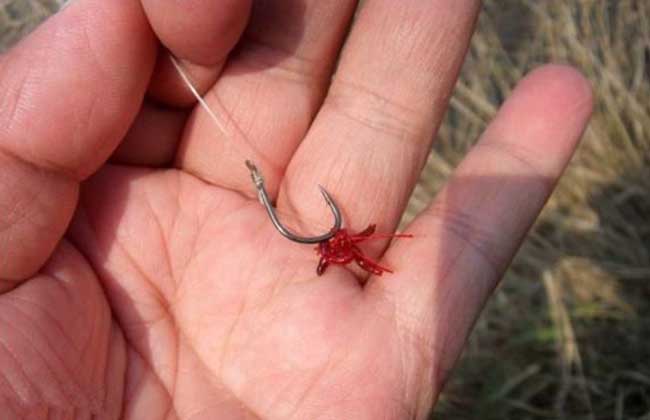
Bloodworms have low specific gravity, and when using bloodworms you also use thin-wire hooks, which are likewise very light, so many anglers worry about not being able to find the bottom. First, choose a No. 1 small float, adjust to four marks by adding or removing lead sheeting without attaching the hooklength, then attach the hooklength and see how many marks the hooks can pull the float down. If it goes down two marks, that is very good. Attach 3 bloodworms to each hook and cast out again to see how many more marks it pulls down. If your float is not too poor, at this point the float tip should show one mark or be level with the water. Next, find the bottom. Assume that with bloodworms attached the float tip shows one mark above the water; then attach bloodworms to both hooks and cast to the fishing spot, and move the float seat upward until the float tip shows two marks. Now one hook touches the bottom and one hook is suspended (sensitive). Move the float seat up a little more, and the float tip shows three marks: one hook lies on the bottom and one hook lightly touches the bottom (neither sensitive nor dull, neutral). Move the float seat up again, and the float tip shows four marks, which is the adjustment mark when no hooklength is attached: both hooks lie on the bottom (dull). Whether to fish sensitive or dull is your own choice. If the float shows five marks, it means the sinker has already touched the bottom, the hooklength lies entirely on the bottom, and it is very dull. Of course, this is not telling you that you must adjust to these marks; these are just steps. Follow the steps above and apply them flexibly. Attaching lead sheeting to find the bottom is not recommended, as there will be errors. Also, when fishing with bloodworms, it is still better to lean toward dull.
Precautions for Float Adjustment
1. After determining the fishing spot, adjust the float within the fishing spot.
2. Adjust the float with the rig you have decided to use.
3. During actual fishing, the main line enters the water, so during float adjustment the main line must also enter the water. If during actual fishing you hold the rod and fish with the main line not entering the water, then during float adjustment the main line should also not enter the water.
4. Be sure to adjust the float after the float and rig have fully absorbed water (after soaking in water for half an hour); otherwise, for a highly sensitive float, there may be a difference of one or two marks.