What is the difference between river dolphins and pufferfish? You will understand after reading this
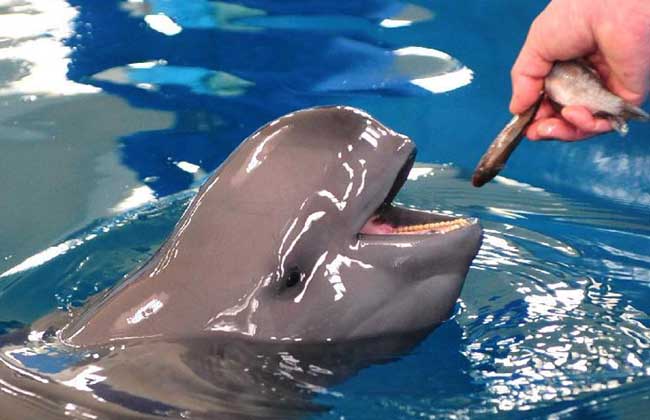
River dolphins are the collective term for animals in the Mammalia class, Cetacea order, and Platanistoidea superfamily, and are the mammals most friendly to humans. Pufferfish are the collective term for fish in the Osteichthyes class and Tetraodontidae family. They are named river "dolphin" because they make a squeaking sound similar to a pig when caught and taken out of the water, and are also known as bubble fish, blow-belly fish, balloon fish, street fish, wax head, boat mackerel, etc. Now let us take a look at the difference between river dolphins and pufferfish!
The difference in family and genus between river dolphins and pufferfish
1. River dolphin: The river dolphin is the collective term for mammals in the Animalia kingdom, Chordata phylum, Vertebrata subphylum, Mammalia class, Eutheria subclass, Cetacea order, Odontoceti suborder, and Platanistoidea superfamily.
2. Pufferfish: The pufferfish is a fish in the Animalia kingdom, Chordata phylum, Vertebrata subphylum, Actinopterygii class, Tetraodontiformes order, Tetraodontidae family, and Takifugu genus.
The morphological difference between river dolphins and pufferfish
1. River dolphin: River dolphins are larger than sea dolphins and can grow to 3 m long. Unlike sea dolphins, their heads can rotate 90 degrees, which gives them an advantage in complex river channels. Sometimes, like sea dolphins, they collectively chase schools of fish to improve feeding efficiency. Their jaws have sensitive hairs, which are said to be tactile organs for hunting crustaceans in mud. They have broad pectoral fins, which improve their flexibility in narrow river channels, and with their tail fins they can also reach a speed of 23 km/h in a short time.
2. Pufferfish: The pufferfish has a cylindrical body and the well-known round, plump shape. It generally measures about 100-300 mm in body length, and large ones can reach more than 630 mm. The upper and lower jawbones and teeth are fused into 4 large tooth plates, and the body length can reach 1.1 m. It has 1 dorsal fin and no pelvic fins. It has no scales or has small spines. It has an air sac and can inflate by taking in air.
The habitat difference between river dolphins and pufferfish
1. River dolphin: The Platanistoidea superfamily has four extant species inhabiting freshwater rivers and estuaries, among which three live in freshwater rivers, while the other species, the La Plata dolphin (Pontoporia blainvillei), lives in saltwater estuaries and nearshore oceans. However, in scientific classification, it is still placed in the Platanistoidea superfamily rather than the Delphinidae family.
2. Pufferfish: Pufferfish are extremely abundant in our country. There are 54 species produced along the coast of China, with an annual output of about 3-4 million tons, and they can be caught almost year-round along the coast. In the Yangtze River and Pearl River, flood seasons appear between spring and summer, making them one of the main fishery targets in coastal areas and the middle and lower reaches of rivers.
The toxicity difference between river dolphins and pufferfish
1. River dolphin: Pufferfish are the collective term for fish in the Tetraodontiformes order and Tetraodontidae family, distributed in offshore waters and river sections entering the sea. Some species have highly toxic organs and blood (called "tetrodotoxin")
2. Pufferfish: River dolphins, by contrast, are the collective term for animals in the Mammalia class and Platanistidae family, including the baiji and others. They mainly live in rivers, and the internal organs in the abdomen are non-toxic. Note that the "river dolphin" mentioned here does not refer to the toxic pufferfish (that is, pufferfish), but to the collective term for freshwater dolphins (which are aquatic mammals). The dolphin that people are familiar with corresponds exactly to it.