The Moral and Meaning of "When the Snipe and the Clam Grapple, the Fisherman Profits"
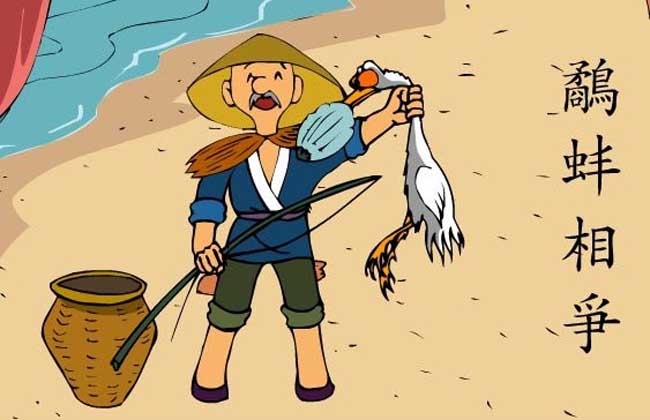
"When the snipe and the clam grapple" comes from a fable told by the strategist Su Dai when he persuaded King Hui of Zhao. At that time, the King of Zhao wanted to attack the State of Yan, and Su Dai, on behalf of the King of Yan, told the King of Zhao that the endless fighting between Zhao and Yan was nothing more than "the snipe and the clam grappling," which would surely let the State of Qin reap "the fisherman's profit." Today this fable tells people that in intricate and complex conflicts, one must stay alert to the real enemy.
Original Text of "When the Snipe and the Clam Grapple, the Fisherman Profits"
Zhao was about to attack Yan. Su Dai spoke to King Hui on behalf of Yan, saying: "Just now, as I was coming here, I passed the Yi River. A clam had just come out to sun itself, when a snipe pecked at its flesh. The clam closed up and clamped the snipe's beak. The snipe said: 'If it doesn't rain today, and doesn't rain tomorrow, there will soon be a dead clam.' The clam also said to the snipe: 'If I don't let you out today, and don't let you out tomorrow, there will soon be a dead snipe.' Neither was willing to let the other go, and the fisherman caught them both together. Now Zhao is about to attack Yan. If Yan and Zhao attack each other for a long time, they will exhaust their masses. I fear that the mighty Qin will play the role of the fisherman. Therefore I hope Your Majesty will consider this carefully." King Hui said: "Well said!" And so he stopped.
Translation of "When the Snipe and the Clam Grapple, the Fisherman Profits"
The King of Zhao was about to attack the State of Yan. Su Dai went to persuade King Hui of Zhao on behalf of Yan, saying: "When I came this time, I passed the Yi River and saw a river clam with its shell open, sunning itself. There was a snipe that stretched out its beak to peck at the clam's flesh. The clam quickly closed its shell and tightly clamped the snipe's beak. The snipe then said: 'If it doesn't rain today, and doesn't rain tomorrow, you will die.' The clam also said to the snipe: 'If I don't let you go today, and don't let you go tomorrow, you will die!' Neither was willing to let the other go. The fisherman saw this and caught them both together. Now Zhao wants to attack Yan. If Yan and Zhao remain locked in a standoff, as the days grow long, the strength of both sides will be severely drained. I worry that the powerful State of Qin will play the role of the 'fisherman' in the grapple between snipe and clam. So I hope Your Majesty will consider this carefully." When King Hui heard this, he suddenly understood and said: "That makes sense!" And he halted the plan to attack Yan.
The Moral of "When the Snipe and the Clam Grapple, the Fisherman Profits"
Everyone is familiar with the story of the snipe and the clam grappling, and through this story we can see some very interesting lessons. Both the snipe and the clam wanted to put the other to death, without considering the consequences of doing so. People should yield to one another and be courteous to one another; taking a step back opens up a broad horizon. In all kinds of intricate and complex conflicts, if two opposing sides remain locked in a standoff, both will suffer and a third party will reap the profit. Therefore, in life one should learn to grasp the principal contradiction and not let a small thing cost a big one. "When the snipe and the clam grapple, the fisherman profits" tells people: when a great enemy is at hand, the weak must unite, eliminate their conflicts, stand together, and jointly deal with the enemy. The same applies to handling internal affairs: partial interests must be subordinate to overall interests, immediate interests must be subordinate to long-term interests, and minor principles must be subordinate to major principles. Otherwise, endless internal strife and mutual refusal to yield will only leave both sides wounded and let a third party profit. In doing things, one must know how to weigh gains and losses, resolve conflicts, and yield to one another, so as to avoid attending to one thing and losing sight of another, and letting others exploit the opening.