What is the difference between hazelnuts and acorns? A quick guide to telling them apart
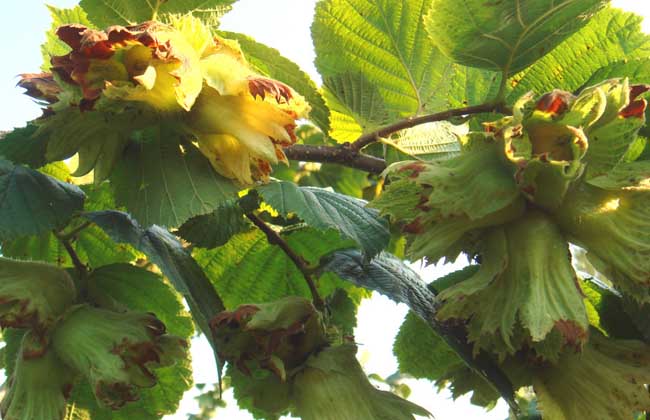
The hazelnut is one of the world's four major dried nuts (walnut, almond, hazelnut, cashew) and is a shrub or small tree of the genus Corylus in the birch family. The acorn is the fruit of the oak tree, shaped like a silkworm cocoon, hence it is also called chestnut cocoon; it is rich in minerals and vitamins such as calcium, phosphorus, potassium and niacin, and it is edible. Let us take a look below at the difference between hazelnuts and acorns!
The difference in family and genus between hazelnuts and acorns
1. Hazelnut: The hazelnut is a shrub or small tree of the plant kingdom, angiosperms, dicotyledons, original perianth subclass, Fagales, Betulaceae, Coryleae, genus Corylus.
2. Acorn: The acorn belongs to the plant kingdom, angiosperms, dicotyledons, Fagales, Fagaceae, genus Quercus, deciduous or evergreen trees.
The difference in morphology between hazelnuts and acorns
1. Hazelnut: The bark of the hazelnut tree is gray, and the branches are dark gray and hairless. The leaves are oblong or broadly obovate, with a notched or truncate apex, a triangular protruding tip in the center, and irregular double-serrate edges; the petiole is sparsely covered with short hairs or nearly hairless. The male inflorescence is solitary; the fruit bract is bell-shaped, densely covered with short soft hairs mixed with sparsely growing long soft hairs, shallowly lobed in the upper part, with triangular lobes and entire edges. The inflorescence stalk is densely covered with short soft hairs. The nut is nearly spherical, hairless or only sparsely covered with long soft hairs at the tip.
2. Acorn: The oak tree reaches 25 m, the bark is dark grayish brown and slightly smooth, and the twigs are brown and hairless. The leaf edges are serrate, rarely entire, and the leaves turn reddish brown before falling in autumn. The male flowers are catkins that hang down, and the female flowers are solitary within the involucre. The nut is solitary, the inner wall of the pericarp is hairless, and the undeveloped ovule is located outside the base of the seed.
The difference in origin between hazelnuts and acorns
1. Hazelnut: The hazelnut grows in mountain shade-slope thickets at an altitude of 200-1000 m. In China it is mainly produced in Heilongjiang, Jilin, Liaoning, Hebei, Shanxi and Shaanxi, and it is also distributed in Turkey, Italy, Spain, the United States, Korea, Japan, the East Siberian and Far Eastern regions of Russia, and eastern Mongolia.
2. Acorn: The distribution of oak trees is also related to topography to a certain extent; they are distributed in Asia, Europe, Africa and the Americas, with abundant resources and about 300 species. China has more than 60 species of oak trees, mostly in Heilongjiang, Liaoning, Jilin, Inner Mongolia, Shandong, Henan, Guizhou, Guangxi, Anhui, Shaanxi, Sichuan and other provinces and regions.
The difference in effects between hazelnuts and acorns
1. Hazelnut: The hazelnut is sweet in taste, neutral in nature, non-toxic, and enters the spleen and stomach meridians. It has the effects of regulating the middle, stimulating the appetite, nourishing qi and blood, and improving eyesight, and it mainly treats symptoms such as unwillingness to eat, fatigue and lack of strength, emaciation, weak limbs, weakness after illness, and blurred vision.
2. Acorn: The acorn has a hard outer shell, brownish red, and the inner kernel is like a peanut kernel; it is rich in starch, with a content of about sixty percent, and it can be eaten as well as used as a raw material for sizing yarn in the textile industry.