What is the difference between hazelnuts and chestnuts? A quick guide to telling them apart
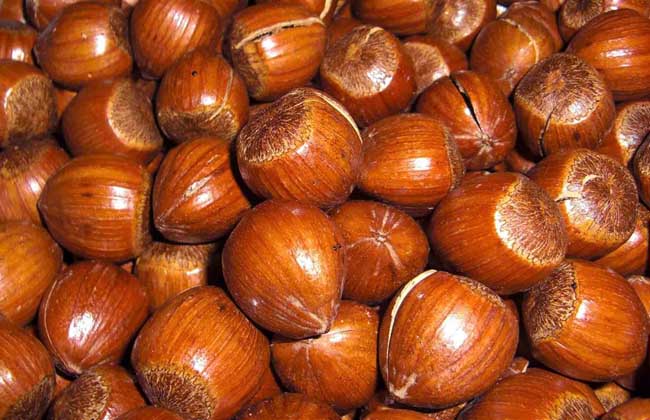
Hazelnut is one of the world's four major dried nuts (walnut, almond, hazelnut, cashew), a shrub or small tree of the genus Corylus in the birch family; chestnut, also known as mao li, ban li and so on, is a specialty of China, long praised as the "king of dried nuts", and abroad it is also called "ginseng fruit". Let's take a look below at the difference between hazelnuts and chestnuts!
The difference in family and genus between hazelnuts and chestnuts
1. Hazelnut: The hazelnut is a shrub or small tree of the plant kingdom, phylum Angiospermae, class Dicotyledoneae, subclass Archichlamydeae, order Fagales, family Betulaceae, tribe Coryleae, genus Corylus.
2. Chestnut: The chestnut is a shrub or small tree of the plant kingdom, phylum Angiospermae, class Dicotyledoneae, order Fagales, family Fagaceae, genus Castanea.
The morphological difference between hazelnuts and chestnuts
1. Hazelnut: The hazelnut tree has gray bark, and its branches are dark gray and hairless. The leaves are oblong or broadly obovate, with a notched or truncate apex and a triangular pointed tip in the center, and the margins have irregular double serrations; the petiole is sparsely covered with short hairs or nearly hairless. The male inflorescence is solitary; the fruit bract is bell-shaped, densely covered with short soft hairs along with scattered long soft hairs, and its upper part is shallowly lobed with triangular lobes and entire margins. The inflorescence stalk is densely covered with short soft hairs. The nut is nearly spherical, hairless or with long soft hairs only sparsely at the tip.
2. Chestnut: The chestnut tree is 15-20 m tall, with dark gray bark; the twigs have short hairs or scattered long downy hairs, and there is no terminal bud. The leaves are alternate, arranged in 2 rows, ovate-elliptic to oblong-lanceolate. The flowers are unisexual and monoecious; the male inflorescence is spicate, and the female flowers are clustered at the base of the male inflorescences on the upper part of the branches. The sharp spines of the mature cupule vary from long to short and from sparse to dense; when dense they completely cover the outer wall of the cupule, and when sparse the outer wall is visible.
The difference in origin between hazelnuts and chestnuts
1. Hazelnut: The hazelnut grows in shrub thickets on shady mountain slopes at an altitude of 200-1000 m. In China it is mainly produced in Heilongjiang, Jilin, Liaoning, Hebei, Shanxi and Shaanxi; it is also distributed in Turkey, Italy, Spain, the United States, Korea, Japan, eastern Siberia and the Far East of Russia, and eastern Mongolia.
2. Chestnut: The chestnut mostly grows on gentle slopes of low hills and in riverbank areas. Hebei, Shandong, Hubei, Luoshan in Xinyang, and Zhen'an in southern Shaanxi are famous chestnut-producing areas. In China, apart from a few provinces and regions such as Qinghai, Ningxia, ** and Hainan, it is produced throughout the north and south.
The difference in effects between hazelnuts and chestnuts
1. Hazelnut: The hazelnut is sweet in taste, neutral in nature and non-toxic; it enters the spleen and stomach meridians and has the effects of regulating the middle, stimulating the appetite, nourishing qi and blood, and improving eyesight. It is mainly used for poor appetite, fatigue and lack of strength, emaciation, weak and aching limbs, weakness after illness, and blurred vision.
2. Chestnut: The chestnut is warm in nature and sweet in taste; it enters the spleen, kidney and stomach meridians and has the effects of nourishing the stomach and strengthening the spleen, tonifying the kidney and strengthening the sinews, and invigorating the blood and stopping bleeding. It is suitable for weakness of the spleen and stomach, nausea, diarrhea, weakness with soreness and aching of the waist and legs, vomiting of blood, nosebleeds, bloody stool, incised wounds, swelling and pain from fractures, and scrofula and toxic swellings.