What is the difference between mulberry and raspberry? Learn to quickly tell the two fruits apart
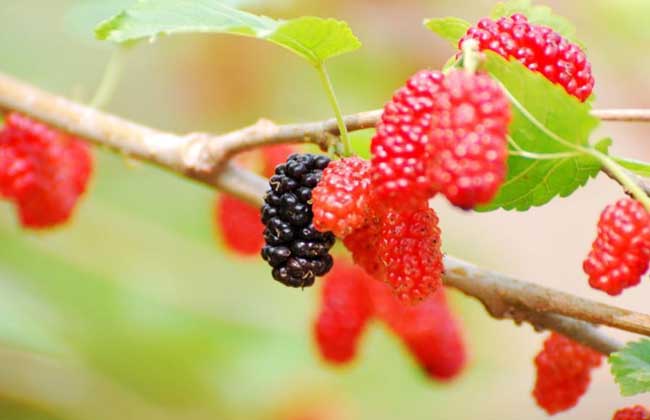
Mulberry is the ripe fruit of the mulberry tree, also called mulberry fruit, mulberry pao'er, etc. Farmers like to eat its ripe fresh fruit; it is sweet and juicy, and it is one of the fruits people commonly eat. Raspberry is also known as mountain paozi, milk pao, sowing pao, bramble, etc. It has the effects of astringing essence, benefiting the kidneys, helping yang and brightening the eyes, sobering up and quenching thirst, and resolving phlegm and detoxifying. Now let us take a look at the difference between mulberry and raspberry!
The difference in family and genus between mulberry and raspberry
1. Mulberry: Mulberry is in the plant kingdom, angiosperms, dicotyledons, original perianth subclass, Urticales, Moraceae, fruit tribe, Morus, a deciduous shrub or small tree.
2. Raspberry: Raspberry is in the plant kingdom, angiosperms, dicotyledons, original perianth subclass, Rosales, Rosineae, Rosaceae, Rosoideae, Rubus, an upright shrub.
The morphological difference between mulberry and raspberry
1. Mulberry: The mulberry tree is 3-15 m tall, with grayish-white bark and shallow strip-like cracks; the root bark is yellow-brown or red-yellow, strongly fibrous; the leaves are simple and alternate; both female and male inflorescences are arranged in spicate catkins; the multiple fruit is mostly densely clustered into an oval or oblong syncarp; the flowering period is March-May, and the fruiting period is May-June.
2. Raspberry: The raspberry plant is 1-3 m tall, with prickles on the branches and soft hairs when young. The leaves are simple, ovate to ovate-lanceolate, 5-12 cm long and 2.5-5 cm wide; the flowers are solitary or few on short branches; the outside of the calyx is densely covered with fine soft hairs; the sepals are ovate or triangular-ovate; the petals are oblong or elliptic; the fruit is composed of many small drupelets; the flowering period is February-March, and the fruiting period is April-June.
The difference in producing areas between mulberry and raspberry
1. Mulberry: Mulberry likes a warm and humid climate and is slightly shade-tolerant. It begins to sprout when the temperature is above 12°C, and the suitable growing temperature is 4-30°C. Above 40°C it is inhibited, and below 12°C it stops growing. It grows in hills, slopes, village sides, fields and other places, and is mostly cultivated artificially. It is cultivated throughout the country and around the world.
2. Raspberry: Raspberry mostly grows in sunny slopes, stream sides, valleys, wasteland and moist places in dense or sparse thickets. In China, except for the Northeast, Anhui, Sichuan, Guizhou, Gansu, Qinghai, ** and Tibet, it is distributed in all other provinces, and it is also found in Korea, Japan, Myanmar and Vietnam.
The difference in effects between mulberry and raspberry
1. Mulberry: Mulberry is sweet and cold in nature and flavor, and has effects such as tonifying the liver and benefiting the kidneys, promoting body fluids and moistening dryness, and darkening hair and brightening the eyes. It is suitable for symptoms such as dizziness and tinnitus, palpitations and insomnia, premature graying of beard and hair, constipation, thirst due to fluid damage, internal heat and wasting-thirst, constipation due to blood deficiency, tonifying the liver, benefiting the kidneys, extinguishing wind, nourishing fluids, and treating yin deficiency of the liver and kidneys.
2. Raspberry: Raspberry has the effects of astringing essence, benefiting the kidneys, helping yang and brightening the eyes, sobering up and quenching thirst, and resolving phlegm and detoxifying. It mainly treats kidney deficiency, spermatorrhea, drunkenness, erysipelas and other conditions. The leaves are slightly bitter in nature and can treat detoxification, reduce swelling, astringe sores, sore throat, multiple abscesses, mastitis and other conditions.