What is the difference between a frog and a field frog? Understanding the differences between the two in one article
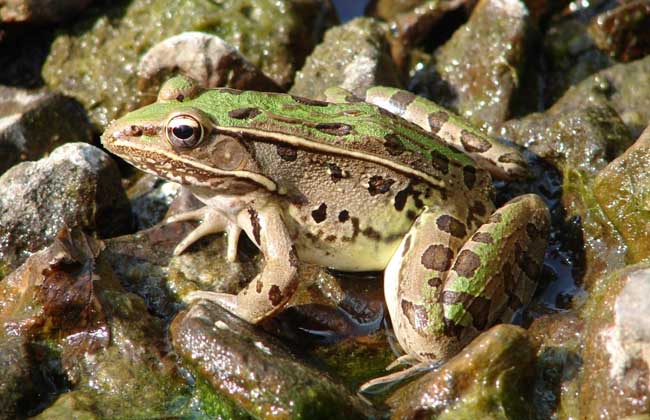
Frogs are amphibians of the order Anura, family Ranidae, and are divided into many species. Common ones include the black-spotted frog, bullfrog, tiger frog, and rice field frog, while the field frog is the tiger frog. This also shows that the field frog is a type of frog. The frog we commonly see is the black-spotted frog. The black-spotted frog and the tiger frog are very similar, and it is not easy to tell the difference. Let us take a look below at exactly what differences they have!
Morphological differences between frogs and field frogs
1. Frog: The body length of a frog is about 70-80 mm, with males slightly smaller. The head length is slightly greater than the head width. The snout is bluntly rounded and slightly pointed, and the snout ridge is not obvious. The interorbital space is very narrow. The forelimbs are short, and the tips are bluntly pointed. The hind limbs are relatively short and stout. The tibio-tarsal articulation reaches the eye. The toes are almost fully webbed. The skin on the back is yellow-green, dark green, or gray-green, and the skin is relatively smooth.
2. Field frog: The field frog is burly and sturdy in build. Females are larger than males. The body length can exceed 12 cm, and the body weight is 250-500 g. The skin is relatively rough. There are dark, irregular markings on the head and sides of the body. The back is yellow-green with a slight brown tinge, with more than a dozen rows of longitudinal skin ridges, and small tubercles scattered between the skin ridges. The underside is white, also with irregular markings, and there are gray-brown spots on the throat and chest. The forelimbs and hind limbs have transverse bands. The toe tips are pointed and rounded, and the toes are fully webbed. The forelimbs are stout, and the digital pads are well developed and gray. Male frogs have a pair of external vocal sacs.
Reproductive differences between frogs and field frogs
1. Frog: The breeding period of frogs is from April to July, with the peak of egg laying in April. They generally begin calling before and after rainfall and at dusk to attract female frogs to pair and lay eggs. Eggs are mostly laid in seedling fields, early rice fields, or other still-water areas, and occasionally in slow-flowing water. Each egg mass contains 2-3.5 thousand eggs, mostly floating on the water surface, with an egg diameter of 1.7-2.0 mm. The tadpole body is clumsy, the tail musculature is weak, the tail fin is well developed, and the tail tip is pointed and rounded. Metamorphosis is completed after about 2 months.
2. Field frog: The breeding period of the field frog is from May to August. After awakening from hibernation, it immediately carries out reproductive activity. External fertilization takes place in water. After the eggs hatch, they become tadpoles, with a series of larval characteristics adapted to life in water, and as the developmental stages differ, the morphological characteristics also change accordingly. The tadpole undergoes metamorphosis and develops into a frog, then moves to land to live. The life history includes three stages: egg, tadpole, and frog.
Distribution differences between frogs and field frogs
1. Frog: Frogs are mainly distributed in Jiangsu, Zhejiang, Jiangxi, Hunan, Hubei, Anhui, Shandong, Shanxi, Hebei, Sichuan, Chongqing, Guizhou, Fujian, Guangdong, Heilongjiang, Jilin, Liaoning, Inner Mongolia, and other places.
2. Field frog: The field frog has a relatively wide distribution range. In China, it is distributed in Jiangsu, Zhejiang, Hunan, Hubei, Anhui, Guangdong, Guangxi, Guizhou, Fujian, Taiwan, China, Yunnan, Jiangxi, Hainan, Shanghai, Henan, Chongqing, Sichuan, and southern Shaanxi, and abroad it is also found in South Asia and Southeast Asia.
Dietary differences between frogs and field frogs
1. Frog: Frogs are omnivorous animals, among which plant-based food accounts for only about 7% of the diet, while animal-based food accounts for about 93% of the diet. The main foods include rice leaf roller, rice stem borer, rice skipper, armyworm, corn borer, cotton pink bollworm, rice caseworm, rice leaf beetle, rice eye butterfly, rice hispa, rice weevil, scarab beetle, ladybug, white-backed planthopper, gray-backed planthopper, rice black stink bug, brown-backed planthopper, rice leaf miner, rice midge, fruit fly, mosquito, and others.
2. Field frog: The field frog eats many kinds of food, among which it mainly feeds on Coleoptera insects, accounting for about 36% of the food intake. Others include spiders, earthworms, myriapods, shrimp, crabs, loach, and animal carcasses. What is hard to believe is that it also eats frogs such as the rice field frog and black-spotted frog, as well as house mice, and these occupy a very important position in the diet of the tiger frog.