Differences Between Russula Vinosa and the Poisonous Russula Emetica and How to Tell Them Apart
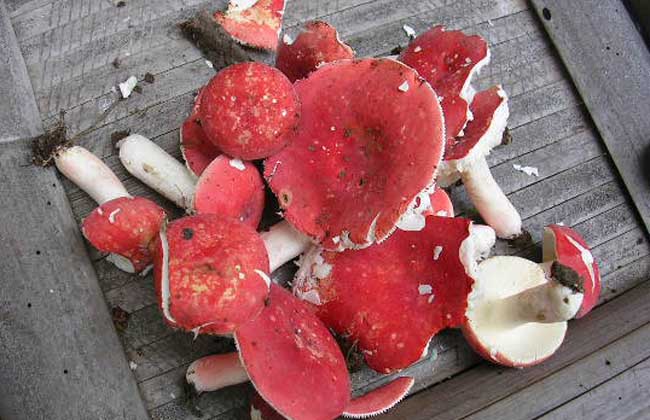
Russula vinosa is also known as big red mushroom, true red mushroom, authentic red mushroom, and so on. Its fruiting body is generally medium-sized. Russula emetica, also known as the vomiting russula, looks similar to Russula vinosa, but its fruiting body is generally smaller, and it is a fairly widely distributed poisonous fungus. Both belong to the order Agaricales, family Russulaceae, genus Russula. Let us take a look below at the differences between Russula vinosa and Russula emetica!
Differences in Appearance Between Russula Vinosa and Russula Emetica
1. Russula vinosa: The fruiting body of Russula vinosa is generally medium-sized, with a cap diameter of 5-12 cm. It is initially hemispherical and then flat-spreading, sticky when young, dull or velvety, with the center dark red to dark (black) red and the margin paler, deep red, with fine transverse lines commonly seen along the cap edge. The flesh, gills, and stem are all white, the spores are nearly spherical and colorless, and the cystidia are nearly spindle-shaped.
2. Russula emetica: The fruiting body of Russula emetica is generally smaller, with a cap 5-9 cm across, hemispherical, later becoming flat-spreading and concave when old, sticky, smooth, light pink to coral red, with the margin paler and ridged, the skin easily peeled off, the flesh white, the gills pure white, the stem white or pink, the spores nearly spherical and colorless, and the cystidia lanceolate.
Differences in Distribution Between Russula Vinosa and Russula Emetica
1. Russula vinosa: Russula vinosa grows in groups or singly on forest ground in summer and autumn. It is mostly produced in Hunan, Fujian, Jiangxi, Guangdong, Guangxi, Sichuan, Shaanxi, Yunnan, Hubei, and other places. Abroad, it is distributed in Vietnam, Myanmar, Laos, Cambodia, and other places.
2. Russula emetica: Russula emetica grows scattered or in groups on forest ground in summer and autumn. It is mostly produced in Hebei, Jilin, Henan, Jiangsu, Anhui, Fujian, Hunan, Sichuan, Gansu, Shaanxi, Guangdong, Guangxi, Tibet, and Yunnan.
Differences in Toxicity Between Russula Vinosa and Russula Emetica
1. Russula vinosa: Russula vinosa is nutritious, non-toxic, and a high-protein food. It has the effect of nourishing the body and mind and is suitable for both young and old. It can be boiled, steamed, or stewed on its own, and can also be added as a seasoning to meat and eggs. After freshly picked red mushrooms are boiled or stewed, their flesh is smooth, tender, and excellent in taste, and the broth is bright red and sweet. If cooked or clear-stewed together with chicken, duck, or pork ribs, it is complete in color, aroma, and taste.
2. Russula emetica: Russula emetica tastes numbing and spicy and is toxic. After eating it, it mainly causes gastroenteritis-type poisoning symptoms. The onset is generally rapid and the course short. In addition to severe nausea, vomiting, diarrhea, and abdominal pain, severe cases also experience facial muscle twitching, accelerated pulse, and rising or falling body temperature. Some may die from cardiac weakness or circulatory failure.