What is the difference between ivy and Boston ivy?
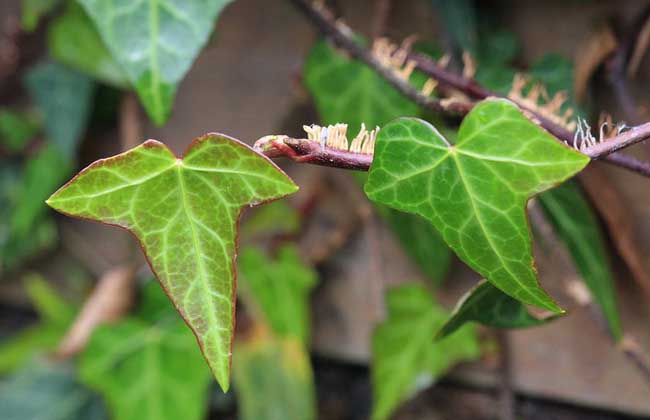
Ivy is highly adaptable to its environment and is a fairly popular indoor foliage plant, while Boston ivy is a perennial large deciduous woody vine in the genus Parthenocissus of the grape family, commonly seen climbing on walls and rocks. The two look somewhat similar in appearance, and in many places Boston ivy is also called ivy. Let's take a look below at the differences between ivy and Boston ivy!
The difference in family and genus between ivy and Boston ivy
1. Ivy: Ivy is an evergreen woody vine in the plant kingdom, angiosperms, dicotyledons, Rosidae, Apiales, Araliaceae, tribe Schefflereae, genus Hedera.
2. Boston ivy: Boston ivy is a perennial large deciduous woody vine in the plant kingdom, angiosperms, dicotyledons, Rosidae, Vitales, Vitaceae, genus Parthenocissus.
The morphological differences between ivy and Boston ivy
1. Ivy: Ivy has woody stems, with stems reaching 3-5 m in length, much branched, with aerial roots on the stems; the slender young branches are covered with soft hairs and appear rusty-colored and scale-like; the leaves are leathery and alternate; the umbels are solitary or 2-7 in terminal clusters, yellow-white or green-white; the fruit is spherical, berry-like, yellow or red; the flowering period is May-August, and the fruiting period is September-November.
2. Boston ivy: Boston ivy's form resembles that of wild grape vines; the vine stems can reach 18 m in length, and the surface has lenticels; the cymes usually grow on short branches between two leaves, in inconspicuous clusters, yellow-green, or berries purple-black; mostly bisexual, monoecious; the berries are small and spherical, blue-black when ripe, covered with white bloom, and eaten by birds; the flowering period is June, and the fruiting period is September-October.
The differences in habits between ivy and Boston ivy
1. Ivy: Ivy is highly adaptable to its environment, prefers a relatively cool climate, has strong cold resistance, and dislikes hot, stuffy environments; growth stops when the temperature is above 30°C. It is not strict about light, and can grow and develop both in direct sunlight and in indoor conditions with insufficient light.
2. Boston ivy: Boston ivy is highly adaptable and prefers shady, humid environments, but it is not afraid of strong light; it is cold-resistant, drought-resistant, and tolerant of poor soil, with broad climatic adaptability. South of the warm temperate zone, it can remain semi-evergreen or evergreen in winter. It tolerates pruning, fears waterlogging, and is not strict about soil. It can grow vigorously in both shady, humid environments and sunny spots, but grows best in shady, humid, fertile soil. It has strong resistance to harmful gases such as sulfur dioxide and hydrogen chloride, and can absorb dust from the air.
The distribution differences between ivy and Boston ivy
1. Ivy: Ivy is also known as Chinese ivy, centipede vine, and so on. It is native to Europe, Asia, and North Africa, and is distributed in central China, east China, southwest China, Gansu, and Shaanxi in our country.
2. Boston ivy: Boston ivy is also known as kunshilong, maple vine, xiaochonger wocao, hongsicao, hongge, pashanhu, red grape vine, bashanhu, and so on. It is native to eastern Asia, the Himalayan region, and North America, and is distributed in Henan, Liaoning, Hebei, Shanxi, Shaanxi, Shandong, Jiangsu, Anhui, Zhejiang, Jiangxi, Hunan, Hubei, Guangxi, Guangdong, Sichuan, Guizhou, Yunnan, and Fujian in our country.
The differences in effects between ivy and Boston ivy
1. Ivy: Ivy is bitter and pungent in taste and warm in nature, and has the effects of dispelling wind and draining dampness, activating blood and reducing swelling, calming the liver and detoxifying. It has therapeutic effects on conditions such as bruises, waist and leg pain, and rheumatoid arthritis.
2. Boston ivy: Boston ivy is sweet and astringent in taste, warm in nature, and toxic. It has the effects of breaking blood stasis, invigorating the sinews and stopping bleeding, and reducing swelling and toxicity. It is used for rheumatic joint pain, and externally for bruises, boils, swelling, and toxic conditions.