Why do flies love rubbing their hands? It turns out there are these reasons
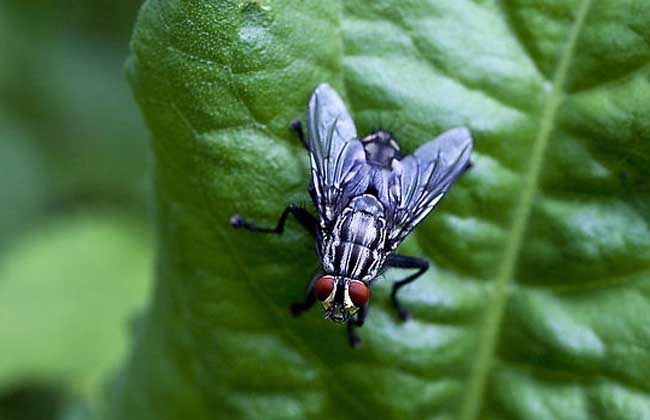
Flies are typical holometabolous insects. Although they have no nose, they have another taste organ, and it is not on the head or face but on the feet. As soon as a fly lands on food, it first uses the taste organ on its feet to sample how the food tastes, and then eats it with its mouth. Now let us take a look at why flies always rub their hands!
Flies are not infected by bacteria
While eating, flies also take in harmful bacteria, so the method of "eating while vomiting and excreting" helps quickly remove bacteria. From feeding and processing to absorbing nutrients and finally expelling waste from the body, it takes only 7-11 seconds. When encountering bacteria with rapid reproductive ability, the fly's immune system launches two globulins, BF64 and BD2. Once they contact bacteria, an "explosion" occurs and they "perish together" with the bacteria. These two globulins are always launched one after the other, in pairs, never out of order.
Why flies always rub their hands
1. Keeping hands and feet clean: Flies move everywhere, and their bodies pick up many dirty substances. If these substances are not removed, they increase the fly's body weight and affect flight. After picking things up, the suction pads on its hands and feet attach to object surfaces when it lands, and once stopped it is not easy for it to walk quickly. So this is why flies always keep rubbing their hands and feet.
2. Keeping taste sensitive: Flies have taste receptors on their feet. That is, if we humans want to taste flavor, we need to put food into our mouths, but a fly can taste it just by touching it with its feet. So when a fly stops, it keeps touching around with its feet. After tasting flavor, it rubs them again, in order to clean the taste receptors, remove the old flavor, then touch again and taste a new flavor. No wonder the flies we see, after stopping, always walk around and rub their feet while walking. It never occurred to us that it is tasting everywhere.
3. Spreading symbiotic bacteria: Whenever a fly flies above dirty matter, it lands on it, crawls around on it, and rubs its feet on it, sticking the bacteria on it to its own feet. When the fly completes this task, it takes off again, then lands on human food and begins rubbing its feet, rubbing the bacteria off its feet. The bacteria then fall onto the food, and the process of bacterial transmission is complete. When people eat this food, the bacteria enter the human body and parasitize it, and they have a symbiotic relationship with the bacteria.
The living habits of flies
1. Mating: Flies have the physiological characteristic that one mating can allow lifetime egg-laying. At suitable temperatures, male houseflies can reach sexual maturity and mate 18-24 hours after emergence, and female houseflies 30 hours after emergence. Mating usually occurs in the early morning.
2. Egg-laying: The length of the female fly's pre-oviposition period (that is, the time from emergence to first egg-laying) is closely related to environmental temperature. Its reproductive capacity is astonishing. According to the most conservative estimate, each female fly can produce 200 offspring, and after only 10 generations of reproduction, the total number of flies will reach 2 trillion trillion.
3. Feeding habits: The feeding habits of flies depend on their species. Some specialize in sucking nectar and plant sap, and some specialize in feeding on human and livestock blood, or blood from animal wounds and eye and nasal secretions. The common housefly, Chrysomya megacephala, Lucilia sericata, blowfly, and flesh fly are omnivorous flies, that is, they widely feed on human food, livestock and poultry secretions and excreta, kitchen scraps, and organic matter in garbage, and they have a very strong tendency toward sugar, vinegar, ammonia odor, and fishy odor.
4. Development: Biologically, flies are typical holometabolous insects. Their life requires going through four stages: egg stage, larva, pupa stage, and adult.
5. Lifespan: The factors affecting fly lifespan include temperature, humidity, food, and water. A temperature of 25-33°C and air humidity of 60-70% are optimal. The adult lifespan of an ordinary fly is 15-25 days. If the larval stage and pupal stage are included, the lifespan is 25-70 days. Female flies live longer than male flies, with a lifespan of 30-60 days. Under low-temperature overwintering conditions, flies can live as long as half a year.