What is the difference between hyacinth bean and snow pea? This article teaches you to tell them apart
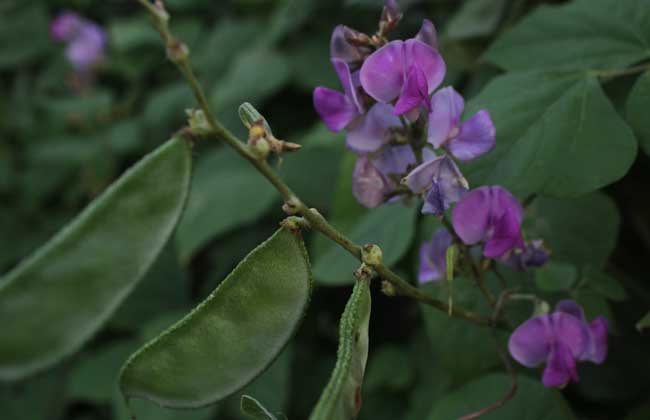
The hyacinth bean is a perennial twining vine of the genus Lablab in the Fabaceae family, originating in southwestern Asia and the eastern Mediterranean region, and is now cultivated in tropical and subtropical regions worldwide. The snow pea is an annual twining herb of the genus Pisum in the Fabaceae family, grown mainly for its tender pods, and is native to the Mediterranean coast and western Asia. Let us now take a look at what differences exist between the hyacinth bean and the snow pea!
The difference in family and genus between hyacinth bean and snow pea
1. Hyacinth bean: The hyacinth bean is a perennial twining vine of the plant kingdom, Angiosperms, Dicotyledons, Archichlamydeae, Rosales, Rosineae, Fabaceae, Faboideae, Phaseoleae, genus Lablab.
2. Snow pea: The snow pea is an annual twining herb of the plant kingdom, Angiosperms, Dicotyledons, Archichlamydeae, Rosales, Rosineae, Fabaceae, Faboideae, Vicieae, genus Pisum.
The difference in alternative names between hyacinth bean and snow pea
1. Hyacinth bean: The hyacinth bean is also known as biandou, huolian biandou, tengdou, yanli dou, quedou, chadou, yueliang cai, and more. It originated in southwestern Asia and the eastern Mediterranean region. In China it is mainly produced in Shanxi, Shaanxi, Gansu, Hebei, Henan, Hubei, Yunnan, Sichuan and other places.
2. Snow pea: The snow pea is also known as honey bean, honey pea, green pea, xiaohan dou, huai dou, ma dou, qing xiao dou, liu dou, jin dou, huihui dou, mai wan dou, mai dou, bi dou, ma lei, guo dou, soft-pod pea, podded pea, sweet pea, heren dou, qing ban, cai wan dou, and more. It is found throughout the world; in China the main producing areas include Sichuan, Henan, Hubei, Jiangsu, Qinghai and other places.
The difference in morphology between hyacinth bean and snow pea
1. Hyacinth bean: The whole hyacinth bean plant is nearly hairless, with stems reaching up to 6 m long, often pale purple. It has pinnately compound leaves, upright racemes, oblong sickle-shaped pods, and flat, long-elliptical seeds. The flowering period is from April to December.
2. Snow pea: The snow pea grows 90-180 cm tall, with the whole plant green, smooth and hairless, covered with a powdery bloom. It has heart-shaped stipules, ovate leaflets, and white or purplish-red flowers borne singly or 1-3 in axillary racemes. The pods are long-elliptical, and the flowering and fruiting period is from April to May.
The difference in effects between hyacinth bean and snow pea
1. Hyacinth bean: The hyacinth bean is sweet in taste and neutral in nature, and enters the stomach meridian. It has the effects of strengthening the spleen, harmonizing the middle, tonifying qi, resolving dampness and relieving summer heat. It is mainly used for conditions such as spleen deficiency with dampness, poor appetite and loose stools, damp turbidity pouring downward, excessive vaginal discharge in women, summer dampness damaging the middle, and vomiting, diarrhea and muscle cramps.
2. Snow pea: The snow pea is sweet in taste and neutral in nature, and enters the spleen and stomach meridians. It has the effects of tonifying the middle qi, stopping diarrhea and dysentery, regulating the nutritive and defensive qi, and promoting urination. It is suitable for conditions such as diabetes, abdominal bloating, lower limb edema, beriberi, and insufficient lactation in postpartum women.