What is the difference between a roe deer and a muntjac? A quick guide to telling them apart
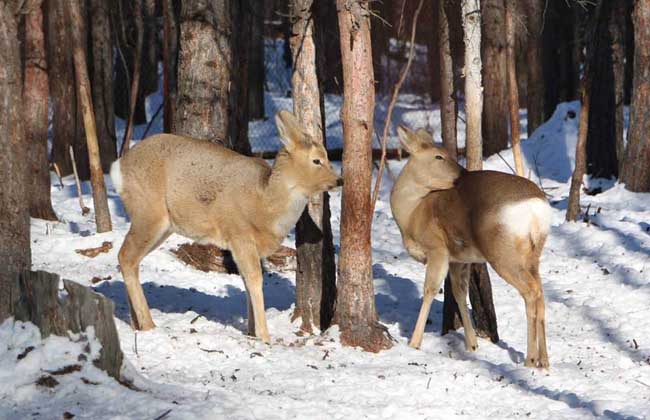
The roe deer is also known as the dwarf deer, wild sheep, roe, and roe deer, among other names. It is a herbivorous animal in the family Cervidae, subfamily Odocoileinae, genus Capreolus, and is one of the common wild animals in Northeast China. The muntjac, commonly known as the muntjac, is a mammal in the family Cervidae, genus Muntiacus. Three species are found in China, namely the black muntjac, the red muntjac, and the small muntjac. Now let us take a look at what the differences between roe deer and muntjac are!
The difference in family and genus between roe deer and muntjac
1. Roe deer: The roe deer is a herbivorous mammal in the animal kingdom, phylum Chordata, subphylum Vertebrata, class Mammalia, subclass Eutheria, order Artiodactyla, suborder Ruminantia, family Cervidae, subfamily Odocoileinae, genus Capreolus.
2. Muntjac: The muntjac is a herbivorous mammal in the animal kingdom, phylum Chordata, subphylum Vertebrata, class Mammalia, subclass Eutheria, order Artiodactyla, suborder Ruminantia, family Cervidae, subfamily Muntiacinae, genus Muntiacus.
The difference in appearance between roe deer and muntjac
1. Roe deer: The roe deer has a body length of 100-140 cm, a tail length of only 2-3 cm, and a body weight of 50-80 kg. Males are slightly larger. The body is grass-yellow, with white hair below the base of the tail. Male roe deer have antlers, while females do not. The muzzle is brown, the tip of the nose is black, the cheeks are yellow-brown, the base of the ears is yellow-brown, the back of the ears is gray-brown, the inside of the ears is pale yellow and nearly white, and the ear tips are black. The forehead, neck, and back are dark brown with a slightly yellowish-brown tinge, the lower jaw is pale yellow, the throat is gray-brown, the abdomen is pale yellow, and the outer sides of the limbs are sand-yellow.
2. Muntjac: An adult muntjac weighs 16-25 kg and has a body length of 75-115 cm. Its legs are slender but strong, and it is good at jumping. Its skin is very soft and can be made into leather. Only male muntjacs have short antlers. The antler stalks extend backward, and the tips curve inward. They are either unbranched or have only 1 small branch. The base of the antlers forms a longitudinal ridge on the face. The hair is short and fine, the limbs are slender, and the hooves are narrow and pointed. It has large upper canine teeth that curve in a tusklike shape, but they are smaller than the tusks of musk deer and river deer. The skull is roughly triangular, and the tear pits are prominent.
The difference in distribution between roe deer and muntjac
1. Roe deer: The roe deer is a common wild animal in the forest areas of Northeast China, mainly distributed in Northeast China, Outer Northeast China, Siberia, Europe, and other places.
2. Muntjac: Three species are distributed in China, namely the black muntjac, the red muntjac, and the small muntjac. The black muntjac is only seen at the borders of Zhejiang, Anhui, Fujian, and other provinces. The red muntjac is distributed in Guangdong, Guangxi, Yunnan, Guizhou, Sichuan, and other places in China. The small muntjac is distributed in Jiangsu, Zhejiang, Fujian, Yunnan, Guizhou, Sichuan, Hunan, Hubei, Jiangxi, Taiwan, China, and other places.