What is the difference between lavender and sage? A quick guide to telling them apart
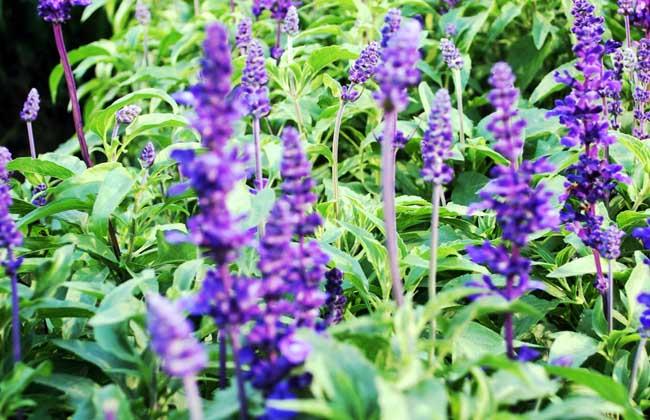
Lavender is also known as perfume plant, spirit fragrance grass, fragrant grass, yellow fragrant grass, etc., and is a small shrub of the genus Lavandula in the Lamiaceae family. Sage is also known as medicinal sage, salvia, Japanese purple-flowered sage, southern salvia, stone-see-through, etc., and is an aromatic plant of the genus Salvia in the Lamiaceae family. Let us take a look below at the differences between lavender and sage!
Differences in family and genus between lavender and sage
1. Lavender: Lavender is a perennial subshrub or low shrub in the plant kingdom, Angiospermae, Angiospermae subphylum, Dicotyledoneae, Sympetalae, Tubiflorae, Tubiflorae suborder, Lamiaceae, Lavanduloideae, genus Lavandula.
2. Sage: Sage is a perennial aromatic herbaceous plant in the plant kingdom, Angiospermae, Angiospermae subphylum, Dicotyledoneae, Sympetalae, Tubiflorae, Tubiflorae suborder, Lamiaceae, Lamioideae, tribe Mentheae, genus Salvia, subgenus Salvia.
Differences in morphology between lavender and sage
1. Lavender: The stems of lavender are upright, covered with stellate hairs; the old branches are grayish brown and have strip-like peeling bark; the leaves are linear or lanceolate-linear, covered with sparse or dense gray stellate hairs, grayish white or olive green when dry, entire and outwardly rolled; the verticillasters gather at the branch tips into interrupted or nearly continuous spikes; the bracts are rhombic-ovate; the bracteoles are inconspicuous; the calyx is ovate-tubular or nearly tubular, the tube straight, with glandular hairs inside at the throat; the nutlets are elliptic and smooth.
2. Sage: The sage plant is shrub-like, about 60 cm tall; the leaves are broadly elliptic, with short fine hairs, grayish green to white-green, rough or finely wrinkled; the flowers are purple, pink, white, or red, varying by variety, fragrant and slightly pungent; the nutlets are elliptic; the flowering period is June to September.
Distribution of lavender and sage origins
1. Lavender: Lavender originated along the Mediterranean coast, various parts of Europe, and the islands of Oceania, and was later widely cultivated in the United Kingdom and Yugoslavia. In China, it is mainly distributed in the **Yili region.
2. Sage: Sage originated in southern Europe and the Mediterranean coastal region. In China, it is mainly distributed in Zhejiang, southern Anhui, Jiangsu, Jiangxi, Hubei, Fujian, Taiwan, China, Guangdong, Guangxi, and other places, and it is also distributed in Japan.
Differences in effects between lavender and sage
1. Lavender: Lavender is pungent in taste and cool in nature, and has the effects of clearing heat and detoxifying, dispelling wind, and relieving itching. It mainly treats headache, dizziness, mouth and tongue sores, red and swollen throat, burns and scalds, rubella, scabies, and other conditions.
2. Sage: Sage is bitter and pungent in taste and neutral in nature, and has the effects of clearing heat and draining dampness, activating blood and regulating menstruation, and detoxifying and reducing swelling. It mainly treats jaundice, red and white dysentery, damp-heat leukorrhea, irregular menstruation, dysmenorrhea, sores and boils, bruises, and other conditions.