What is the difference between Chinese toon and tree of heaven? Learn the quick way to tell them apart
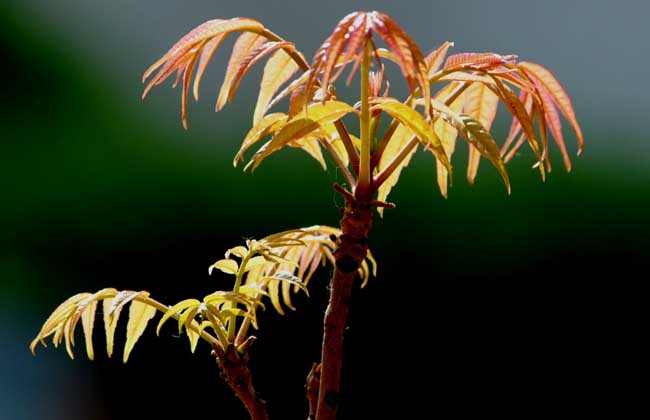
Chinese toon (Toona sinensis) is also known as xiangchun sprouts, xiangzhuangtou, large red toon tree, chuntian and so on. Its sprouts are rich in nutrients and have a dietary therapeutic effect. Tree of heaven (Ailanthus altissima) is also known as chouchun bark, large-fruited tree of heaven and so on; its bark, root bark and fruit can all be used as medicine, with effects such as clearing heat and draining dampness, and astringing to stop dysentery. In ancient times, Chinese toon was called chun and tree of heaven was called chu. Now let us take a look at what the differences between Chinese toon and tree of heaven are!
Differences in family and genus between Chinese toon and tree of heaven
1. Chinese toon: Chinese toon is a deciduous tree in the plant kingdom, Angiosperms, Dicotyledons, Archichlamydeae, Sapindales, Rutineae, Meliaceae, Cedreloideae, Cedreleae, genus Toona.
2. Tree of heaven: Tree of heaven is a deciduous tree in the plant kingdom, Angiosperms, Dicotyledons, Archichlamydeae, Sapindales, Rutineae, Simaroubaceae, genus Ailanthus.
Differences in morphology between Chinese toon and tree of heaven
1. Chinese toon: The bark of the Chinese toon tree is rough, dark brown, and flakes off in plates. The leaves have long petioles and are even-pinnately compound, with a caudate-acuminate tip. The panicle is equal in length to the leaves or longer, sparsely covered with rusty short pubescence or sometimes nearly hairless. The small cymes grow on short branchlets and bear many flowers. The fruit is narrowly elliptical, dark brown, with small pale white lenticels, and thin valves. The seed base is usually blunt, with a membranous long wing at the upper end and no wing at the lower end. The flowering period is June to August, and the fruiting period is October to December.
2. Tree of heaven: Tree of heaven can reach more than 20 m in height. The bark is smooth with straight striations. The young branches have pith and are covered with yellow or yellowish-brown pubescence when young, which later falls off. The leaves are odd-pinnately compound. The panicle is 10-30 cm long, the flowers are pale green, and the pedicels are 1-2.5 mm long. The samara is oblong-elliptical, 3-4.5 cm long and 1-1.2 cm wide. The seed is located in the middle of the wing and is flat-round. The flowering period is April to May, and the fruiting period is August to October.
Differences in other names between Chinese toon and tree of heaven
1. Chinese toon: Chinese toon is also known as xiangchun sprouts, xiangzhuangtou, large red toon tree, chuntian, chunmiao, chunbaipi and so on. It is native to central and southern China, and is cultivated from southern Liaoning in the northeast, to Gansu in the west, from southern Inner Mongolia in the north, to Guangdong and Guangxi in the south, and to Yunnan in the southwest, with the most planting in Shandong, Henan and Hebei.
2. Tree of heaven: Tree of heaven is also known as chouchun bark, large-fruited tree of heaven and so on. It is distributed in northern, eastern and southwestern China, and southeast to Taiwan, China. Except for Heilongjiang, Jilin, **, Qinghai, Ningxia, Gansu and Hainan, it is distributed in all other places.
Differences in effects between Chinese toon and tree of heaven
1. Chinese toon: Chinese toon contains components such as calcium, phosphorus, potassium and sodium. It has effects such as tonifying deficiency, strengthening yang and securing essence, tonifying the kidney, nourishing hair and promoting hair growth, reducing inflammation, stopping bleeding and relieving pain, and promoting the movement of qi, regulating blood and strengthening the stomach. Anyone with decline of kidney yang, cold and painful waist and knees, spermatorrhea, impotence, or hair loss is advised to eat it.
2. Tree of heaven: The bark, root bark and fruit of tree of heaven can all be used as medicine, with effects of clearing heat and drying dampness, astringing and stopping leukorrhea, stopping diarrhea, and stopping bleeding. According to records in traditional Chinese medicine literature, tree of heaven has “minor toxicity” and is only to be used externally as a decoction for washing; the leaves cannot be eaten.