What is the difference between pothos and lily-of-the-valley bush? A quick guide to telling the two plants apart
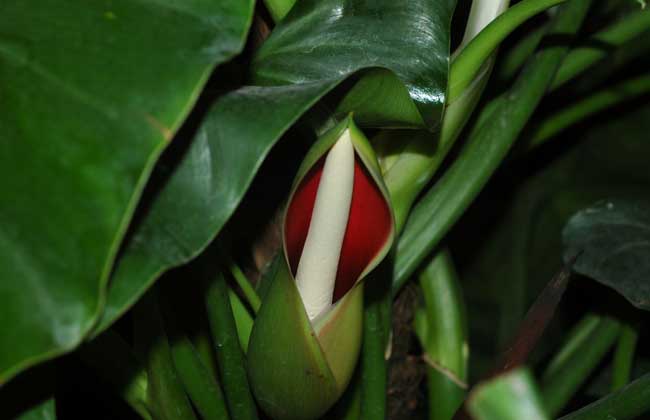
Pothos belongs to the genus Epipremnum in the Araceae family and is a large evergreen climbing vine native to the tropical rainforests of Indonesia and the Solomon Islands, while lily-of-the-valley bush is a perennial herbaceous plant in the genus Rohdea of the Liliaceae family, distributed in China and Japan. Let's take a look below at what the differences between pothos and lily-of-the-valley bush are!
The difference in family and genus between pothos and lily-of-the-valley bush
1. Pothos: Pothos is a large evergreen climbing vine in the plant kingdom, Angiosperms, Monocotyledons, Arales, Araceae, Monstereae, genus Epipremnum.
2. Lily-of-the-valley bush: Lily-of-the-valley bush is a perennial herbaceous plant in the plant kingdom, Angiosperms, Monocotyledons, Liliales, Liliineae, Liliaceae, Convallarieae, genus Rohdea.
The morphological difference between pothos and lily-of-the-valley bush
1. Pothos: On mature branches of pothos the leaf stalks are thick and strong, 30-40 cm long, slightly enlarged at the base, with the upper joint 2.5-3 cm long and slightly thickened, bearing a broad groove on the ventral side, and long leaf sheaths; the leaf blade is thinly leathery, emerald green, usually (especially on the leaf surface) with many irregular pure yellow patches, entire, unequal-sided ovate or ovate-oblong, with a short acuminate apex and a deeply cordate base, slightly thick, with both surfaces slightly raised.
2. Lily-of-the-valley bush: The rhizome of lily-of-the-valley bush is 1.5-2.5 cm thick; the leaves number 3-6, thickly papery, oblong, lanceolate or oblanceolate, green, with the longitudinal veins distinctly raised; the sheath leaves are lanceolate, 5-12 cm long; the scape is shorter than the leaves, 2.5-4 cm long; the spike is 3-4 cm long and 1.2-1.7 cm wide, bearing several dozen densely packed flowers; the perianth is 4-5 mm long and 6 mm wide, pale yellow, with thick lobes; the berry is about 8 mm in diameter and red when ripe; the flowering period is May to June, and the fruiting period is September to November.
The alternative names of pothos and lily-of-the-valley bush differ
1. Pothos: Pothos is also known as devil's ivy, golden pothos, golden vine, mulberry leaf, and so on. It is native to the Solomon Islands and is widely cultivated in the tropical regions of Asia.
2. Lily-of-the-valley bush: Lily-of-the-valley bush is also known as red-fruited lily-of-the-valley bush, open-throat sword, nine-joint lotus, winter-evergreen, iron carrying pole, and so on. It is produced in Shandong, Jiangsu, Zhejiang, Jiangxi, Hubei, Hunan, Guangxi, Guizhou, Sichuan, and other places.
The medicinal effects of pothos and lily-of-the-valley bush differ
1. Pothos: Pothos is pungent in taste, neutral in nature, and enters the kidney meridian. It has the effect of invigorating the blood and dispersing stasis, and is often used for conditions such as traumatic injuries.
2. Lily-of-the-valley bush: Lily-of-the-valley bush is bitter and slightly sweet in taste, cold in nature, and slightly toxic, and enters the lung and heart meridians. It has the effects of clearing heat and detoxifying, strengthening the heart and promoting diuresis, and cooling the blood and stopping bleeding. It mainly treats sore throat, diphtheria, sores and swelling toxins, snake and insect bites, heart failure, edema and distension, hemoptysis, hematemesis, metrorrhagia, and other conditions.