What is the difference between Arisaema and Pinellia? A quick guide to telling them apart
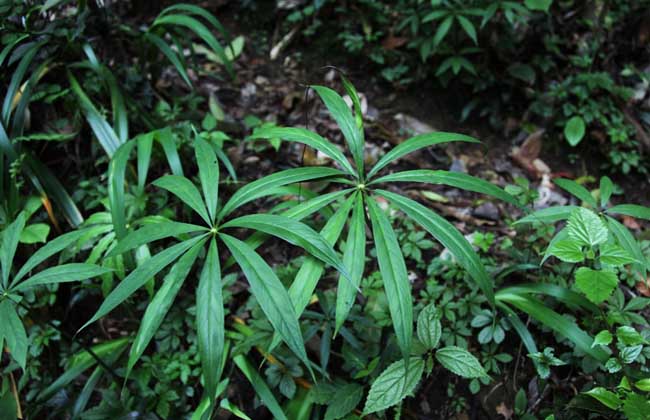
Arisaema is the dried tuber of the Araceae plants Arisaema erubescens, Arisaema heterophyllum, or Arisaema amurense, and has the effect of dispersing nodules and reducing swelling. Pinellia is the dried tuber of the Araceae plant Pinellia ternata, and has the effects of drying dampness and transforming phlegm, directing qi downward and stopping vomiting, and resolving distension and dispersing nodules. Let us take a look below at the difference between Arisaema and Pinellia!
The difference in family and genus between Arisaema and Pinellia
1. Arisaema: Arisaema is a perennial herbaceous plant in the plant kingdom, Angiosperms, Monocotyledons, Arales, Araceae, Arisaemateae, Arisaema.
2. Pinellia: Pinellia is a perennial herbaceous plant in the plant kingdom, Angiosperms, Monocotyledons, Arales, Araceae, Arisaemateae, Pinellia.
The morphological difference between Arisaema and Pinellia
1. Arisaema: Arisaema grows 40-90 cm tall, with a flattened spherical tuber and a yellowish-brown outer skin. The leaf is often solitary, the petiole is cylindrical, and the leaf blade is pedate. The inflorescence stalk is 30-55 cm long. The spadix bears both bisexual and unisexual male inflorescences. The berries are yellow-red or red, cylindrical, about 5 mm long, containing 1 club-shaped seed and 2-3 sterile ovules. The seeds are yellow with red spots. The flowering period is April-May, and the fruiting period is July-September.
2. Pinellia: The tuber of Pinellia is spherical, 1-2 cm in diameter, with fibrous roots. There are 2-5 leaves, sometimes 1. The petiole is 15-20 cm long. The seedling leaf blade is ovate-cordate to hastate. The inflorescence stalk is 25-30 cm long, longer than the petiole. The spathe is green or greenish-white, with a narrow cylindrical tube. The spadix is present. The berry is ovoid, yellow-green, with the apex gradually narrowed into a distinct style. The flowering period is May-July, and the fruit ripens in August.
The difference in alternative names between Arisaema and Pinellia
1. Arisaema: Arisaema is also known as Nanxing, Banbianlian, Gouzhua Banxia, Huzhang Banxia, Mayuzi, Da Banxia, Duzusan, Shanmoyu, Huzhang, Shetousuan, Suohoulian, Shecaotou, Dujiaolian, Shebaogu, Duyeyizhiqiang, Qinggan Duyeyizhiqiang, Sheliugu, Tianliangsan, Shebangtou, Shuanglongyu, and so on. Except for the northwest and Xizang, it is distributed in most provinces and regions.
2. Pinellia: Pinellia is also known as Sanye Banxia, Sanbutiao, Mayuguo, Tianlixin, Wuxincai, Laoyayan, Laoyayutou, Yanzimei, Dicigu, Qiu Banxia, Jianye Banxia, Laohuangju, Laoheshangkou, Yeyutou, Laoyatou, Dixxing, Sanbuhun, Mayuzi, Xiao Tianlaoxing, Yaogoudan, Sanyetoucao, Sanlengcao, Yanglitou, Xiao Tiannanxing, Kouzilian, Sheng Banxia, Tu Banxia, Ye Banxia, Banzi, Sanpianye, Sankaihua, Sanjiaocao, Sanxingcao, Diwen, Hegu, Shoutian, Dizhu Banxia, and so on. It is widely distributed in the Yangtze River basin of China as well as the northeast, north China, and other regions.
The difference in effects between Arisaema and Pinellia
1. Arisaema: Arisaema is bitter and pungent in taste and warm in nature, and enters the lung, liver, and spleen meridians. It has the effect of dispersing nodules and reducing swelling, and is used externally for carbuncles, swellings, and snake and insect bites. Prepared Arisaema has the effects of drying dampness and transforming phlegm, dispelling wind and stopping spasms, and dispersing nodules and reducing swelling. It is used for stubborn phlegm cough, wind-phlegm dizziness, apoplexy with phlegm obstruction, facial paralysis, hemiplegia, epilepsy, convulsions, tetanus, and other conditions, and is used externally for carbuncles, swellings, and snake and insect bites.
2. Pinellia: Pinellia is pungent in taste and warm in nature, and enters the spleen, stomach, and lung meridians. It has the effects of drying dampness and transforming phlegm, directing qi downward and stopping vomiting, and resolving distension and dispersing nodules. It is used for damp phlegm and cold phlegm, cough and asthma with profuse phlegm, phlegm-fluid dizziness and palpitations, wind-phlegm dizziness, phlegm syncope headache, vomiting and nausea, chest and epigastric distension and oppression, plum-pit qi, and other conditions, and is used externally for carbuncles, swellings, and phlegm nodules.