What is the difference between stone frogs and toads? A quick guide to telling them apart
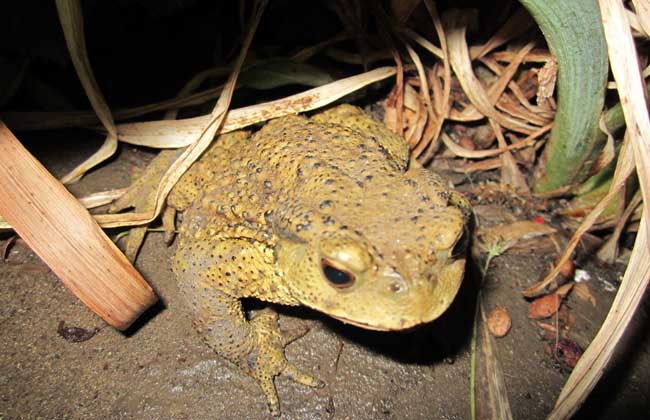
StoneFrogIts standard name is the spiny-breasted frog, also known as stone clam, stone chicken, mountain chicken, etc. It is an animal of the class Amphibia, order Anura, family Ranidae. The toad is also called hama, has many warts on its body surface containing venom glands, and is divided in China into two species, the Chinese toad and the black-spectacled toad. Let us take a look below at what differences there are between stone frogs and toads!
Stone frogs and toads belong to different families and genera
1. Stone frog: The stone frog is an amphibian of the animal kingdom, phylum Chordata, subphylum Vertebrata, class Amphibia, subclass Lissamphibia, order Anura, family Ranidae, tribe Paini, genus Quasipaa.
2. Toad: The toad is an amphibian of the animal kingdom, phylum Chordata, subphylum Vertebrata, class Amphibia, subclass Lissamphibia, order Anura, family Bufonidae, genus Bufo.
The difference in alternative names between stone frogs and toads
1. Stone frog: The stone frog is also known as stone clam, stone chicken, mountain chicken, stone jelly, flying fish, stone scale, stone toad, stone shrimp toad, stone pit frog, stone luan, mu huai (southern Sichuan), etc. It is widely distributed in our region, especially in large numbers in the mountainous areas of Jinggangshan, Ninggang and Anfu in the west, and is distributed in Hubei, Anhui, Jiangsu, Zhejiang, Jiangxi, Hunan, Fujian, Guangdong, Hong Kong and Guangxi, among other places.
2. Toad: The toad is also known as scabies toad, warty toad, hama, warty thorn, warty lump, etc. It is distributed throughout China. From late spring to late autumn, it mostly hides by day among grass and crops, or under stones and in earthen holes around dwellings and in dry fields, and at dusk it often crawls along roadsides and on grass searching for food.
The difference in morphology between stone frogs and toads
1. Stone frog: The stone frog is large and robust, with a body shape similar to the black-spotted frog or the tiger frog, and varies in body color. Its head is flat and broad, the tip of the snout is bluntly rounded and protrudes beyond the lower jaw, the trunk is relatively short and flat, there is no tail, and the neck is not obvious. The male frog has special forelimbs, and its back has narrow, long warts of varying lengths. Its belly is pale yellowish-white. The forelimbs of the female are less developed than those of the male, there are no narrow, long warts on the back, and the ventral surface is smooth and white.
2. Toad: The toad's head width is greater than its head length, the tip of the snout is round, the snout ridge is prominent, and the cheeks slope outward. The internasal space is slightly smaller than the interorbital space, the upper eyelid is wide and slightly larger than the interorbital space, and the tympanum is prominent and oval. The forelimbs are thick and short, the body is obese, the hindlimbs are short, and the foot is longer than the tibia. The skin of the male is rough, with warts of unequal size densely covering the head, upper eyelids and back; the female has fewer warts, and the ventral surface is milky white.
The difference in effects between stone frogs and toads
1. Stone frog: Stone frog meat is sweet in flavor and neutral in nature, rich in protein, calcium and other components, low in fat, easy to digest, and very high in nutritional value. Eating it has the effects of clearing heat, improving eyesight, resolving sores, and nourishing and strengthening the body.
2. Toad: The toad is pungent in flavor, cool in nature, and toxic. It enters the heart, liver, spleen and lung meridians, and has the effects of breaking up masses, moving water and dampness, resolving toxins, killing parasites and relieving pain. It mainly treats boils, cellulitis of the back, deep-rooted yin abscesses and scrofula, malignant sores, abdominal masses and accumulations, tympanites, edema, infantile malnutrition, chronic bronchitis and other conditions.