Twenty years with bonsai, Nanshan Lu continues to walk hand in hand
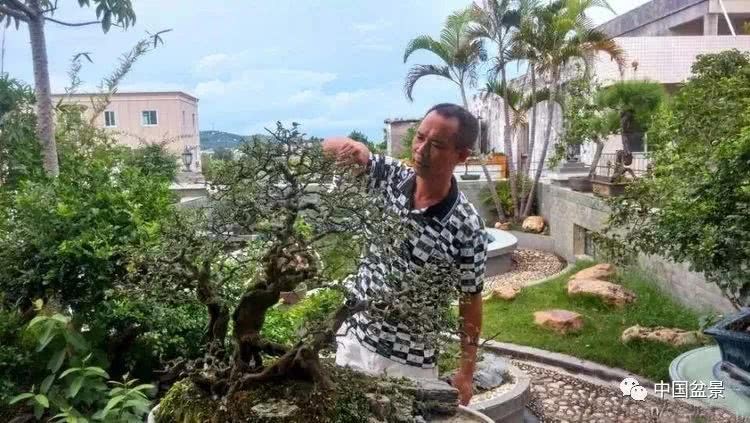
Twenty years of encountering bonsai, let's continue to walk hand in hand!
Photos and text by Nanshan Lu
Picking chrysanthemums by the eastern fence, leisurely I see the southern mountains.
First published on @Nanshan Lu's Meipian
Copyright belongs to @Nanshan Lu
Time flies so fast - by this spring, it has been a full twenty years since I encountered bonsai.
Encountering bonsai was a matter of fate, a love affair. What is worth being proud of is that this love interest has quite high aesthetic appeal, and has been praised since ancient times as "three-dimensional painting, wordless poetry." Almost all who love her are literati and refined scholars.
My first encounter with bonsai was twenty years ago, at the dormitory entrance of my colleagues Old Xu and Old Ou. The bonsai I saw at that time were just raw stock materials that Old Xu and the others had collected and dug up from the mountains. At first sight of these bare tree stumps, there was not much to admire; some stumps, if not planted well, would even wither and die. I laughed at Old Xu and the others: after all that effort, in the end all that's left is a pile of firewood. Later, I saw that the potted plants that had been kept alive became more and more beautiful in Old Xu and the others' hands, and gradually they started to have some appeal. Even later, on weekends, I followed them into the wild mountains, and thus formally took bonsai by the hand.
When I first started working with bonsai, I did not understand how to care for them. After collecting them, I often had to invite some seniors over to take a look. I asked the seniors to help cut branches and preserve trunks, removing excess branches and roots. Under the seniors' guidance, I learned to bank up soil and water. To avoid overly strong light, I also had to learn to build shelters for shade and to spray with water mist to maintain moisture. When the stumps sprouted and grew branches, I also had to learn to remove useless buds and tender shoots. Once the branches and leaves grew stable, I also had to learn to fertilize and remove pests... Different varieties have different light requirements and different water needs, and I had to slowly become familiar with them, understand them, and learn about them. Watching the stumps gradually survive and grow healthily under my care, I slowly fell in love with them.
Once the stumps grew stable and the branches and leaves flourished, I began to learn pruning. Pruning bonsai is not an easy task. As the saying goes, "Judging a deity statue is easy, carving a deity statue is hard" - this proverb could not be more apt when applied to pruning bonsai. Anyone can evaluate a bonsai work, but if you are actually asked to take up a pair of scissors and prune, you will often find yourself not knowing where to start. Some bonsai friends have tended bonsai for more than ten years and still dare not take up the scissors to trim branches. Not daring to start, not knowing where to start - this is because bonsai is a comprehensive, coherent art that emphasizes years of accumulated skill. From raw stock to finished form, a bonsai often must undergo more than a dozen, or even dozens, of prunings. Each cut must consider not only the current shape, but also the future shape; not only the beauty of the tree form and the creation of artistic conception, but also the sprouting of buds and the impact on the tree's growth. Wu Zhaoqi, former chairman of the Maoming CPPCC and a famous calligrapher, once said this: Bonsai is an art with the strongest comprehensiveness, the most all-around knowledge requirements, and the longest time investment. It requires not only knowledge of cultivation, but also the aesthetic ability of a painter, the literary cultivation of a writer, and a calm heart that can endure loneliness.
From learning to prune to daring to cut on my own, I went through a full four or five years. During those four or five years, I was fortunate to receive guidance from many bonsai seniors. The one who helped me the most was Teacher Zeng Wenhai. Teacher Zeng started bonsai more than ten years before I did. He devoted himself to research and had superb pruning skills, yet he was humble and never placed himself above others because of his artistry. Whenever I sought his advice, he would always guide me meticulously. Under his guidance and encouragement, I gradually mastered some basic pruning techniques.
Once I dared to cut on my own, the process of pruning became a kind of enjoyment. On weekends, with a pot of clear tea, a piece of guqin music, a pair of scissors, and a bonsai, I could enjoy an entire morning. For a bonsai with a beautiful shape, I often could not bear to finish it all at once; I would look again and again and prune slowly. If one morning was not enough, then a day. If one day was not enough, then I would enjoy it for several more days. Once pruned, whenever I had free time I would gaze at the bonsai in fascination. This feeling really was just like being passionately in love.
Once a stump has taken shape, it still cannot be considered a complete work. It still needs to be potted and named. The size, color, and shape of the matching pot should be chosen according to the height, size, and form of the stump. Naming considers not only the tree's form and artistic conception, but also tests the creator's life experience and literary cultivation. A suitable pot can better highlight the tree's spirit and charm. A suitable name can awaken the soul of the work.
Some bonsai works, in different seasons and at different stages of tree growth, can inspire different insights or associations, and can even be given several different names. One of my wind-blown-branch Chinese plum works had several names. In early spring, when a few points of new green just sprouted on the wind-blown branches, admiring it made me think of Jiangnan, of Wang Anshi, of "The spring wind has greened the southern bank again; when will the bright moon shine on my return?" So I named it "The Spring Wind Has Greened the Southern Bank Again." At the turn of summer and autumn, when the tree was "blown by strong winds" and clouds flew in the courtyard, admiring it made me think of Liu Bang returning home to visit his family, of "A great wind rises, clouds fly and flutter..." So I named it "A Great Wind Rises." In winter, when the north wind howled and the tree was bleak, admiring it made me think of the Yi River, of Jing Ke, of "The wind sighs and the Yi River is cold; once the brave man departs, he will not return..." So I named it "The Wind Sighs."
When a bonsai is pruned well and named well, each work becomes a three-dimensional painting and a wordless poem. One of my Chinese plum works has an aged trunk and dancing branches and leaves, matched with a water-and-dry pot, with stones arranged on the right and blank space left to create a waterside scene. On the waterside bank are placed two old men drinking together, and it is named "Long Accustomed to Watching the Autumn Moon and Spring Wind." The work's image is beautiful and three-dimensional, and the artistic conception of "White-haired fisherman and woodcutter on the river isle, long accustomed to watching the autumn moon and spring wind" is condensed onto the pot; admiring it naturally gives rise to the open-hearted heroic spirit of "How many affairs of ancient and modern times are all consigned to laughter and talk."
Another of my works, a exposed-root mountain pine, has powerful, aged roots and trunk, clear and extraordinary bark and bone structure, and a drooping, unrestrained crown, like a literati elder who has weathered many storms and seen through life. Admiring it often makes me think of Su Dongpo in "Calming the Wind and Waves": "Do not listen to the sound of rain beating on the bamboo grove; why not chant and whistle and walk slowly?" Therefore I named it "A Straw Raincoat for the Mist and Rain of a Lifetime." When my mood is low, looking at this work suddenly makes my heart open and cheerful.
Once a bonsai has taken shape and has a name, I often invite her indoors. Sometimes I place her in the main hall, sometimes in the study or tea room. Whenever I have leisure, I keep company with her and gaze at her, as if newly married. At this point, it is no longer passionate love with the bonsai, but entering the stage of companionship.
It is just that once bonsai are brought indoors, they are often difficult to maintain. In recent years, almost every year one or two works have withered and died. Watching works that I had cared for and crafted for several years or even more than ten years wither and die, my heart always feels very heavy. The first bonsai work to wither and die was a orange jasmine that I had planted and cared for several years. I remember in those days, watching the branches and leaves wither one by one, my heart was terribly blocked; I could not sleep well or eat with relish. In the end, I did not even dare to face the tree's withered appearance. After several days, I really could not bear it, so I instructed my family to quietly take it outside and dispose of it when I was not at home. My first double-trunk mountain tangerine bonsai, collected from the wild and crafted into form, I gave to a classmate. The next year, the classmate told me that, not knowing how to care for it, it had withered and died. Hearing this news, I was sad for several more days. From then on, I no longer casually gave away my bonsai.
Among the bonsai that withered and died, the one I regret most is a mountain tangerine work named "The Highest Good Is Like Water." The raw stock was not good, with one large and one small double trunk, and the lines were not graceful. Later, under Teacher Zeng Wenhai's guidance, it was uniformly made into weeping branches. After several prunings, the effect was unexpectedly good, with a flavor of breaking convention - the two "tough guys," one large and one small, lowered their heads at the highest point, tender as water. So it was named "The Highest Good Is Like Water." After the work took shape, it participated in several exhibitions. In 2011, at the Qingyuan International Rare Stone and Bonsai Exhibition, someone offered a high price to buy it, but because I cherished it, I did not sell. In 2012, it participated in the Dianbai County Bonsai and Rare Stone Exhibition; it was kept indoors too long, and the on-site personnel cared for it improperly, and a few days after returning it withered and died. The death of my most beloved bonsai should have been very sad, but because I had already experienced too many bonsai deaths before this, I instead felt relieved. In fact, encountering bonsai, like encountering people, is all a matter of fate: when fate comes, you meet; when fate ends, you part. Only, since then, for every bonsai work that has withered and died, I have carefully collected the photos, written a little text, and put it in my WeChat Moments or Meipian, keeping it as a beautiful memory.
Twenty years of encountering bonsai - bonsai is not only a high-aesthetic-appeal lover, but also a good friend and a good teacher. "Keep good company and you shall be good." Before encountering bonsai, in my free time I always liked to keep company with playing cards and mahjong; after playing, aside from killing time, I gained nothing. After encountering bonsai, in order to keep bonsai alive and to prune them beautifully, I was always driven to keep learning, studying, and consulting seniors and peers. Most of those on the same path are literati and refined scholars; seeing the worthy, I sought to equal them. I not only learned cultivation knowledge and mastered pruning techniques, but also improved my aesthetic ability, raised my cultural cultivation, and elevated my taste and inner qualities.
Before encountering bonsai, because of pressure from work and family, my mental state was once anxious and uneasy, and it had seriously affected my work and life. Although I saw a doctor and took medicine, and the situation improved somewhat, the shadow in my heart could not be eradicated. After encountering bonsai, in my free time I always made bonsai my friend. Either I went into the wild mountains to collect, or I pruned and cared for them at home, and I no longer had the mind to think about those troubling matters. Not only was the shadow in my heart and my mental anxiety completely eradicated, but my physical condition also became much better than before.
Pruning bonsai requires cutting away some excess branches and trunks. Which branch to cut and which branch to keep often requires repeated consideration. At the beginning, I was always cautious, cutting little by little. The branches and trunks left behind were often many. With continuous pruning and repeated examination, my aesthetic ability kept improving, my courage in cutting grew greater and greater, and my choices of which branches and trunks to keep or discard became more decisive, calm, and unhurried. The more the branches and trunks were cut, the fewer they became, yet the tree instead became lighter and lighter, and appeared larger and larger. Thus, in pruning, I grasped some truths: some things, when there are more, instead become complicated and burdensome; when there are fewer, they instead hit just the right point, revealing the great through the small. The great way is simple; where there is loss, there is gain. This is so in pruning bonsai, and so in life. Dare to discard, know how to discard, and life will be relaxed and free, and you will live out your own brilliance. Bonsai is, in fact, a good teacher. From it, I learned the way of choosing and discarding.
Being in love with bonsai taught me to understand beauty and ugliness, and to take lightly gatherings and partings; being friends with bonsai taught me to understand elegance and vulgarity, and brought me health. Taking bonsai as my teacher taught me to discard, and to learn how to choose and let go. Twenty years of encountering bonsai has brought me no small gain. I am grateful for the encounter, and for the rest of my life I will continue to walk hand in hand.
[Bonsai practitioner's reflections]
Text by @Zhou Yingzhi, Xiamen, Fujian
Someone once asked me, what do you like most? I said I like watches, I like the time on watches, because in this world only time will not deceive people, only time can prove everything - what is true, what is false. To judge people, do not look with your eyes, for it is easy to misjudge; even less should you listen with your ears, because they are all lies. Only use time, use your heart to feel: the true cannot become false, and the false cannot become true! So what I like most is time: time will leave behind the truest people.
Wonderful replay:
Chinese bonsai welcomes you!
Enjoy at any timeappreciatethe bonsai exhibition hall
Promote bonsai culture, exchange bonsai techniques!
Appreciate bonsai art, share a happy life!