What is the difference between blackberry lily and daylily? A quick guide to tell them apart
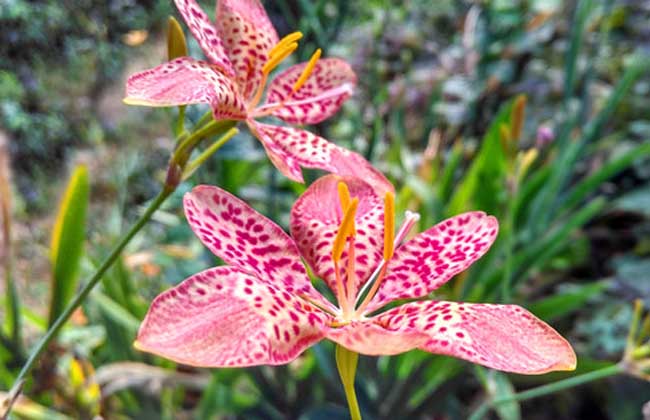
Blackberry lily, also known as Wushan, Wupu, Huangyuan, Wusha, Yegan and so on, is a perennial herb of the genus Iris in the family Iridaceae, and its rhizome can be used as medicine. Daylily, also known as golden needle vegetable, lemon hemerocallis and so on, is a perennial herb of the order Liliales, family Liliaceae, and can be eaten as well as used as medicine. Let's take a look below at what the differences between blackberry lily and daylily are!
The difference in family and genus between blackberry lily and daylily
1. Blackberry lily: Blackberry lily is a perennial herb of the plant kingdom, phylum Angiosperms, class Monocotyledons, order Liliales, suborder Liliineae, family Iridaceae, genus Iris.
2. Daylily: Daylily is a perennial herb of the plant kingdom, phylum Angiosperms, class Monocotyledons, order Liliales, suborder Liliineae, family Liliaceae, tribe Hemerocallideae, genus Hemerocallis.
The difference in origin between blackberry lily and daylily
1. Blackberry lily: Blackberry lily is also known as Wushan, Wupu, Huangyuan, Wusha, Yegan, Wusha, Wuchui, Caojiang, Guishan, Fengyi and so on, and is produced in Jilin, Liaoning, Hebei, Shanxi, Shandong, Henan, Anhui, Jiangsu, Zhejiang, Fujian, Taiwan, China, Hubei, Hunan, Jiangxi, Guangdong, Guangxi, Shaanxi, Gansu, Sichuan, Guizhou, Yunnan, Xizang and other places.
2. Daylily: Daylily is also known as xuancao, wangyoucao, golden needle vegetable, xuancaohua, brain-boosting vegetable, calming vegetable, green onion flower and so on. It is cultivated throughout northern and southern China, and is mostly distributed in Hunan, Jiangsu, Zhejiang, Hubei, Jiangxi, Sichuan, Gansu, Shaanxi, Jilin, Guangdong and the Inner Mongolia grasslands and other places. Quxian in Sichuan is called the "Hometown of Chinese Daylily".
The morphological difference between blackberry lily and daylily
1. Blackberry lily: The rhizome of blackberry lily is irregularly lumpy, the stem is upright, 1-1.5 m tall, the leaves are alternate, arranged in an imbricate manner, sword-shaped, the inflorescence is terminal, with forked branching, and at the tip of each branch several flowers are clustered; the capsule is obovate or long elliptic, yellow-green, the seeds are spherical, black-purple, glossy, and borne on the fruit axis; the flowering period is June to August, and the fruiting period is July to September.
2. Daylily: The roots of daylily are nearly fleshy, often with spindle-shaped swellings in the middle and lower parts, the stem is 30-65 cm tall, the scapes vary in length, the pedicels are relatively short, the flowers are numerous, the perianth is pale yellow, orange-red, or black-purple, the capsule is obtusely triangular-elliptic, and there are more than 20 seeds, black, with ridges; the flowering and fruiting period is May to September.
The difference in effects between blackberry lily and daylily
1. Blackberry lily: Blackberry lily is bitter in taste and cold in nature, enters the lung meridian, and has the effects of clearing heat and detoxifying, reducing phlegm and benefiting the throat. It mainly treats conditions such as heat toxin and phlegm-fire binding, sore throat, excessive phlegm and saliva, and cough with asthma.
2. Daylily: Daylily is sweet in taste and neutral in nature, slightly toxic, enters the liver, spleen and kidney meridians, and has the effects of clearing heat and promoting urination, detoxifying and reducing swelling, stopping bleeding and relieving restlessness, and promoting lactation. It is suitable for conditions such as dizziness and tinnitus, insomnia, palpitations and restlessness, weak constitution, cancer, dark and rough urination, edema, hemorrhoids, blood in the stool, insufficient milk after childbirth, and irregular menstruation.