What is the difference between peony and dahlia? A quick guide to telling them apart
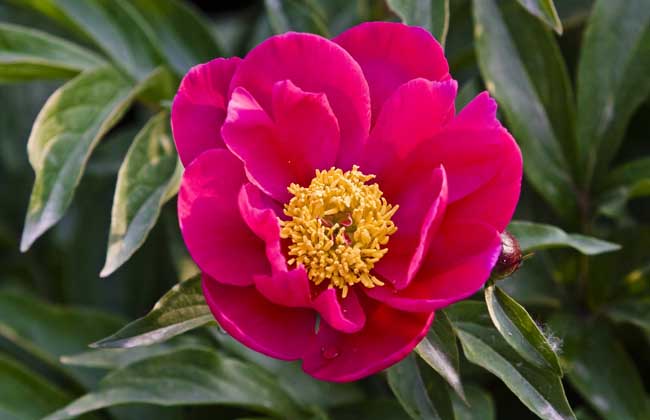
Peony is also known as Jiangli, Licao, and others; it is a perennial herbaceous flower of the genus Paeonia in the family Paeoniaceae. Dahlia is also known as Dalihua, Tianzhu Mudan, Dongyang Ju, Daliju, Digua Hua, and others; it is a perennial herbaceous plant of the genus Dahlia in the family Asteraceae. Now let us take a look at what differences there are between peony and dahlia!
Differences in family and genus between peony and dahlia
1. Peony: Peony is a perennial herbaceous plant in the plant kingdom, Angiosperms, Dicotyledons, Dilleniales, Paeoniaceae, Paeonioideae, genus Paeonia.
2. Dahlia: Dahlia is a perennial herbaceous plant in the plant kingdom, Angiosperms, Dicotyledons, Sympetalae, Campanulales, Asteraceae, Tubuliflorae, Heliantheae, genus Dahlia.
Differences in morphology between peony and dahlia
1. Peony: The tuberous roots of peony grow from below the root crown, are fleshy and thick, and are spindle-shaped or long columnar. Buds cluster on the root crown, and the stems cluster from the roots, about 50-110 cm tall. The flowers usually bloom singly at the top of the stem or near the top in the leaf axils. The follicle is spindle-shaped, oval, bottle-shaped, and so on. The seeds are black or blackish brown, large, and round, oblong, or pointed-round. The flowering period is May to June.
2. Dahlia: Dahlia has huge club-shaped tuberous roots. The stems are upright and much branched, 1.5-2 m tall. The leaves are 1-3 times pinnately parted. The capitulum is large, with a long peduncle, and often drooping. The achene is oblong. The flowering period is June to December, and the fruiting period is September to October.
Peony and dahlia have different distributions
1. Peony: Peony is also known as Jiangli, Licao, Lanweichun, Yurong, Lishi, Meigu Hua, Hei Qianyi, Hongyao, and others. In China it is distributed in Jiangsu, Northeast China, North China, Shaanxi, and southern Gansu. In Northeast China it is distributed on hillside grasslands and under forests at an altitude of 480-700 m. In other provinces it is distributed on hillside grasslands at an altitude of 1000-2300 m. It is also distributed in Korea, Japan, Mongolia, and Siberia.
2. Dahlia: Dahlia is also known as Dalihua, Tianzhu Mudan, Dongyang Ju, Daliju, Xifanlian, Digua Hua, and others. It is native to Mexico and is the most widely cultivated ornamental plant in the world. It was introduced to China in the early 20th century, and is now cultivated in many provinces and regions.
Peony and dahlia have different medicinal effects
1. Peony: Peony is bitter and sour in taste, slightly cold in nature, and enters the liver and spleen meridians. It has the effects of nourishing blood and astringing yin, softening the liver and relieving pain, and calming liver yang. It is used for irregular menstruation, uterine bleeding, spontaneous sweating, acute abdominal pain, hypochondriac pain, limb cramps, headache and dizziness, and other conditions.
2. Dahlia: Dahlia is pungent and sweet in taste, neutral in nature, and enters the liver meridian. It has the effect of activating blood and dispersing stasis, and mainly treats traumatic injuries and other conditions.