What are the ways to tell real agarwood from fake? Learn to easily distinguish the genuine from the counterfeit
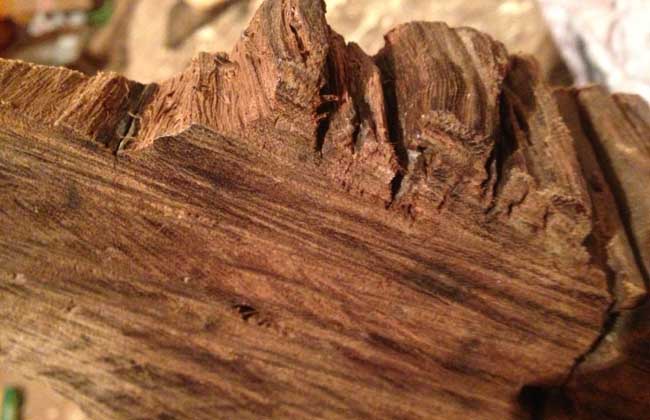
Agarwood is a treasure in every part, with very high economic value. It has been a luxury item throughout history and is now increasingly becoming a target of collectors' attention. Precisely because of this, driven by profit, there are more and more counterfeit agarwood products on the market today, making it increasingly important to learn how to identify fakes. Let's take a look below at the methods for telling real agarwood from fake!
Methods for identifying agarwood
1. Look: that is, with the material in hand, first look at whether its grain (that is, the oil lines) is clear and whether the color is uniform, because natural things cannot be without flaws. Man-made things tend to have uniform color and look relatively perfect to the senses.
2. Touch: rub and feel the surface of the agarwood with your hand. If it is real agarwood, the surface will have an oily, sticky feel and a cool sensation, which fake agarwood does not have. Then feel its weight with your hand. The oil content and the actual weight are directly proportional: the higher the oil content, the heavier the weight; the lower the oil content, the lighter the weight.
3. Smell: natural agarwood is the truest and purest fragrance given by nature, and the scent varies depending on the place of origin. The scent of pure natural agarwood cannot be reproduced by modern high technology. The vast majority of fake agarwood is made by processing agarwood juice or chemical fragrance essences through methods such as pressing, squeezing, injecting and steaming, so its smell is never a single, pure fragrance. When you smell natural agarwood with your nose, the more you smell it, the more you want to smell it; with fake agarwood, it is the opposite.
4. Burn: if after the above three steps you still cannot tell real from fake, then use the method of directly burning with an open flame to smell its scent, or take a small piece and burn and smell it directly in an electric incense heater. Then the truth will surely become clear at once. Real agarwood has a mellow, single scent, while fake agarwood often carries a chemical fragrance essence smell or a relatively turbid non-agarwood smell.
Methods for storing agarwood
1. Ambient temperature: usually 18-21°C is considered the ideal temperature for storing agarwood. The temperature should not be too high. If it is higher than 39°C, it will cause the oils in the agarwood to evaporate, reducing the lifespan of the agarwood.
2. Storage time: there is no time limit for storing agarwood; the older it gets, the more fragrant it becomes. After being stored for many years, agarwood can still maintain its fragrance unchanged.
3. Storage location: agarwood should be stored in a cool place, protected from direct sunlight. If the indoor humidity is relatively high, you can wrap the agarwood in cling film. To prevent medicinal properties and fragrances from mixing, each variety of incense product is best stored separately. Incense products such as incense sticks and coil incense are best placed flat inside a wooden box, which can prevent moisture, prevent dryness and prevent damage, so that they will not deform or bend, and it is also conducive to the further blending of the incense material and long-term storage.
4. Maintenance method: avoid contact with water containing cleaning products, such as soap, scented soap, shampoo, laundry detergent water, etc. After mixing with these chemical agents, the agarwood oils distributed on the surface of the agarwood will undergo chemical reactions and be washed away, making the agarwood scent weaker. Agarwood bracelets will also form a natural patina when worn regularly, and the scent will become lighter, but that does not matter. At night when sleeping, place it under the pillow or seal it in a plastic bag, and when you take it out again the fragrance will still be there.
Differences among types of agarwood
1. Daoshui (fallen agarwood): the market definition of daoshui is agarwood wood that has fallen and lain in soil or water, and after a certain degree of fermentation and decay, most of the non-resinous xylem has rotted away, leaving a small amount of resinous agarwood, which is called daoshui agarwood. Simply put, when trees that can form agarwood, due to age and related natural factors, fall over and after decades or even a hundred years of wind and rain, the remaining non-rotted parts form agarwood, that is daoshui. Daoshui is one of the best types of agarwood. Its scent is very distinctive and wonderful. Smelled from afar, it is clear, mellow and sweet, somewhat like the scent of qinan. Smelled up close, however, it feels strong yet slightly bitter. Daoshui also has a saying that it recognizes its owner. It is said that after it recognizes its owner, strangers cannot smell its scent, and those who are fortunate enough to smell it will all be amazed. The scent generally has 3-5 kinds of changes, extremely wonderful. Generally, the color of daoshui is an evenly distributed light black with a slight earthy yellow, and it must not carry red.
2. Shuichen (water agarwood): according to the consistent saying in the industry, shuichen is the best agarwood aside from qinan and daoshui, and it is also the agarwood that appears most frequently on the market. There are two views on the definition of shuichen. One is based on the account of practitioners in Taiwan, China: after the fragrant wood falls and is buried in a swamp, it undergoes biological decomposition and is then retrieved from the swamp area; this is shuichen. Another view is that agarwood with enough oil content and a specific gravity greater than water, which can sink in water, is called shuichen. Shuichen mainly has the following major characteristics: generally most widths do not exceed 10cm, and the length generally does not exceed 50cm; good shuichen generally has very high density, even as hard as stone, and its surface is not very smooth either; its colors are mainly green, dark green, yellow, brown or black, with the oily parts being dark in color and the woody parts being a lighter yellow-white, and multiple colors mix to form a variety of grains; shuichen with high oil content generally has a relatively dark color and a moist, lustrous texture, and is also very easy to light, and when burned you can also see boiling agarwood oil.
3. Tuchen (earth agarwood): the process by which tuchen forms resinous fragrance is relatively similar to that of shuichen; the difference is that it is buried in earth. The boundary between tuchen and shuichen is not very obvious. If one must distinguish them, it is only a difference in effects and scent. For example, tuchen evolves in dry soil, belongs to yang, is hot and drying in nature, and has the effects of warming the middle and descending qi, while shuichen is soaked in moisture year-round, belongs to yin, is mild in nature, and has the remarkable effect of warming the kidneys. The scent of tuchen is relatively richer and more mellow compared with shuichen. There are now many tuchen products on the market passed off as shuichen, but sometimes tuchen is not necessarily inferior to shuichen. It is not surprising for the same piece of agarwood to have tuchen in the upper part and shuichen in the lower part.
4. Yichen (ant agarwood): as the name suggests, yichen is the remaining part after an agarwood tree, while still living, is artificially cut down and, after falling to the ground, is eaten by white ants. There is also another view that yichen is mostly not caused by white ants, but rather that after an agarwood tree is bitten by insects and then artificially cut down, it still has vitality and secretes resin to heal the wound; these resins combine with the insect secretions and produce a fungal infection, thus forming agarwood.
5. Huochen (living agarwood): when the agarwood tree is still a living plant, it is artificially made to form resinous fragrance and then harvested. The tree has not died naturally but is still alive and living; this kind of agarwood is called huochen. Simply put, agarwood obtained directly by cutting down a living tree is huochen. Because huochen has not had enough aging time and has relatively low oil content, some of it carries a hint of raw wood smell when burned.
6. Baimu (white wood): tree age of ten years or less, already having a slight fragrance. There is also another view that agarwood trees that have not yet formed resinous fragrance are all collectively called baimu. The value of baimu is relatively low, so it will not be discussed further here.
7. Qinan: "qinan" is a word translated from Sanskrit. In Tang dynasty Buddhist scriptures it was often written as "duojialuo", and later there were also names such as "qielan", "qienan" and "qinan". The most precious type of agarwood is called qinan xiang. If one speaks of gold, silver, jewelry and gems, diamond is the foremost, while qinan is the diamond among fragrant materials. In order of preciousness from greatest to least, it can generally be divided into: bai qinan, yingge green ripe formation (commonly known as green qi), orchid ripe formation (commonly known as purple qi or honey qi), golden silk formation (commonly known as yellow qi), sugar formation, and iron formation (commonly known as black qi).