What is the difference between mint and spearmint? A guide to telling them apart easily
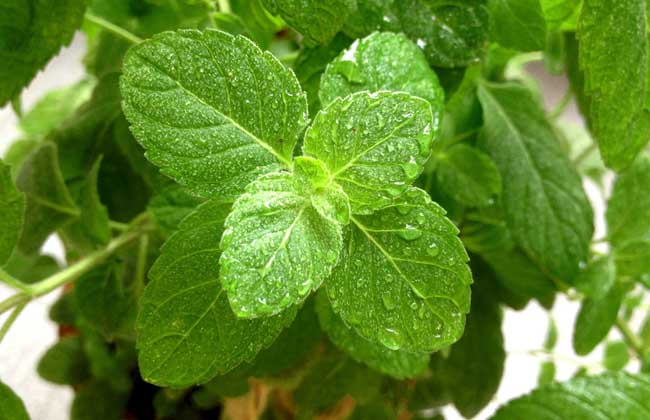
Mint is also known as wild mint, yexixiang, and yindancao, and is one of the commonly used traditional Chinese medicines. Spearmint is also known as green mint, fragrant mint, Dutch mint, green mint, xianghuacai, and yuxiangcai; its stems and leaves can be distilled to extract spearmint oil, which can be used as medicine and as food. In traditional Chinese medicine, the two cannot be used interchangeably. Let us take a look at their differences below!
Differences in stems and leaves between mint and spearmint
1. Mint: The stem is upright, 30-60 cm tall, with fine fibrous roots and horizontal creeping rhizomes at the lower nodes, sharply four-angled, with four grooves, the upper part covered with reflexed fine pubescence, the lower part with fine pubescence only along the angles, much branched. The leaf blade is oblong-lanceolate, 3-5 cm long, 0.8-3 cm wide, acute at the apex, wedge-shaped to nearly rounded at the base; the petiole is 2-10 mm long, concave on the upper side and convex on the lower side, covered with fine pubescence.
2. Spearmint: The stem is upright, 40-130 cm tall, hairless or nearly hairless, green, obtusely four-angled, with grooves and stripes; sterile branches grow only close to the ground. The leaves are sessile or nearly sessile, ovate-oblong or oblong-lanceolate, 3-7 cm long, 1-2 cm wide, acute at the apex, broadly wedge-shaped to nearly rounded at the base, with sharp and irregular serrations along the margin, herbaceous, green above and grayish-green below.
Differences in flowers and fruits between mint and spearmint
1. Mint: The verticillate cymes of mint are many-flowered, with small pale purple flowers, labiate; after flowering it produces small dark purple-brown granular fruits with small glandular pits. The flowering period is July-September, and the fruiting period is October.
2. Spearmint: The verticillate cymes of spearmint are borne at the top of the stem and branches, forming a cylindrical spike 4-10 cm long, interrupted but densely arranged upward, purple or white. The flowering period is July-September.
Mint and spearmint differ in composition
1. Mint: Fresh mint leaves contain 0.8-1% volatile oil, and dried stems and leaves contain 1.3-2%. The main component of the oil is menthol (content about 77-78%), followed by menthone (content 8-12%), and it also contains menthyl acetate, camphene, limonene, isomenthone, pinene, menthenone, resin, and a small amount of tannins and rosmarinic acid.
2. Spearmint: The spearmint plant contains aromatic oil, with an oil content of 0.6-0.7%. Its oil is called spearmint oil or green mint oil. The main component is carvone (content 60-65%). In addition, it also contains limonene, phellandrene, and others. It is mainly used as a fragrance in candy and toothpaste, and is also used in medicine.
Mint and spearmint have different effects
1. Mint: Mint is pungent in flavor and cool in nature, entering the lung and liver meridians. It has effects such as dispersing wind-heat, clearing and soothing the throat, promoting eruption and detoxifying, soothing the liver and relieving depression, and relieving itching. It is suitable for conditions such as cold with fever, headache, sore and swollen throat, absence of sweating, red eyes due to wind-fire, rubella, itchy skin, hernia pain, dysentery, and scrofula. External use has a mild pain-relieving effect and is used for neuralgia and other conditions.
2. Spearmint: Spearmint is pungent and sweet in flavor, slightly warm in nature, entering the liver, spleen, and stomach meridians. It dispels wind and disperses cold, relieves cough, reduces swelling, and detoxifies. It is used for conditions such as colds, cough, stomach pain, abdominal bloating, and nervous headache, and externally for traumatic swelling and pain, red and painful eyes, and sores and boils in children.