What is the difference between the red spider lily and the datura?
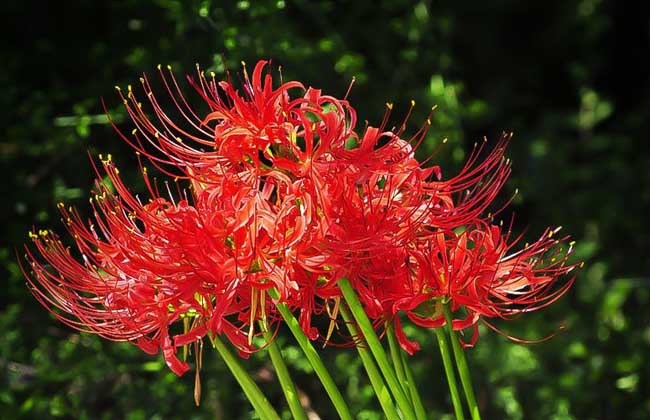
The red spider lily, also known as manjusaka, is a variety of Lycoris radiata. The datura is a wild upright woody annual herb in the Solanaceae family. Both flowers have ties to Buddhism and both represent death, but they can be completely distinguished by their morphology. Let us take a look together below!
The red spider lily and the datura belong to different families and genera
1. Red spider lily: The red spider lily is a variety in the plant kingdom, Angiosperms, Monocotyledons, Asparagales, Amaryllidaceae, Lycoris, Lycoris radiata.
2. Datura: The datura is a plant in the plant kingdom, Angiosperms, Angiosperm subphylum, Dicotyledons, Asteridae, Solanales, Solanaceae, Datureae, Datura.
The red spider lily and the datura have different alternative names
1. Red spider lily: The alternative names of the red spider lily include red flower Lycoris, manjusaka, dragon claw flower, old crow garlic, garlic head grass, ghost torch fire, ghost flower, hell flower, and so on.
2. Datura: The alternative names of the datura include mandala, manda, manzha, manda, intoxicating flower, dog walnut, foreign golden flower, maple eggplant flower, ten thousand peach flower, large trumpet flower, mountain eggplant, and so on.
Morphological differences between the red spider lily and the datura
1. Red spider lily: Lycoris radiata is a perennial herbaceous plant. The bulb is nearly spherical, covered with a purple-brown membrane, 1-3 cm in diameter. The leaves are narrowly strap-shaped, about 15 cm long and about 0.5 cm wide, with blunt tips, dark green, with a pinkish-green band in the middle. The umbel is terminal, the flower stem is about 30 cm tall, and the flowers are bright red. The flowering period is August-September, and the fruiting period is October.
2. Datura: The datura is a wild upright woody annual herb in the Solanaceae family, 0.5-1.5 m tall, with a stout cylindrical stem, pale green or tinged with purple, woody at the lower part. The leaves are alternate, opposite toward the upper part, and the leaf blades are ovate or broadly ovate with acuminate tips. The flowers are solitary in the branch forks or leaf axils, upright, with short pedicels; the calyx is tubular, 4-5 cm long; the corolla is funnel-shaped, green in the lower half and white or pale purple in the upper part. The capsule is upright, ovate, 3-4.5 cm long and 2-4 cm in diameter, with hard spines on the surface, or sometimes nearly smooth without spines, and pale yellow when mature.
Similarities between the red spider lily and the datura
1. Both have very beautiful names, and both also have very mysterious legends.
2. Both have ties to Buddhism. The datura is one of the four famous flowers of Buddhism. The red spider lily, also called manjusaka, is one of the four flowers in the Lotus Sutra.
3. Both are poisonous. Legend says the seeds of the datura are extremely poisonous, and the rhizome of the red spider lily is poisonous.
4. Both are inauspicious flowers. Both flowers represent death. It is said that datura flowers bloom on the road to heaven, representing darkness, hope, death, and so on. The red spider lily covers the road to hell, representing sorrow, longing, death.