What is the difference between Schisandra sphenanthera (southern schisandra) and Schisandra chinensis (northern schisandra)?
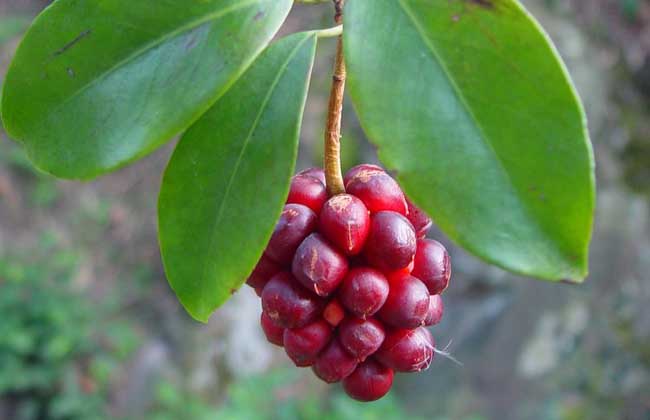
Schisandra is divided into southern schisandra and northern schisandra, and the quality of northern schisandra is better than that of southern schisandra. Southern schisandra refers to South China, North China, Hunan, Hubei, Jiangxi, Sichuan and other places. Northern schisandra refers to Hebei, Liaoning, Jilin, Heilongjiang and other places. Let us now take a look at their differences!
Morphological differences between Schisandra sphenanthera and Schisandra chinensis
1. Schisandra chinensis: The underside of the young leaves of Schisandra chinensis is covered with downy hair, the stamens number 4~5(6), no fleshy receptacle is formed, the anther cells dehiscence outward, and the flowers are milky white or light pink.
2. Schisandra sphenanthera: The leaves of Schisandra sphenanthera are hairless on both sides, the stamens number 9~12, forming a fleshy receptacle, the anther cells dehiscence inward, and the flowers are orange-yellow.
Distribution differences between Schisandra sphenanthera and Schisandra chinensis
1. Schisandra chinensis: Schisandra chinensis is naturally distributed in mountain areas such as the Xiaoxing'anling, Wandashan, Zhangguangcailing and Laoyeling in Heilongjiang Province, and is mainly produced in Northeast China, Hebei and other places.
2. Schisandra sphenanthera: Schisandra sphenanthera prefers a warm and humid climate, has strong adaptability, is not very demanding about soil, and prefers slightly acidic humus soil. It is produced in Jiangsu, Anhui, Zhejiang, Jiangxi, Fujian, Hubei, Hunan, Guangdong, Guangxi, Sichuan, Yunnan and other places in China.
Character differences between Schisandra sphenanthera and Schisandra chinensis
1. Schisandra chinensis: It is irregularly spherical or flattened spherical, 5~8 mm in diameter, with a red, purplish-red or dark red surface, wrinkled, appearing oily and moist; some surfaces are blackish red or show a “white frost”; the fruit flesh is soft, and there are 1~2 seeds, kidney-shaped, with a yellow-brown surface and luster; the seed coat is thin and brittle; the fruit flesh has a faint odor and a sour taste; after the seeds are crushed, they have a fragrant aroma and a pungent, slightly bitter taste.
2. Schisandra sphenanthera: It is spherical or flattened spherical, 4~6 mm in diameter, with a brownish-red to dark brown surface, shriveled and wrinkled, and the fruit flesh often clings tightly to the seeds; there are 1~2 seeds, kidney-shaped, with a brownish-yellow surface and luster, and the seed coat is thin and brittle. The fruit flesh has a faint odor and a slightly sour taste.
Differences in effects between Schisandra sphenanthera and Schisandra chinensis
1. Schisandra chinensis: It has the effects of astringing and securing, tonifying qi and promoting fluid production, tonifying the kidney and calming the heart. It is used for chronic cough with deficiency panting, nocturnal emission and spermatorrhea, enuresis and frequent urination, chronic diarrhea, spontaneous sweating and night sweats, fluid damage with thirst, internal heat and wasting thirst, palpitations and insomnia, and other symptoms.
2. Schisandra sphenanthera: It has the effects of astringing and securing, tonifying qi and promoting fluid production, tonifying the kidney and calming the heart. It is used for chronic cough with deficiency panting, nocturnal emission and spermatorrhea, enuresis and frequent urination, chronic diarrhea, spontaneous sweating and night sweats, fluid damage with thirst, shortness of breath and weak pulse, internal heat and wasting thirst, palpitations and insomnia, and other symptoms.