Is an ostrich a bird? Answered from the perspective of biological classification
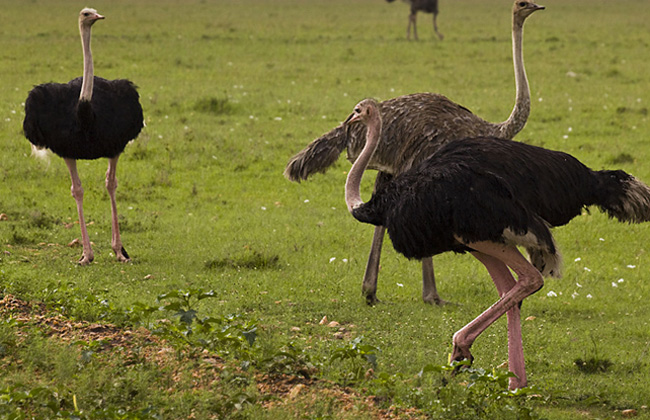
Ostriches are widely distributed in the dry areas of Africa with low rainfall, and are the largest living bird species in the world, found from the Sahara Desert southward throughout Africa; they were introduced to Australia between 1862 and 1869 AD. Because ostriches cannot fly, many people think ostriches are not birds, but this is actually wrong. Let's take a look below!
Is an ostrich a bird?
The ostrich is a bird. The ostrich is a huge, flightless but very fast-running bird from Africa, and it is also the largest living bird species in the world. It can reach 2.5 m in height, has black-and-white feathers all over its body, a long bare neck, short small wings, and long legs.
In biological classification, the ostrich belongs to the class Aves, subclass Neornithes, order Struthioniformes, family Struthionidae, genus Struthio.
Can ostriches fly?
Ostriches cannot fly. Because ostriches are too heavy, and their wings are too short and small compared with their bodies, and their flight feathers are degenerate, lacking hooks, with the feathers loose and not stiff. At the same time, because they do not fly, the keel process that flying birds have is also degenerate and lost, so it cannot support a large attachment of wing muscles used for rapidly flapping the wings. In fact, the ancestors of ostriches were also a kind of flying bird, and during the course of evolution their flying ability gradually weakened until it was lost.
The ostrich's running ability is astonishing. Its toes tend to be reduced because they are suited to running, and it is the only bird in the world with two toes, and the outer toe is relatively small while the inner toe is particularly well developed. It can leap 2.5 m into the air, cover 8 m in a single step, and its sprint speed is over 70 km per hour.
What characteristics do birds have
1. Birds have feathers.
2. A bird's body is usually spindle-shaped, and its bones are not only light and hard, but also have air-filled cavities inside.
3. The forelimbs of birds have evolved into wings, suitable for flight.
4. A bird's respiratory organs can let about 75% of inhaled air bypass the lungs and be stored in air sacs.
5. Birds are warm-blooded animals. In addition, a bird's heart has two atria and ventricles, roughly the same as mammals.