What is the difference between mink and sable? Let us teach you to tell them apart quickly
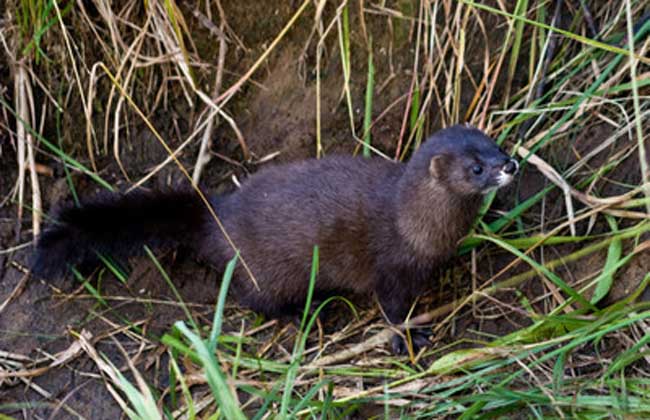
Marten fur has long been known as the “king of furs”. It comes from the fur of marten-type animals, mainly mink and sable. Mink and sable are somewhat similar in outward appearance, and many people cannot tell them apart. Let us take a look below at what differences there are between mink and sable!
Sable
The sable is also called the black sable, red sable, green-gate sable, and so on. Its body shape is very much like a yellow weasel (yellow rat wolf), but larger, with a body length of about 40 cm and a weight of about 650 g. Its limbs are short and sturdy, the hind limbs are slightly longer than the forelimbs, and both the forelimbs and hind limbs have five toes. It also has fleshy pads, and its curved sharp claws are semi-retractable, making it very suitable for climbing trees.
The sable's body is slender and slim, the face and nose are rather pointed, the tip of the muzzle is round and blunt, and there is an obvious longitudinal groove in the center of the nose and lip area, along with more than 20 well-developed, highly elastic whiskers. Its eyes are large and spirited, its ear shells are large and upright and slightly triangular, and its tail is thick and large with fluffy tail hair, accounting for about 30-40% of its body length.
The sable is now found only in the cold, snowy forest seas of the Greater Khingan Mountains, Lesser Khingan Mountains, Laoyeling, Zhangguangcailing and Wandashan in Heilongjiang, the Changbai Mountains in Jilin and the territory of Huanren County in Liaoning, as well as in the Altai Mountains in northern **. It has a discontinuous distribution and likes to live in coniferous and broad-leaved mixed forests and subarctic coniferous forests at altitudes of 800-1600 m, where it is one of the typical animals.
Mink
The mink has a slender body. Males have a body length of 38-42 cm, a tail length of 20 cm, and a weight of 1.6-2.2 kg. Females are smaller, with yellow-brown body fur, white spots on the jaw, a small head, round eyes, and ears that are semicircular, slightly higher than the head and tilted forward, and unable to swing.
The mink has a thick, short neck and sturdy limbs. The forelimbs are slightly shorter than the hind limbs, there are webs between the fingers and toes, the webs between the hind toes are more obvious, and there are fleshy pads on the soles of the feet. Its tail is slender and the fur is fluffy. It is mainly active at night and eats small rodents, as well as mole crickets, frogs and fish.
Mink live in caves or rock crevices along the banks of streams. Some breeding farms raise mink for their fur, mainly dark brown fur. The North American mink is somewhat larger in body size and has now been introduced to European fur farms. The main commercial part of the mink is the skin.
The difference between mink and sable
1. Different families and genera: the sable belongs to the family Mustelidae, genus Martes. The mink belongs to the family Mustelidae, genus Mustela.
2. Different living environments: the wild living environment of the sable is primitive forest. The mink lives in rivers, streams, lakes, marshes and other waterside areas, and can swim and dive.
3. Different body features: the sable is relatively stout, and its appearance resembles a medium-sized domestic cat (the head especially resembles a cat, with large triangular upright ears); the mink is slender, and its appearance resembles a yellow weasel (small ears).
4. Different reproductive capacity: the sable reaches sexual maturity late, generally at 27-29 months of age, mates in June-August in summer, gives birth in March-May of the following year, has a gestation period of 9 months, and gives birth to an average of about 2.7 young per litter, with low reproductive capacity. The mink matures early (9 months of age), mates in March, gives birth in April-May, and has about 6 per litter, with high reproductive capacity.
4. Different fur quality: sable fur is lighter than mink fur (the skin board is thin, only 1/2 that of mink skin), softer and more pliable, and the guard hair and underfur are finer and more splendid. The fur texture of sable is also better than that of mink, and on snowy days, sable fur will not stick to snow.