A detailed explanation of the differences between Cornus officinalis and Evodia rutaecarpa, teaching you to distinguish the two types of "zhuyu"
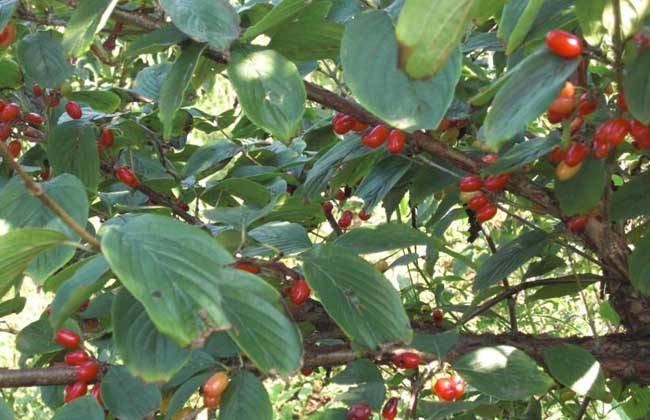
Cornus officinalis and Evodia rutaecarpa are Chinese medicinal materials with different natures and flavors, different meridian tropisms, different effects, and different uses. In clinical medication, the two must not be confused, and even less can they be substituted for each other. Let us now take a look at what their differences are!
Cornus officinalis
Cornus officinalis is the dried ripe fruit flesh of the Cornaceae plant Cornus officinalis, distributed in Shanxi, Jiangsu, Zhejiang, Anhui, Jiangxi, Shandong, Henan, Hunan, Sichuan, Shaanxi, Gansu and other places. It has the effects of tonifying the liver and kidney, astringing and preventing collapse, and is often used for vertigo and tinnitus, soreness and pain of the waist and knees, impotence and seminal emission, enuresis and frequent urination, abnormal uterine bleeding and leukorrhea, profuse sweating and collapse, internal heat and excessive thirst, and other symptoms.
Evodia rutaecarpa
Evodia rutaecarpa is the dried nearly mature fruit of the Rutaceae plants Evodia rutaecarpa, Evodia rutaecarpa var. officinalis, or Evodia rutaecarpa var. bodinieri. It has the effects of dispersing cold and relieving pain, directing qi downward and stopping vomiting, and assisting yang to stop diarrhea, and is often used for Jueyin headache, cold hernia abdominal pain, cold-damp athlete's foot, menstrual abdominal pain, epigastric and abdominal distension and pain, vomiting and acid regurgitation, diarrhea before dawn, and other symptoms.
Differences between Cornus officinalis and Evodia rutaecarpa
1. Different nature and flavor: Cornus officinalis is sour and astringent in flavor, and slightly warm in nature. Evodia rutaecarpa is pungent and bitter in flavor, hot in nature, and slightly toxic.
2. Different meridian tropism: Cornus officinalis enters the liver and kidney meridians. Evodia rutaecarpa enters the liver, spleen, stomach, and kidney meridians.
3. Different effects: Cornus officinalis has the effects of tonifying the liver and kidney, astringing essence, and preventing collapse. Evodia rutaecarpa has the effects of dispersing cold and relieving pain, directing qi downward and stopping vomiting, assisting yang and stopping diarrhea, and so on.
4. Different indications: Cornus officinalis is often used for vertigo and tinnitus, soreness and pain of the waist and knees, impotence and seminal emission, enuresis and frequent urination, abnormal uterine bleeding and leukorrhea, profuse sweating and collapse, internal heat and excessive thirst, and other symptoms. Evodia rutaecarpa is often used for Jueyin headache, cold hernia abdominal pain, cold-damp athlete's foot, menstrual abdominal pain, epigastric and abdominal distension and pain, vomiting and acid regurgitation, diarrhea before dawn, and other symptoms.
5. Different appearance: Cornus officinalis is in irregular slices or sac-like forms, with a surface ranging from purplish red to purplish black, shrunken, glossy, sometimes with a round persistent calyx scar at the apex, and a fruit stalk scar at the base, and it is soft in texture. Evodia rutaecarpa is spherical or slightly pentagonal and flattened-spherical, 2-5 mm in diameter, with a surface ranging from dark yellow-green to brown, rough, with many dot-like protrusions or sunken oil dots, a five-pointed star-shaped crack at the apex, and a fruit stalk covered with yellow down remaining at the base; it is hard and brittle in texture, and the cross-section shows an ovary with 5 locules, each locule containing 1 pale yellow seed, with a rich, aromatic odor.