What is the difference between wild celery and water dropwort? Learn to tell them apart easily
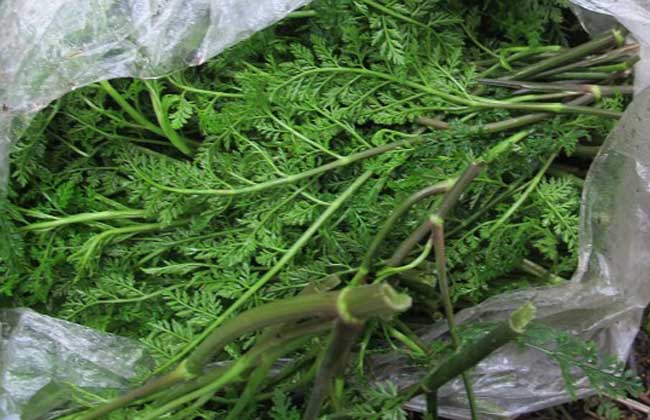
Wild celery generally refers to poison hemlock, also known as Chinese pulsatilla, poison parsnip, celery-leaved death's camas, spotted cowbane, etc. In China it is distributed in the swamps and ditches of the Northeast, Northwest and North China regions. Water dropwort is also known as water English, ox grass, Chu mallow, knife celery, Shu celery, etc. In China, the cultivated area is relatively large in Jiangxi, Zhejiang, Guangdong, Yunnan and Guizhou. Now let us take a look at the difference between wild celery and water dropwort!
The difference in family and genus between wild celery and water dropwort
1. Wild celery: Wild celery is a perennial herbaceous plant in the plant kingdom, angiosperms, dicotyledons, primitive perianth subclass, Apiales, Apiaceae, Apioideae, Cicuta genus.
2. Water dropwort: Water dropwort is a perennial aquatic rosette herbaceous plant in the plant kingdom, angiosperms, dicotyledons, primitive perianth subclass, Apiales, Apiaceae, Apioideae, Oenanthe genus
The morphological difference between wild celery and water dropwort
1. Wild celery: Wild celery can reach 70-100 cm in height, the stem is solitary, hollow, branched, the leaves are bipinnate to tripinnate and fully divided, with sharp serrated edges, the basal leaves have an amplexicaul membranous leaf sheath, the compound umbel is terminal, hemispherical, the petals are white, the schizocarp is nearly spherical, and the whole plant has a foul odor.
2. Water dropwort: Water dropwort is 15-80 cm tall, the stem is upright or prostrate at the base, the basal leaves are stalked, the leaf outline is triangular, the upper leaves are sessile, the compound umbel is terminal without an involucre, the calyx teeth are linear-lanceolate, the petals are white, the stylopodium is conical, the fruit is nearly quadrangular-elliptic or cylindrical-oblong, the flowering period is June to July, and the fruiting period is August to September.
The origin difference between wild celery and water dropwort
1. Wild celery: Wild celery grows under mixed forests, in wetlands or by ditches at an altitude of 400-2900 m, and is distributed in the Far East of the Soviet Union, Mongolia, Korea and Japan, and is produced in Heilongjiang, Jilin, Liaoning, Inner Mongolia, Hebei, Shaanxi, Gansu, Sichuan, ** and other provinces and regions, and was historically cultivated in Xinghua, Jiangsu.
2. Water dropwort: Water dropwort is native to eastern Asia and is distributed in the Yangtze River basin of China, Hokkaido of Japan, southern India, Myanmar, Vietnam, Malaya, Java and the Philippines, etc. It is cultivated more in central and southern China, with a relatively large cultivated area in Jiangxi, Zhejiang, Guangdong, Yunnan and Guizhou.
The toxicity difference between wild celery and water dropwort
1. Wild celery: Wild celery is one of the highly toxic plants. A person will be poisoned within a few minutes after eating it, and the lips often blister (even blood blisters). Its main toxicity is in the central nervous system, with a very significant convulsant effect. After poisoning there are dizziness, vomiting, convulsions, skin redness, a blue complexion, and finally paralysis, with death from respiratory failure. The poisoning dose for humans is 30-60 mg, and the lethal dose is 120-150 mg.
2. Water dropwort: Water dropwort is not toxic and is rich in various vitamins and minerals. Every 100 grams of the edible portion contains 1.8 grams of protein, 0.24 grams of fat, 1.6 grams of carbohydrates, 1.0 grams of crude fiber, 160 mg of calcium, 61 mg of phosphorus, 8.5 mg of iron, and also contains rutin, oenanthetin and quercetin, etc. Its tender stems and leaf stalks are fresh and tender in texture, fragrant and refreshing, and can be eaten raw in salads or stir-fried.