What is the difference between agave and aloe? A quick guide to tell them apart
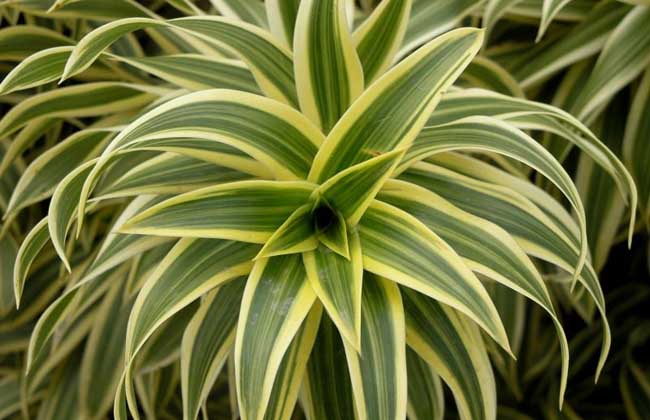
Agave and aloe are both perennial evergreen succulents, with short stem nodes, a white powdery coating on the leaf surface, and spines along the edges and at the tips. They are not easy to tell apart by appearance, but they really are two different plants. Let's take a look below at what their differences are!
Agave
Agave, also known as dragon's tongue palm, sisal hemp, etc., is a perennial evergreen large herbaceous plant in the Asparagaceae family, Agave genus. It is native to tropical America, and is often introduced and cultivated in the provinces and regions of South China and Southwest China, where it is a common ornamental plant.
The leaves of agave are arranged in a rosette, usually 30-40, sometimes 50-60, large, fleshy, oblanceolate-linear, 1-2 m long, 15-20 cm wide in the middle, 10-12 cm wide at the base, with sparse spines along the leaf margin and 1 hard sharp spine at the tip, the spine dark brown, 1.5-2.5 cm long.
The panicle of agave is large, up to 6-12 m long, much branched, with yellow-green flowers, the perianth tube about 1.2 cm long, the perianth lobes 2.5-3 cm long, the stamens about 2 times as long as the perianth, and the capsule oblong, about 5 cm long. After flowering, very few bulbils are produced on the inflorescence.
Aloe
Aloe is a perennial evergreen herbaceous plant in the Liliaceae family, native to the tropical arid regions of Africa, and now distributed almost throughout the world. Because it is easy to grow and is an ornamental plant with both flowers and foliage, it is quite popular with the public, and is cultivated in Fujian, Taiwan, China, Guangdong, Guangxi, Sichuan, Yunnan and other places in China.
The stem of aloe is relatively short, and the leaves are nearly clustered or slightly two-ranked (in young plants), thick and juicy, strap-shaped lanceolate, powdery green, 15-35 cm long, 4-5 cm wide at the base, with several small teeth at the tip and sparse spiny small teeth along the margin.
The scape of aloe is 60-90 cm tall, unbranched or sometimes slightly branched, the raceme has several dozen flowers, the bracts are nearly lanceolate with a sharp tip, the flowers droop, are sparsely arranged, pale yellow with red spots, the perianth is about 2.5 cm long, the lobe tips are slightly curved outward, the stamens are nearly as long as or slightly longer than the perianth, and the style clearly extends beyond the perianth.
The difference between agave and aloe
1. Agave and aloe belong to different families and genera. Agave is in the Asparagaceae family, Agave genus. Aloe is in the Liliaceae family, Aloe genus.
2. The leaves of agave and aloe are different. Although the leaves of agave are fleshy, after breaking a leaf there are thin thread-like fibers inside, no sap flows out, and it does not look transparent. After breaking an aloe leaf there are no fibers, and a sticky sap flows out, tinged with yellow, while its fleshy part is crystal clear and transparent.
3. The way agave and aloe produce leaves is different. In agave, the outermost leaf wraps the leaves inside, forming a conical shape, growing outward layer by layer. Aloe leaves are separate from the small leaf stage onward, and the innermost leaves can be clearly seen.
4. The spines of agave and aloe are different. Agave has hooked spines along the leaf edges, hard and sharp, and a hard dark brown spine at the leaf tip. Aloe's spines are not as hard as the former; its spines grow toward both sides, and the closer to the tip, the smaller the spines.
5. The flowers and fruits of agave and aloe are different. The inflorescence of agave is paniculate and pale yellow-green, and the fruit is elliptical or spherical. Aloe, however, has a raceme that emerges from the leaf rosette, with dense small flowers, orange-yellow with yellow spots, a green calyx, and a triangular fruit.
6. Agave and aloe are similar in plant form. Agave is toxic, so never eat it by mistake. Apart from a few aloe varieties such as Aloe arborescens and Shangnong Daye aloe, whose fresh leaves can be eaten, most varieties are only ornamental plants, and some aloe varieties are also toxic; eating them by mistake may cause poisoning and even endanger life safety.