What are the main differences between wasps and bees?
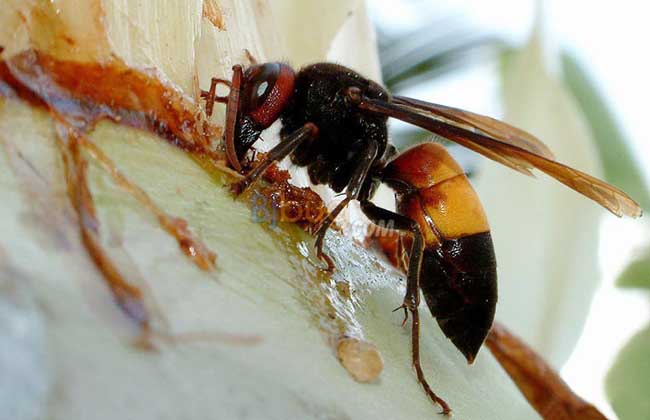
The wasp is also called mafeng, yellow jacket, hornet, red-paper-wrapped waist, ghost-dizzy head, and so on. It is an insect with a wide distribution, a great many species, and rapid flight. Bees belong to the order Hymenoptera, family Apidae, and live entirely on flowers, including pollen and nectar, sometimes brewing and storing it as honey. Let us take a look below at what differences there are between wasps and bees!
Wasps and bees differ in diet
The eating habits of wasps and bees are also very different. Bees are herbivorous insects that feed on pollen, meaning they are vegetarian, and in the process of collecting pollen they play a role in pollination. Wasps have complex feeding habits: besides sipping nectar, the adults are also predatory, and caterpillars on trees and small green worms are all targets for them. Since the objects wasps prey on are all pests, in this respect, like bees, they are beneficial insects.
Wasp nests and bee nests differ in material
Whether it is a wasp or a bee, it can also be told from the “house” they live in. A wasp's nest is a paper nest, while a bee's nest is a wax nest. Judging by material, a bee's nest is clearly more “precious” than a wasp's.
Wasps are more bad-tempered than bees
Both wasps and bees have the habit of living in groups. Because bees are mostly raised artificially, one beehive can hold tens of thousands of bees. Wasps, by contrast, are mostly wild, and the yellow hornet nests found are mostly only about the size of a fist, with roughly one to two hundred yellow hornets living in one nest. Although they have the habit of living in groups, they are also xenophobic: toward members that blunder in, they will attack in a group and kill them. Wasps have a very strong instinct to protect their young and their nest, and their tempers are more violent and more “warlike.”
A bee dies after stinging a person, while a wasp does not
A wasp's stinger is slender and long, and after stinging a person it can be drawn out smoothly. Although after each sting their “combat power” weakens, after resting for a period they recover, and it poses no threat to their life. Bees are not so lucky: a bee's stinger has barbs, and after stinging a person the stinger stays in the person's skin and cannot be pulled out. A bee's stinger is connected to its internal organs, and after stinging a person the organs are pulled out together with the stinger, so a bee stings at the cost of its life. They can sting a person only once in their whole life, and after stinging they soon die.
Wasps are more “vindictive” than bees
Although wasps do not die after stinging a person, when there is no trouble they are also unwilling to be enemies with people. Like bees, if humans do not actively disturb them and they sense no threat, they will not actively attack humans. Wasps live in groups, but some also act alone in places very close to the nest. If you happen to run into a wasp, or find one or two wasps circling in front of you, be sure to dodge quickly and do not strike rashly. Many people, after encountering a wasp, will strike it dead in their panic. Once one wasp is killed, more and more wasps will rush over to attack you, and sometimes the whole nest of wasps will come out to take revenge.
Once a wasp is killed, before dying it releases a unique odor as a danger signal to pass on to its companions. After receiving the signal passed on by its companions, the wasps in the same nest will immediately rush over to provide support. This is why killing one wasp brings a whole nest of wasps. In addition, if you accidentally stir a wasp nest into a frenzy, lie down and do not move, so as to avoid the wasps chasing in a group.
Wasps are more easily “bewitched” by fragrances than bees
Wasps are especially sensitive to smells. Some people are in the habit of spraying perfume before going out, and some people like to use cosmetics with a strong fragrance. When a wasp smells these fragrances, it is stimulated, and then the desire to attack is aroused; it chases the source giving off the fragrance and stings without mercy.
Wasps, like people, are sensitive to different fragrances. Some wasps like floral scents, and some wasps like fruity scents. Therefore, when people go for a walk in the countryside, they should carry less fragrance.
Wasps and bees differ in toxicity
Wasps come in two kinds, venomous and non-venomous. The venomous ones are the females. When stung by a wasp, the wound is usually not large, but if it is not treated in time, an allergic reaction may occur, and in severe cases it can endanger life. The method for handling a wasp sting is different from that for a bee sting.
Bee venom is acidic and can be dabbed on with soapy water and the like, whereas wasp venom is weakly alkaline, so vinegar should be applied to the wound to neutralize the acid and alkali and weaken the toxicity. If there is an onion, it can be sliced and applied to the wound. In addition, essential balm, cooling oil, and the like can also be used to relieve bee venom, but red mercurochrome or iodine tincture must never be used to wipe it, as that not only fails to treat it but instead worsens the swelling.