What is the difference between raw Rehmannia root and prepared Rehmannia root?
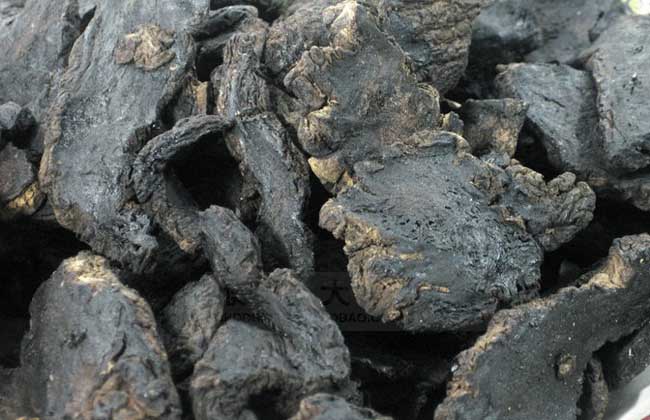
Rehmannia can be divided into two types: raw Rehmannia and prepared Rehmannia. Prepared Rehmannia is the processed product of raw Rehmannia. Raw Rehmannia is strongly cold in nature and cools the blood, so it is used by those with blood heat; prepared Rehmannia is slightly warm and tonifies the kidney, so it is used by those with blood deficiency. Men often have yin deficiency and are better suited to prepared Rehmannia, while women often have blood heat and are better suited to raw Rehmannia. Let us now look at their differences.
Prepared Rehmannia is the processed product of raw Rehmannia
Prepared Rehmannia is made by mixing raw Rehmannia with yellow rice wine, letting it sit covered, then sun-drying and steaming it, so their effects differ. Raw Rehmannia is mostly used to clear heat and nourish yin, while prepared Rehmannia is mostly used to nourish blood and tonify the kidney.
Differences in appearance between raw Rehmannia root and prepared Rehmannia root
1. Raw Rehmannia root: mostly irregular lump-like or oblong in shape, swollen in the middle and slightly narrower at both ends, 6-12 cm long and 3-6 cm in diameter; some are thinner, long and strip-like, slightly flat and curved. The surface is brownish-black or brownish-gray, extremely wrinkled, with irregular transverse curved lines. It is heavy, relatively soft yet tough, and not easy to break; the broken surface is brownish-black or pitch-black, lustrous, and sticky. The taste is slightly sweet.
2. Prepared Rehmannia root: irregular slices and fragments, varying in size and thickness. The surface is pitch-black, lustrous, and highly sticky. It is soft yet resilient, not easy to break; the cut surface is pitch-black, lustrous, and sweet in taste.
Differences in medicinal effects between raw Rehmannia root and prepared Rehmannia root
1. Raw Rehmannia root: cold in nature; its functions are to cool the blood and clear heat, nourish yin and tonify the kidney, and promote fluid production and quench thirst. It is often used to treat conditions such as heat entering the nutrient and blood levels, steaming bone consumptive fever, dry and painful throat, and blood-streaked phlegm. Liuwei Dihuang Wan, made mainly from raw Rehmannia, is a famous ancient formula for tonifying the kidney, and clinically it is also often used in the treatment of chronic nephritis, high blood pressure, neurasthenia, pulmonary tuberculosis and other diseases.
2. Prepared Rehmannia root: warm in nature, and its functions also change; it is a key medicine for nourishing blood. Combined with angelica, white peony root and Sichuan lovage rhizome, it forms the famous "Siwu Tang" (Four-Substance Decoction), often used to treat blood deficiency patterns. Prepared Rehmannia with white peony root nourishes the liver, with arborvitae seed nourishes the heart, with longan aril nourishes the spleen, and with ephedra unblocks the blood vessels. However, prepared Rehmannia is rich and cloying and can stagnate the spleen, hindering digestion, so those with spleen deficiency should eat little of it, and it should not be taken by those with abdominal fullness and loose stools.