What are the differences between venomous snakes and non-venomous snakes
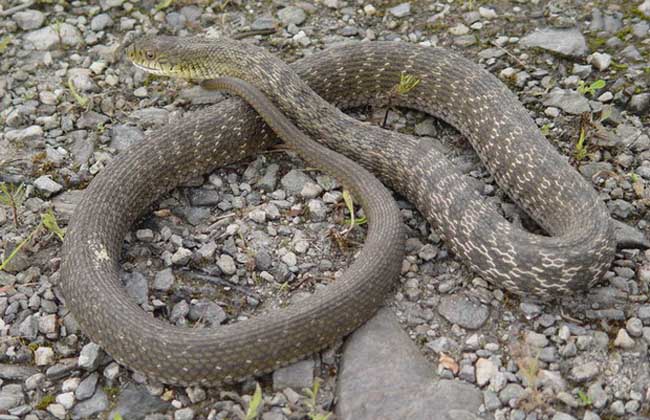
How can you tell a venomous snake from a non-venomous snake? Most people judge simply by whether the head is triangular, whether the tail is thick and short, or whether the colors are bright. This is not comprehensive enough, because in the course of evolution many non-venomous snakes also developed the appearance of venomous snakes. Let us now take a look at exactly what the differences are between venomous snakes and non-venomous snakes!
Differences between venomous snakes and non-venomous snakes
Category Non-venomous snake Venomous snake Bite mark shape: relatively fine tooth marks in rows, double row of tooth marks with two particularly thick and deep marks at the top, single row of tooth marks Body characteristics: slender, long, body stripes not very bright, short, thick, body stripes generally brighter Head characteristics: small, mostly oval, large, mostly triangular Tail characteristics: long, short Demeanor characteristics: quick-moving, slow-moving, often coiled into a ball Venom gland: absent in non-venomous snakes, present in venomous snakes Venom duct: absent in non-venomous snakes, present in venomous snakes Fangs: no fangs in non-venomous snakes, fangs present in venomous snakes, located in the upper jawbone in front of or behind the non-venomous teeth, longer and larger than non-venomous teethNote: After being bitten by a snake, when it is impossible to accurately determine whether it is venomous, it should be treated as a venomous snake bite and the person should be sent to a doctor for treatment promptly.
Common venomous snakes in China
Common venomous snakes in China include: banded krait (also called golden armor belt, golden wrapped iron, golden foot belt, flower fan handle, umbrella handle, Buddha snake), many-banded krait (guojixia, white-jointed black, money white-flower snake, silver armor belt, silver wrapped iron), Chinese cobra (rice shovel head, wind-blowing snake, rice spoon head), king cobra (mountain ten-thousand snake, mountain-crossing peak, large flat-necked snake, large cobra, large flat-headed wind, flat-necked snake, large swollen neck, wind-blowing snake, mountain-crossing marker), pit viper (earth male snake, grass flyer, seven-inch snake, earth grandfather), viper, sharp-nosed pit viper (hundred-step snake, five-step snake, seven-step snake, qishe, valley turtle, hundred-flower snake, Chinese pit viper), bamboo pit viper (green bamboo snake, green bamboo tiger, tricky bamboo green, scorched tail), Chinese habu (original lance-headed pit viper, turtle-shell flower, bamboo shoot shell spot, rat snake, black evil one), sea snake (blue-banded sea snake, banded sea snake), etc.
Common non-venomous snakes in China
Common non-venomous snakes in China include: black-browed ratsnake (house snake, scale-star snake, cauliflower snake, yellow-jawed snake, paper mulberry snake, yellow-throated snake, kind eel, yellow long worm, broad snake), Chinese garter snake (black snake, black wind snake), Oriental ratsnake (grass brocade snake, long-column snake, mountain snake, water law snake, black-fleshed snake, water south snake), king ratsnake (stinky king snake, yellow-throated snake, yellow-jawed snake, king snake, brocade snake, yellow python snake, king python snake, rapeseed flower, stinky yellow python, keeled brocade snake, keeled-scale brocade snake, vegetable snake, king-character head, cauliflower snake, pine-flower snake, stinky green male/female, cauliflower snake, stinky yellow jaw), gray ratsnake (yellow-tip snake, rope snake, tree-crossing snake, tree-crossing dragon, tree-crossing banyan, jumping tree marker, yellow-belly dragon, mountain snake, earth snake, black crooked, upper bamboo dragon), red-banded snake (red forty-eight joints, red long worm, red-spotted snake, red flower seed, dry-ground fire chain, red hundred joints snake, blood third watch, chain snake, mulberry root), jade-banded ratsnake (beauty snake, gaosha snake, god-skin flower snake, jade belt snake), greater green snake (green snake), tiger keelback (pheasant neck, ring-necked pheasant neck, bamboo pole green, cockscomb snake, pheasant neck), Chinese keelback (grass red chain, Chinese keelback).