What is the growth process of Cordyceps sinensis?
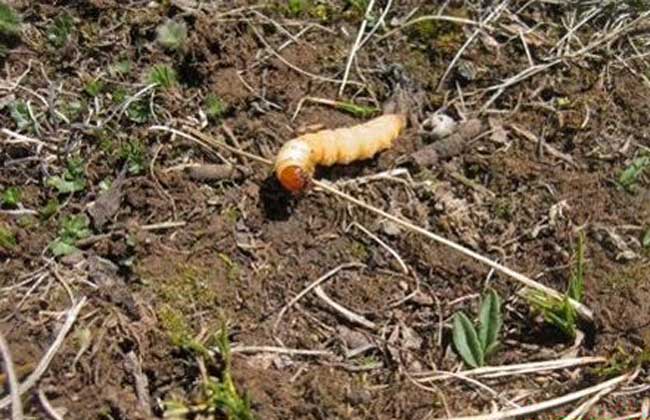
Every year when midsummer arrives, in the Qinghai-Tibet Plateau region at an altitude above 3000 m, an insect called the cordyceps ghost moth enters its egg-laying period. The small, mottled female adult ghost moth lays thousands upon thousands of eggs on the vegetation on the ground. After about one month of incubation, the moth eggs become small larvae, which then burrow into the moist, loose soil and grow by feeding on the nutrients of plant roots and stems, gradually becoming white and plump.
In the soil there is a spherical cordyceps fungus ascospore. When the cordyceps ghost moth larva is attacked by the spore, its body begins to show signs of disease and it burrows into the shallow surface layer, while the cordyceps fungus spore continues to grow inside the larva's body. The larva's internal organs are gradually eroded away until they disappear, and finally it dies with its head up and tail down. At this point the insect body has become a shell filled with mycelium, buried in the soil layer. This is the “winter worm”.
After a winter, in the spring and summer of the following year, as the temperature gradually rises, the mycelium inside the insect body begins to grow again, and finally a small purplish-red grass sprouts from the mouth or head of the dead larva and pushes out of the ground. The grass is usually about two to five cm long, with a pineapple-shaped capsule at the top. This is the “summer grass”.
Finally, the shell of the cordyceps ghost moth larva and the small grass that grows out together form a complete “Cordyceps sinensis”.