What is the difference between Gynura segetum and Panax notoginseng, and how to tell them apart?
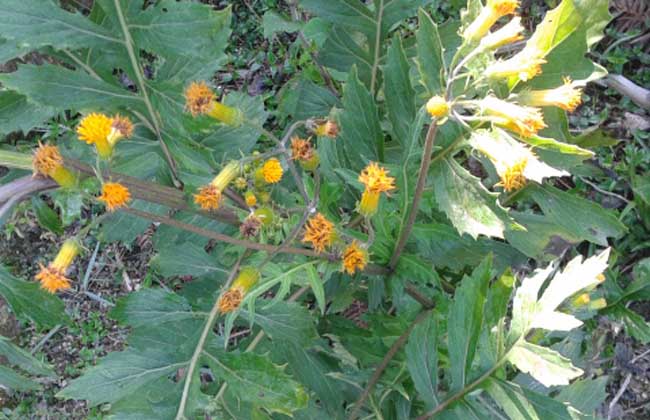
What are the differences between Gynura segetum and Panax notoginseng? Because Panax notoginseng is precious, many other "notoginseng" have appeared that are named after it but actually have completely different effects from it, and "Gynura segetum" is one of them. "Gynura segetum" is completely different from "Panax notoginseng". "Gynura segetum" is also known as "Jusanqi", and also called "Sanqicao", belonging to the Asteraceae family. Although the two are similar in efficacy, both having the effects of dissipating blood stasis, reducing swelling and relieving pain, and clearing heat and detoxifying, they come from different plant families, and more importantly, their toxicity is different!
Differences in medicinal names
1. Aliases of Gynura segetum: Sedum aizoon, Hansanqi, Xueshancao, Liuyuelin, Xieziicao, Jusanqi, Caosanqi, Sanqicao.
2. Aliases of Panax notoginseng: Tianqi, Shanqi, Renshen Sanqi, Nanguo Shencao, King of Ginseng, Jinbuhuan, etc.
Differences in family and origin
1. Gynura segetum: a plant of the Crassulaceae family, distributed in Northeast China, North China, Northwest China and the provinces along the Yangtze River basin in China. It is also distributed in Korea, Japan, Mongolia, Russia and Vietnam.
2. Panax notoginseng: the dried root of the Araliaceae plant Panax notoginseng, mainly produced in Wenshan Prefecture, Yunnan. A small amount is also grown in Tianyang, Jingxi and Baise in Guangxi, but the quality is mostly inferior to that produced in Wenshan, and the output of Wenshan Prefecture, Yunnan is also the largest, accounting for more than 90% of total output.
Differences in traits
1. Gynura segetum: a perennial herb, sun-loving, drought-tolerant, salt- and alkali-tolerant, with very strong vitality. It grows at the edges of mountain forests, under forests, in thickets or in grasslands and gravelly land. The stem is cylindrical, 30-50 cm long, with a dark brown or purple-brown surface. It is brittle, easily broken, and hollow in cross-section. The leaves are shrunken and often fall off, alternate or nearly opposite, and when flattened are oblanceolate; the flowers it produces are yellow. The root is cylindrical or slightly conical. It is not easy to dry, and after drying it is relatively loose in texture, dark brown, with an uneven surface, in a cracked state.
2. Panax notoginseng: a perennial herb, 70% shade-loving and 30% sun-loving (which is also the source of its name), naturally delicate, not tolerant of cold or heat, with strict requirements for growing altitude, soil, climate, latitude and so on. The plant is 60 cm tall, with an upright stem, palmately compound leaves, and 3-4 leaves whorled at the top of the stem, with fine serrations at the edges. The inflorescence stalk emerges from the center of the stem top, the flowers are green and umbrella-shaped, and after maturity they are red, berry-like, and can be sown. The main root is somewhat conical or cylindrical, and its surface varies according to the soil color of the planting site, commonly earthy red and grayish brown (after being scrubbed clean with a brush, its original color is all blue-green), with branch root scars on the main body, a stem scar at the top, and tumor-like protrusions around it. It is solid in texture, with a grayish green or yellow-brown cross-section, and the cross-section is slightly radially arranged, commonly known as chrysanthemum heart, and the bark and xylem are relatively easy to separate.
Differences in taste
1. Gynura segetum: sweet in taste, slightly bitter, with a sour taste; excessive accidental ingestion can cause liver damage.
2. Panax notoginseng: bitter on entry, then sweet afterward, with no pungent, numbing or sour taste. Panax notoginseng is very bitter on entry, but immediately becomes sweet afterward, and the bitterness does not stay in the mouth for long. "Reaches the mouth but not the throat" means that there should not be a feeling of bitterness reaching the throat.