Do figs actually have flowers? Read this and you will understand
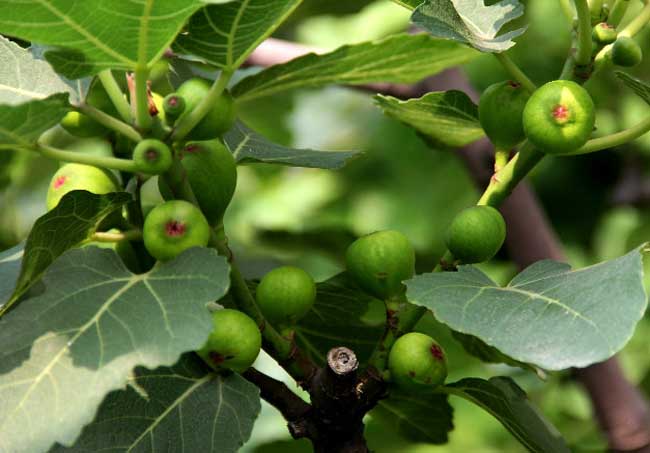
Do figs have flowers? From the name, it seems figs have no flowers, but people's eyes have been deceived by it. Its flowers hide in the leaf axils of new branches, and its female flowers and male flowers are hidden inside the sac-like enlarged receptacle. The top of the receptacle is deeply sunken inward, creating a spacious chamber. Because the receptacle wraps the female flowers and male flowers from top to bottom, people cannot see them, and therefore think that figs do not bloom.
Do figs have flowers?
Figs do have flowers. In the plant kingdom, where there is fruit there must be flowers; without flowers, how could there be fruit? There are several hundred species of plants that "seem to have no flowers but actually do," and the fig is a typical example.
Figs not only have flowers, they have many flowers; it is just that people cannot see them with the naked eye. The figs we eat are not the true fruit of the fig, but the fleshy ball formed by the enlargement of its receptacle, and the fig's flowers and fruit are hidden inside that fleshy ball. So from the outside, the fig's flowers cannot be seen. In botany, this kind of flower belongs to the "syconium."
If you cut open the fleshy ball of a fig and observe it with a magnifying glass, you can see countless small balls inside. There is a hole in the center of each small ball, and countless fuzzy little flowers grow inside the hole. The male flowers and female flowers are separated above and below, and each male flower and each female flower forms a small fruit, also hidden inside the fleshy ball. Therefore, the name "fig" actually does not match reality.
The flowering and fruiting period of figs is from May to July.
The origin and distribution of figs
Figs originated along the Mediterranean coast. They are distributed from Turkey to Afghanistan. They were introduced to China from Persia as early as the Tang Dynasty, and are now cultivated in both the north and south, **especially in the south.
Figs prefer a warm and humid climate, tolerate poor soil, resist drought, and are not tolerant of cold or waterlogging. It is best to cultivate them on sunny, deep, loose, fertile, well-drained sandy loam or clay loam.
Fig variety classification
1. Brunswick: A dual-purpose variety for summer and autumn crops, with few summer figs and mainly autumn figs. Summer figs are oval and greenish-yellow when ripe; autumn figs are inverted conical or obovate, with an average single fruit weight of 50-60 g, yellowish-brown skin, and a hollow fruit; the flesh is reddish-brown, contains more than 16% soluble solids, and tastes sweet and aromatic. This variety has moderate tree vigor, a semi-spreading tree shape, a dwarfed tree body, weak branching, strong continuous fruiting ability, and not high yield; it is cold-resistant and highly salt-tolerant.
2. Penglai Persimmon: A variety specifically for autumn figs, with very few summer figs. Autumn figs are inverted conical or oval, with a round and slightly flat top that cracks easily, a single fruit weight of 60-70 g, thick purplish-red skin; the flesh is bright red, contains 16% soluble solids, and is fairly sweet, but the texture is coarse and it has no aroma. This variety has extremely strong tree vigor, an upright tree shape, a tall and vigorous crown. The branches are sparse, long, and thick, and it has good cold resistance.
3. Qingpi: A dual-purpose variety for summer and autumn crops, mainly autumn figs. Autumn figs are inverted conical, with a single fruit weight of 60-80 g and a maximum of more than 120 g. When ripe, they are light green, the fruit apex does not crack, but there are cracks on the fruit shoulder. The flesh is purplish-red, hollow, contains more than 16% soluble solids, and has excellent flavor. This variety has vigorous tree vigor, a semi-spreading tree shape, thick branches, and relatively few branches. It has moderate cold resistance, strong disease resistance, and fairly strong salt tolerance.