The Legend of the Carp Leaping Over the Dragon Gate and a Detailed Explanation of the Idiom's Meaning
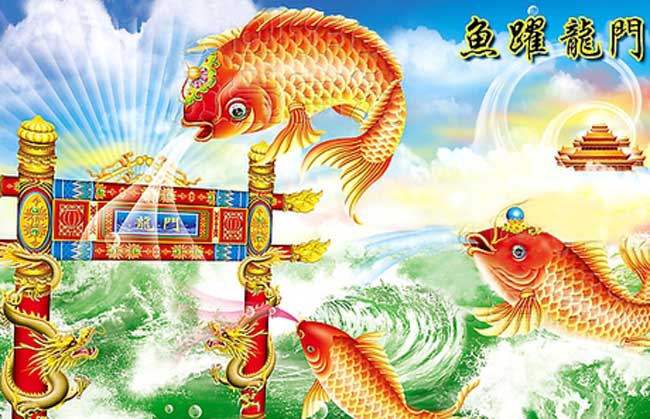
In ancient Han legend, if a Yellow River carp leaps over the Dragon Gate, it transforms into a dragon. It is a metaphor for sudden success such as passing the imperial examination or being promoted to high office, and also for pressing forward against the current and striving upward. Let us now take a look together at the legend of the carp leaping over the Dragon Gate and the explanation of the idiom.
The Legend
In ancient legend, if a Yellow River carp leaps over the Dragon Gate (Longmen Mountain in Luoyang, Henan Province), it transforms into a dragon. Long, long ago, before the Dragon Gate had been carved open, the waters of the Yi River were blocked here by Longmen Mountain and pooled into a large lake on the south side of the mountain.
The carp living in the Yellow River heard that the scenery at the Dragon Gate was beautiful and all wanted to go see it. They set out from the Yellow River at Mengjin in Henan, traveled through the Luo River, and then followed the Yi River to the place where the water splashed at the Dragon Gate. But there was no waterway up Longmen Mountain, so they could not get up and had to gather at the foot of the mountain on the north side of the Dragon Gate. "I have an idea. How about we jump over Longmen Mountain?" a big red carp said to everyone. "It is so high, how could we jump it?" "If we fail, we will fall to our deaths!" The companions all talked at once and could not make up their minds. Then the big red carp volunteered and said, "I will jump first and give it a try."
It was seen gathering all its strength from half a li away, like an arrow loosed from the string, and with a great leap it shot straight up into the clouds halfway across the sky, carrying the clouds and rain in the air along with it. A ball of heavenly fire pursued it from behind and burned off its tail. Enduring the pain, it kept leaping forward and finally cleared Longmen Mountain, landing in the lake water south of the mountain, and in the blink of an eye it turned into a giant dragon. When the carp north of the mountain saw this scene, every one of them was so frightened that they huddled together and did not dare take the risk again.
Just then, a giant dragon was suddenly seen descending from the sky, saying, "Do not be afraid. I am your companion, the big red carp. Because I leaped over the Dragon Gate, I turned into a dragon. You must also bravely jump!" Hearing these words, the carp were encouraged and began to leap over Longmen Mountain one after another. But apart from the few that made it across and turned into dragons, most could not get over. Those that failed to jump over and fell from the air received a black scar on their foreheads. To this day, that black scar still grows on the foreheads of Yellow River carp.
Later, the great Tang dynasty poet Li Bai wrote a poem especially about this: "The three-chi carp of the Yellow River, originally dwelling at Mengjin, failed to become a dragon when its forehead was marked, and returned to keep company with ordinary fish."
Explanation of the Idiom
In ancient Han legend, if a Yellow River carp leaps over the Dragon Gate, it transforms into a dragon. It is a metaphor for sudden success such as passing the imperial examination or being promoted to high office. It is also a metaphor for pressing forward against the current and striving upward.
Source and Usage
[Source]: Piya, "Explaining Fish": "It is commonly said that when a fish leaps over the Dragon Gate and gets across, it becomes a dragon; only the carp may do so."
[Usage]: Used as an object; a metaphor for sudden success such as passing the imperial examination or being promoted to high office.