What are the uses of water hyacinth? A rundown of its main applications
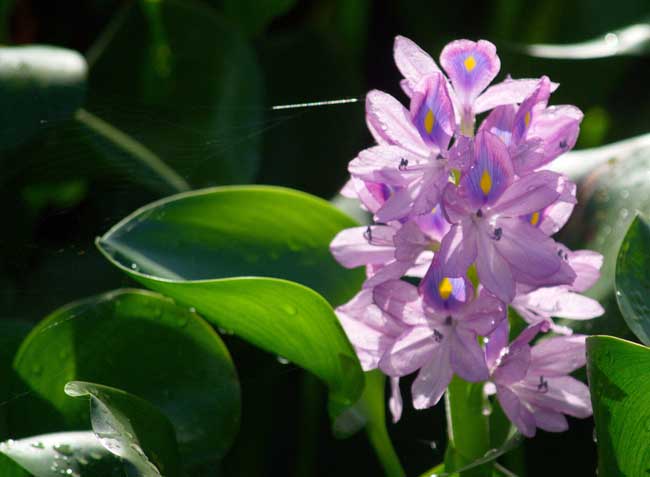
Water hyacinth, whose scientific name is Eichhornia crassipes, is also known as water lettuce and water hyacinth. It is beautiful yet undemanding, a perennial herbaceous floating aquatic plant with a persistent rootstock. Every summer and autumn, water hyacinth runs rampant in rivers, but everything has two sides, and where there is a drawback there is also a benefit. Water hyacinth is no exception. Let us learn about water hyacinth and its uses below!
Water hyacinth has a large gourd-shaped air bladder between its roots and leaves, its stems and leaves hang above the water, and its tillering branches creep along the water surface. The flowers are multi-angled and trumpet-shaped, with bright, beautiful colors. The leaves are emerald green, on the darker side. The leaf margins are entire, smooth and textured. The fibrous roots are well developed, tillering and reproduction are fast, and management is extensive, making it an excellent plant for beautifying the environment and purifying water quality.
Treating pollution
The pollution-absorbing capacity of water hyacinth is considered the strongest among all aquatic plants. Under suitable conditions, one hectare of water hyacinth can absorb on the same day the nitrogen and phosphorus elements discharged by 800 people, and water hyacinth can also remove heavy metal elements such as cadmium, lead, mercury, thallium, silver, cobalt and strontium from sewage.
Ingenious furniture making
Various furniture and decorations woven from specially processed water hyacinth not only cost less than rattan and wooden furniture, but are also free of formaldehyde and inexpensive. Treated water hyacinth furniture can also break down various indoor harmful gases into water and carbon dioxide, helping to purify the environment.
Raising rex rabbits
Qingpu District in Shanghai processes water hyacinth into grass powder feed for raising rex rabbits, and uses rabbit manure and the press filtrate of water hyacinth as a source for biogas generation. As a result, the project can collect 120,000 tons of water hyacinth and raise 250,000 rex rabbits a year.
Making adhesives
A biotechnology company in Wuhan used water hyacinth to make a non-toxic biological adhesive, widely used in composite flooring. This patented technology has attracted the attention of many enterprises.
Functional beverage
The flowers and tender leaves of water hyacinth can be eaten directly; they taste fresh and refreshing and have the effect of moistening the intestines and relieving constipation. Indigenous residents in places such as Malaysia often use the tender leaves and flowers of water hyacinth as a vegetable. In addition, a company in Hubei has produced the first batch of 170,000 bottles of water hyacinth functional beverage, and they sold out.
Paper-making raw material
Water hyacinth is a very good paper-making raw material. In the 1980s, a research institute in Hyderabad, India, began using water hyacinth leaves to produce writing paper, advertising paper and card paper, among others.
Medicinal value
[Collection] The whole plant is used as medicine, collected in spring and summer, washed clean, dried in the sun for later use or used fresh. Dosage 15-30 grams.
[Usage] Internal use: decocted as a soup, 0.5-1 liang; external use: mashed and applied.
[Main indications] Clearing heat and relieving summer heat, dispersing wind and promoting eruption, promoting urination and reducing swelling. Mainly used for skin eczema, rubella, heatstroke with thirst, nephritic edema, and difficult urination.