What are the float-tuning techniques for winter fishing? A full analysis in one article
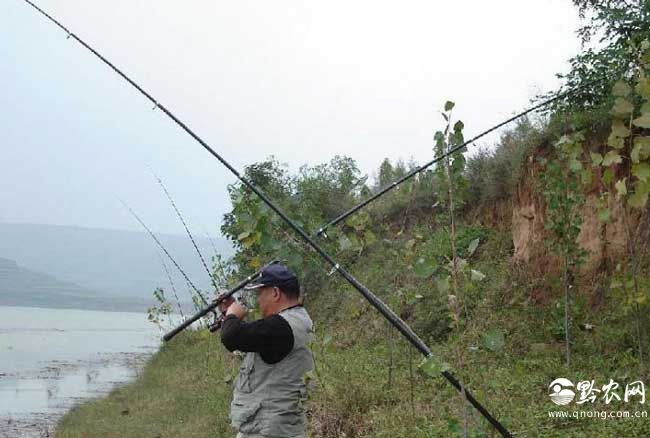
Every angling enthusiast wants to know the float-tuning techniques for winter fishing. The float shows no movement, yet when you lift the rod you have hooked a fish. There are fish in the swim and the bait is right, so why does the fish take the bait without the float moving? The float is the angler's eyes; if the fish sucks in the bait and the float does not react, is that not fishing blind?
Why do you need to tune the float when fishing?
There are many theories about float tuning; some are so mystifying that they invoke aircraft and submarine design theory, air and water friction coefficients, and complicated calculation formulas. In fact, you only need to simplify the complex problem and hold firmly to one point——the force with which the fish sucks in the bait must be greater than the residual buoyancy of the float, and that is enough.
Though it is a simple sentence, achieving this is not simple; it involves the entire rig, the state of the bait, float tuning and every other aspect. It is a systematic project, and no detail can be treated lightly, especially when fishing for small crucian carp in winter.
In winter, because the fish's range of activity is small, its movements are slow and its mouth opening is small, feeding seems to become an instinctive reaction of the fish, and the force with which it sucks in the bait is very weak, so a clear bite is hard to show. Under these circumstances, producing a clear bite is even more crucial; otherwise you will be fishing blind and not even know how you caught the fish. When fishing in winter, float tuning requires mastering certain techniques. The winter fishing float-tuning techniques are as follows.
It is hard to fish sensitive when fishing dull
For example, with a setting of tune-four fish-two and a small pulled bait, the two hooks are on the bottom with one hook lightly touching the bottom and one hook suspended. When the fish sucks in the bait, under the upward pull of the float's residual buoyancy, its weak oral pressure makes it very hard to suck the bait into its mouth; as soon as it sucks, the float tip is pulled upward, and the float signal shows a very vague up-and-down trembling, or even no signal at all. In this situation, some anglers may think "fish present but no bite, so fish sensitive" and push the float down to fish one mark, but the result will be the opposite of what was wanted. If instead you change to tune-four fish-four-plus, the state of the hooks on the bottom should be one hook touching the bottom with the leader curved, and the other hook lightly touching the bottom. In this state, when the fish eats the bait it does not need to overcome residual buoyancy, and it naturally sucks the bait into its mouth and then raises its head, so the float shows a downward dip or a float-lifting movement.
What are the float-tuning techniques for winter fishing? Of course, sensitive and dull are always dialectical and changing; summer and winter differ greatly, so you must adapt to the time.
Start by finding from sensitive
How do you accurately find the fishing depth you want to set, or in other words, how do you accurately find the bottom and find the bite? Then you must follow what Teacher Wang Huade called "start by finding from sensitive." First, it can avoid the water line tilting and finding the bottom too deep. In winter when fishing for crucian carp the rig is relatively small, and the leader is generally between 0.2——0.1, and the fine, soft leader has very weak supporting force; only by maintaining a certain verticality of the water line and starting from sensitive, touching the bottom slowly, can you avoid the leader becoming too curved and finding the bottom too deep. Second, starting from sensitive can produce acceleration or a sharp dip when the crucian carp is off the bottom, which is exactly the dialectical bottom that Teacher Wang spoke of.
Selection of floats for winter crucian carp fishing
Differences in float type also affect the setting of the tuning and fishing depth. Generally speaking, for winter crucian carp fishing it is better to choose a slim-bodied, ultra-fine, hard-tail float. Its slim body reduces resistance when the float starts and descends, and the ultra-fine hard tail greatly reduces the float's residual buoyancy; these two characteristics can make the float's movement amplitude larger and clearer. I remember that three years ago when we were fishing at Guyun Lake, we happened to meet an expert. Seeing him catching fish frequently, we asked him what tuning and fishing depth he used. The expert said: "How can I answer the question you are asking? My float and rig are different from yours." At the time we all thought the expert was putting on airs and showing off, but afterward we learned that this expert was Teacher Cui Xiaojin, a very helpful person, and we also came to appreciate that his words were quite philosophical. Different floats, different rigs, and different bait states also mean different tuning and fishing depths; you must never think that because an expert tunes and fishes at a certain depth, I should tune and fish at the same depth. You must adapt to local conditions.
Never make the float's expressive language into a fixed formula
The same float and the same rig express themselves differently in different environments and under different conditions. You must never imagine that a fish swallowing the bait is necessarily a downward dip of one mark and then wait passively for that one movement. Even on the same day, as the temperature changes in the morning, noon and afternoon, and as the school of fish underwater changes, differences in the float's expression will appear. For example, when more fish gather in the swim and there is competition for food, the float's movement will be large and forceful; conversely, when an individual passing fish instinctively sucks in the bait, it may be reflected on the float as only a slight dip or lift of one line. Therefore, when watching the float you must never make it into a fixed formula; you must seize every abnormal expression of the float and not let it go, and only then can you reap a rich harvest.
In short, fishing cannot be met by responding to all changes with no change; you must respond to changes with changes, and there is no end to it. This is the charm of fishing. The above are the float-tuning techniques for winter fishing. As the saying goes, "practice in the coldest days of winter"; if you practice fishing for small crucian carp well in the cold winter, then next spring you will surely achieve great things.