What are some practical tips for fishing for crucian carp in winter?
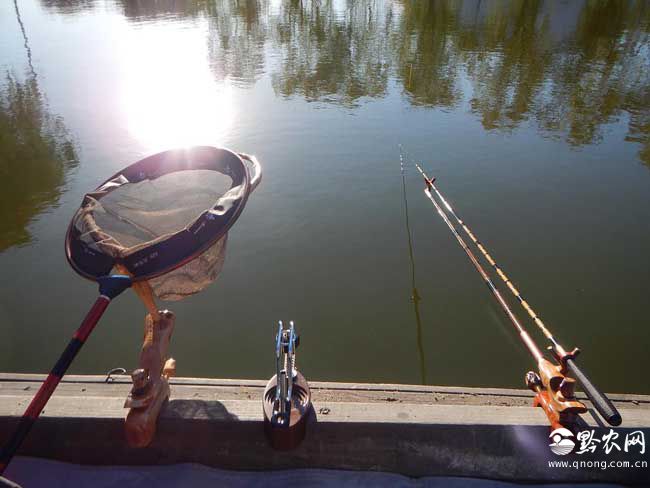
After the "Start of Winter," winter in the true sense arrives, cold air intrudes frequently, and the weather gradually turns cold. Crucian carp all gather in groups and hide in deep-water areas and under obstacles where the water temperature is higher to spend the winter, which creates good preconditions for winter crucian carp fishing. Large crucian carp that are usually hard to catch can often be caught in multiple numbers in a single winter fishing trip. Although winter crucian carp fishing has a certain degree of difficulty, choosing the right fishing spot, using the right bait, and selecting suitable fishing times can also bring a good harvest, with the amount of fish caught no less than in other seasons. For winter crucian carp fishing, as long as you master the following ten points, a good harvest is not difficult to obtain.
In winter crucian carp fishing, choose a sunny side for the spot, but do not give up the shady side
The well-known proverb "fish the sunny side in winter" is usually understood in two basic senses: first, it refers to days in winter when there is sunlight; second, it means that at any time in winter, one should fish the unobstructed sunlit water surface.
However, through practice, the former is beyond reproach, while the latter is somewhat one-sided. That is to say, fishing the sunlit water surface should only be done when there is sunlight, because only then will it seem warmer than the gloomy places, so fish are likely to gather and be easy to catch. But dialectically speaking, even if there is sun, before sunrise, because of the shroud of cold mist and especially because there is no sun, and because of the penetration and disturbance of cold air from the entire atmospheric circulation, the water temperature here is not as good as some shaded places on the bank that are blocked and sheltered, such as bends with high ridges behind hills, dense woods with grass, and places blocked by tall buildings. Precisely for this reason, according to the survival conditions and activity patterns of fish, at this time they will not go to the "disaster zone" of the sunlit water surface to settle in nests and return to lairs, but instead dive into the "natural dwelling" of the gloomy places to rest and hide. Therefore, in winter, when choosing a favorable position for "fishing the sunny side in winter," one should also not give up timely "fishing the shady side"; only then is it more scientific, more practical, and more rewarding.
In winter crucian carp fishing, choose good weather, and do not fish during sudden cold spells
Fish are cold-blooded poikilothermic animals, so once the water temperature conditions of their living environment change due to the influence of air temperature, their entire living habits change accordingly.
It is precisely for this reason that the earlier statement "winter is mainly for crucian carp fishing" does not mean that crucian carp can be caught at any time in this season. For truly relatively good fishing, one still has to choose winter "clear days." Especially if clear good weather appears continuously for about a week, the air temperature will be even more stable, and the water temperature of 12 to 15 degrees in the morning and evening and at noon will also be relatively lasting and constant. As the saying goes, "Fish cloudy days in autumn, fish clear days in winter; five days of sunshine is like fishing in spring." If you really encounter this rare kind of bright sunny weather in winter, that is the best time to fish for crucian carp.
Of course, on cloudy winter days and even on relatively cold snowy days, as long as the constant water temperature in the water area over a considerable period does not fall below 5 degrees, the lowest critical feeding water temperature for crucian carp, they will innately "sleep" but not "die," and will still bite the hook. But if the air suddenly turns cold, causing the water temperature to suddenly drop below 5 degrees, then the fish will feel especially uncomfortable due to this unexpected conditioned reflex and develop a kind of acquired "panic disorder," temporarily stopping feeding. Therefore, many experienced anglers, after the Start of Winter each year, often use the fishing idea "In winter do not think of fishing for grass crucian carp; when it turns suddenly cold, crucian carp stop nibbling too" to arrange their activity times, and when they encounter suddenly cold weather, even if they are idle at home with nothing to do, they are unwilling to go out fishing.
In winter crucian carp fishing, the water level should be appropriate, and one should not fish too deep
"Fish deep in winter" is also a basic common sense in fishing and a habit of many anglers. But if "deep" is simply understood as some people say, "Deep water hides big crucian carp; the deeper the better," then it seems somewhat one-sided and divorced from reality. Because although water temperature follows the natural law that in summer "deep" means "cool" and in winter "deep" means "warm," and this relatively suits the living environment of fish as a scientific principle, the deeper the water, the less dissolved oxygen there is. Therefore, according to relevant ichthyology materials and the experience of veteran anglers, even relatively cold-tolerant crucian carp and carp in winter generally only inhabit the bottom layer at a depth of 4 to 6 m, which best suits their living environment, and it is not that the deeper the better. Especially crucian carp, at noon on a very good clear day, will also swim to some shallower places to forage. Of course, the "shallow" mentioned here is not as shallow as during spring spawning; it should be at least around 2.5 m, which is their hiding place.
In fact, according to the common saying everyone often repeats, "Water level does not matter as deep or shallow; having fish is the key," this also includes one-sided statements like "fish deep in winter." Therefore, when choosing a fishing position in winter, if you do not decide according to conditions and only deliberately fish very deep, it often will not turn out as you wish.
In winter crucian carp fishing, bait should be rich in color and aroma, and one should not use too bland or stale bait
To a certain extent in fishing, "chum" is more important than "hook bait." As the saying goes, "If there are fish in the nest, rely on fishing skill; if there are no fish in the nest, rely on attracting power." Especially in winter, when fish move little and are lazy, the chum should not only emphasize rich aroma but also pay attention to fresh color. Only by using "aroma" and "color" to stimulate the fish's sense of smell and vision can fish be "strongly" attracted to gather into the nest. For example, using commercial bait's red "musk rice," yellow and traditional bait's white medicated rice grains, fermented glutinous rice mixed with (dry) rice, and other such excellent baits to scatter into the nest all have quite good attracting and gathering effects, but one should first feed an appropriate amount and later replenish only a little.
In winter crucian carp fishing, use worm baits as hook bait, and do not use dough-type bait
The feeding habits of freshwater fish generally have a preference for "vegetarian" food in summer and autumn and "meat" food in winter and spring. Hence there is a fishing proverb: "At Start of Summer, dough bait catches grass carp and carp; when winter comes, earthworms are good for catching crucian carp." The reason worm bait, especially earthworms, works better in winter fishing than bloodworms, meat maggots, and mosquito larvae is not only that they contain high protein and have a special aroma, but also that when used whole and alive, they keep stretching, curling, and wriggling on the hook, making them easier for fish to discover and giving them considerable allure.
On the contrary, if you use powdery, troublesome dough-type vegetarian hook bait, besides lacking the special teasing effect of earthworms, the problem is also that if it is too loose and soft, before the fish that move little and are lazy enter the nest and bite the hook, it may already have fallen off and atomized. If it is somewhat harder, although this situation can be avoided, fish very much like to touch and nibble such "dead pills." Therefore, the best first choice for winter hook bait is earthworms, but they must be kept alive and used alive. Also, because winter crucian carp have a small "bite," when hooking them, one should also pay attention to choosing large ones and discarding small ones. Generally, the thickness of a matchstick is most suitable. If the bait body is too fat, it will bulge in the bend of the hook and block the hook gap, affecting the hook point's smooth penetration of the fish's mouth, often producing the phenomenon of a "tug" without hooking a fish.
In winter crucian carp fishing, attracting fish takes a long time, and one should not frequently change nests
In winter, because fish are in a "hibernating" state of moving little and being lazy, after feeding the nest, even if the chum is a high-grade excellent bait with fresh color and rich aroma that can stimulate their smell and vision, it will take at least two hours, or even longer, before fish enter the nest. During this period, if the angler, as in spring and autumn when "fish look for food," expects a reaction from fish within 20 to 30 minutes, that is clearly too impatient. If one then frequently changes nests because of this, it often results in "people leave and fish come; people arrive and fish scatter. The more you change, the more frequent; the more frequent, the more annoying. Now east, now west, busy at both ends. This nest and that nest, not a single fish scale in sight."
In practice, the method for mastering nest-changing time in winter fishing is: for nest A, from scattering chum to trial fishing for about two hours, if there is no reaction in the float at all, then consider nest B, which was also scattered and fed with bait at the same time; if after trial fishing in nest B for 30 to 40 minutes there is still no fish signal, then change to nest C, and so on, trying them one by one. When you find that some nest has fish, even if you only catch one every once in a while, it is best not to "transfer your affections" again. Winter is, after all, winter; changing again will be no more than this, or even worse.
In winter crucian carp fishing, when the water is deep, lift the rod with force, and do not use a light flick
The water depth at winter fishing spots is generally deeper than in spring and autumn. Precisely because of this, once a fish bites the hook, the wrist "flicking force" used to lift the rod should be "heavier" than when fishing shallow water, so that you can be sure to catch the fish. Because when fishing shallow water, the section of fishing line from the hook to the float is shorter, so when lifting the rod and pulling the line, the line's water resistance while cutting through the water layer is very small. Therefore, even if the upward "flicking force" of the rod tip is relatively light, the "upward lifting" piercing force it quickly transmits to the fish hook is still very easy to drive into the fish's mouth.
Conversely, when fishing deep water, because the section of fishing line from the hook to the float is longer, when lifting the rod and pulling the line, the line's water resistance while cutting through the water layer is very large. At this moment, if the angler's wrist "flicking force" when lifting the rod is still as light as when fishing shallow water, then it reduces vibration and buffers the speed and strength of the "upward lifting" piercing force that this section of fishing line transmits to the fish hook, making it very difficult for the fish hook to pierce the fish's mouth. Often there is the hand feel of a "tug," yet it is hard to hook the fish.
In winter crucian carp fishing, float signals are weak, and one should not wait for a big signal
In winter, crucian carp feed and bite the hook more gently and weakly than usual. Therefore, even if the float, hook, bait, and sinker have exactly equal "sinking and floating force," making the rig respond quite sensitively, because their "bite" is really too strange, even the fish signal transmitted from an earthworm hook bait to the float rarely shows obvious "rising" or "dragging down" behavior. Therefore, no matter whether the angler uses a standing float or a star float, attention should be paid to any weak reaction of the float, and the timing of lifting the rod should be accurately grasped. If one wants to wait for it to "rise and fall greatly," then often nine out of ten lifts will be empty.