What are the winter fishing techniques? With video guidance
Winter fishing techniques video guidance
As everyone knows, water has its greatest density at 4 degrees Celsius, so in deep water, even though the surface (or ice surface) temperature may be minus 10 degrees Celsius or lower, the water temperature at the bottom always stays at around 4 degrees Celsius. The optimal temperature for the growth of most fish is 15—25 degrees Celsius; above 30 degrees Celsius or below 4 degrees Celsius they stop eating and moving. Cold-tolerant fish such as crucian carp, common carp, grass carp and black carp still feed as usual at 4 degrees Celsius. In order to survive and to reproduce the following year, as long as there is food to eat, they will not miss the opportunity. Therefore, fish can still be caught in winter. In the north, winter is precisely the great season for "ice fishing." In the south, winter temperatures are low, and the swimming and feeding activity of fish drops to its lowest point, making fishing more difficult. But as long as you have a good grasp of winter fish habits, climate, waters and other characteristics, you can still catch fish, and may even fill your basket. South of the Yangtze River, with its relatively warm climate advantage, winter is still a good opportunity for fishing. If you go fishing, not only can you catch quite a lot, but you can also savor a pleasure that no other season can match.
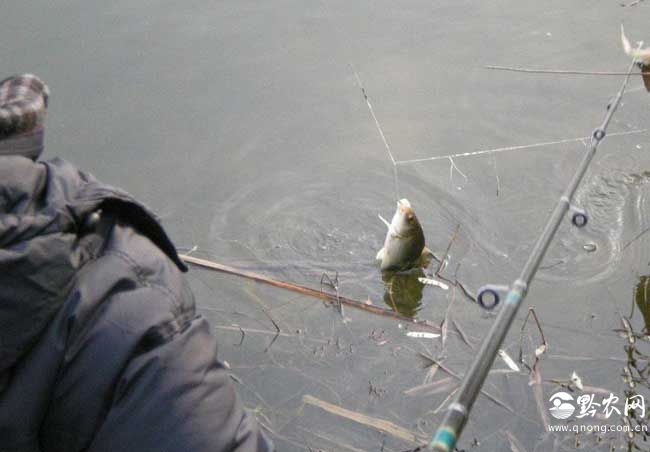
1. Choose good weather: In the south, winter temperatures are not too low; generally the temperature is minus 3—4 degrees Celsius, with a maximum temperature of around 10 degrees Celsius. In Chongqing, temperatures below 4 degrees Celsius are generally rare, and although there is thin ice on the water surface, it quickly melts once the sun shines on it. Choose a windless or breezy, bright sunny day to cast your hook, and do not fish in wind, rain or overcast weather. Fish are highly sensitive to changes in water temperature; at a low temperature of zero degrees Celsius they enter a dormant state, but under sunlight, as the water temperature rises, the fish begin to move, and the higher the water temperature, the greater the fish's activity and enthusiasm.
2. Choose good fishing times: In winter, the time of day when fish bite most actively is from 9 a.m. to 3 p.m., and this is also the best time for fishing. During this period, the air and water temperatures are the highest of the day, and it is the golden window for fish activity and feeding. At other times, because the air and water temperatures are lower, the fish eat and move less. The "angler" need not go out early and return late, avoiding the hardship of staying up late.
3. Choose a good fishing venue: For winter fishing, it is best to fish in small waters; small bodies of water absorb heat quickly, and the water temperature is relatively higher than in large waters. For example, a pond with darker water color is even more ideal: first, there are more fish; second, the water temperature is relatively higher, making it easier to catch fish. The fish density in ponds is relatively high, so choose ponds with plenty of crucian carp and common carp; other fish generally do not feed at low temperatures, but these fish still do. Avoid fishing large waters, especially flowing waters, because their water temperature is too low, the fish are in a dormant, fasting state, and it is very hard to catch fish.
4. Choose a good fishing spot: In winter fishing, find a way to locate the "fish nest." Fish are extremely sensitive to changes in water temperature; for example, in the same pond, fish mostly inhabit and feed on the sunny side, so the fishing spot should be chosen on the side facing south. If there are obstacles to extending your rod on the sunny side, the side-facing-sun position will also do. The winter fishing spot should also be in water that is neither too deep nor too shallow. Although the water temperature is higher in deep water, fish mostly overwinter and "escape the cold" there, so a depth of 1—2 m is suitable. Winter fishing in deep water does not mean the deeper the better; when the water is more than 6 m deep, there is insufficient light and a lack of natural bait, so fish do not inhabit or feed there, and it is therefore very hard to catch fish.
5. Choose good bait: Winter fishing technique: the attractant bait must be fragrant to quickly draw in schools of fish. For winter fishing attractant, "medicated rice" is the finest. It is made by soaking 6 non-toxic Chinese herbs - Lingcao, Paicao, Xiangsong, fennel, talc and rhubarb - in sorghum white liquor. Before fishing, pour a little of the medicated liquor into a small plastic bottle filled with rice, and it becomes "medicated rice." When using "medicated rice" to make nests, you can make several, and at fishing grounds with no one or few people around, you can even make a dozen or so. Spread out your line to sow widely and reap thinly, casting your hook at each in turn. If fish bite at several nests, give up the nests without fish and concentrate on fishing these key nests. If the angler has no "medicated rice" on hand, wheat bran, broken rice soaked in white liquor, corn grits, rapeseed cake, beer lees, food scraps and the like can also be used, mixed with a small amount of edible flavoring or distiller's yeast, or sugar.
6. Choose good hook bait: The bait formula for winter fishing should let meat-based foods play the leading role. For winter fishing, using nematodes and earthworms as hook bait is most effective. These two hook baits have a strong fishy smell, high protein, bright colors, and can wriggle once in the water. When crucian carp and common carp see such a delicious meal, how could they pass it up? In some ponds, where the fish are used to vegetarian bait, you can use red sweet potato, corn cake, flour, beer lees and so on, which are also good vegetarian baits for winter fishing. If you add a little flavoring, distilled liquor or sugar, the effect is even better.
7. Choose a good fishing method: In winter, when the water temperature is low and fish swim and feed slowly, it is best to fish by guarding the nest. After making a nest, it takes about half an hour for fish to swim into the spot. So be patient, sit steady on the fishing platform, and if you wait long enough, fish will surely come to visit. The worst thing is to "skim like a dragonfly," frequently changing positions. After casting the hook, you should also lift and move the hook at any time, turning dead bait into live bait, to tease the fish's appetite and lure them into biting.
8. Tackle configuration: For winter fishing, the hand rod should be long, the fishing line should be fine, the fish hook should be small, the sinker should be small but heavy, and the float should be slender, to improve the sensitivity of response. A rod of 5.4—6.3 m can fish far and reach deep water. Fishing line of imported 0.1—0.15 mm is best, fish hooks of sizes 5—6 are best, and for the sinker, use thick fuse wire hammered flat and thin, cut into small rectangles and wrapped around the fishing line. For the float, it is best to use a fine float or a "seven-star float." For winter fishing for crucian carp in bright open water, the rock fishing rod with a string of hooks should be the first choice. In winter, fish gather and hide in deep water far from the shore, beyond the reach of a hand rod. Making a nest to lure fish works poorly because in winter the fish's range of activity is very small, and in a low-temperature environment the smell of the bait diffuses with great difficulty.
9. Lift the rod at the right time: In winter, fish feed with a very small bite and extremely slight movement, so you must concentrate on watching the float, and lift the rod at the slightest quiver. According to the winter fishing tackle combination described above, after a fish takes the hook, if you use 3 beads of the "seven-star float," then for a crucian carp, generally one or two of the floats in the water slowly rise, which is the great moment to lift the rod; if you use a standing float, then for a crucian carp, generally the float slowly rises or lies flat on the water surface, and you should also lift the rod. After a common carp takes the hook, the float slowly sinks, and at this moment you should lift the rod immediately, and a lively, jumping common carp will be yours.