What harm does the golden apple snail cause? A detailed guide to prevention and control measures
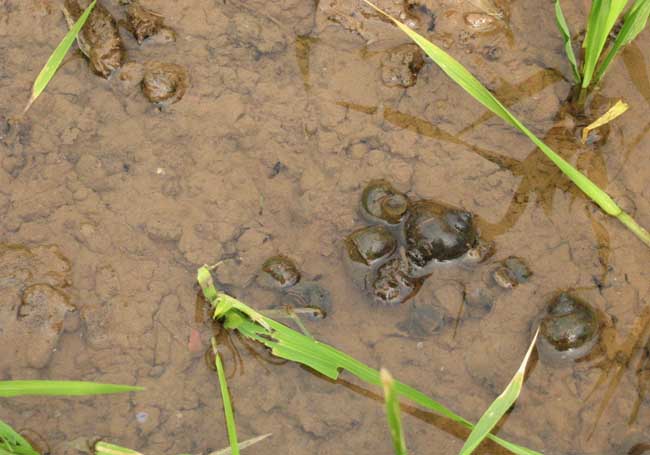
The golden apple snail can bite off the main tillers and effective tillers of rice, causing a reduction in effective panicles and resulting in a yield loss of more than 20%. Besides feeding on aquatic plants such as rice, it also transmits diseases such as Angiostrongylus cantonensis. Humans can become infected after eating raw or incompletely heated golden apple snails, which can cause eosinophilic meningitis and meningoencephalitis in humans, causing symptoms such as headache, dizziness, fever, neck stiffness, and facial nerve paralysis; in severe cases, paralysis, lethargy, coma, and even death may occur.
The golden apple snail was introduced to Taiwan, China in the 1970s, and in 1981 it was introduced to Guangdong by a Chinese person of Brazilian nationality. After 1984, the golden apple snail was widely farmed in Guangdong. Due to overbreeding, combined with its poor taste, it was released into the wild. The golden apple snail has a strong ability to adapt to the environment and reproduces quickly, so it spread rapidly through rivers, lakes, and fields; it has a large appetite and a wide variety of food sources, and can damage the growth of food crops, vegetables, and aquatic crops, and has become a harmful animal in Guangdong, Guangxi, Fujian, Yunnan, Zhejiang, Shanghai, Jiangsu, and other places. In the vast areas south of the Yangtze River, the golden apple snail can overwinter naturally and has two generations per year. In places such as Luzhai County, Guangxi, the density of the golden apple snail in rice fields can reach as high as 16.95 per sq m; the rate of damaged rice plants is generally 7%-15%, with a maximum of 64%. The golden apple snail has omnivorous feeding habits and harms lotus roots; young snails can gnaw on lotus leaves floating on the water surface from the underside of the leaves, causing perforations or notches in the leaves, and in severe cases the leaves are gnawed full of holes and have difficulty rising away from the water surface. The golden apple snail also harms various aquatic plants such as narcissus and orchids, and has become a major scourge in the waters of southern China. In addition, the golden apple snail is also an intermediate host of a zoonotic parasitic disease, and can easily bring health problems to nearby residents. It is estimated that the waters (ponds, lakes, paddy fields, etc.) harmed by it in the provinces and cities of southern China are no less than 100,000 hectares. The prevention and control of the golden apple snail is mainly based on chemical control, supplemented by manual control; raising ducks to eat snails is one method of biological control. There is insufficient understanding of the ecological habits of the golden apple snail, and prevention and control are inadequate. In particular, the selected chemical molluscicides are highly toxic to water bodies and seriously pollute water quality; the application rate is large, the cost is high, and the effect is poor.
Agricultural prevention and control measures for the golden apple snail
1. Eliminate overwintering snail sources: The golden apple snail mainly concentrates in streams, rivers, channels, and low-lying waterlogged spots in ditches to overwinter. Therefore, before spring plowing, clear the ditches at the edges of rice fields, remove silt and weeds, destroy the overwintering sites of the golden apple snail, and reduce the survival rate of overwintering snails and the number of residual snails after winter. At the same time, for ditches and low-lying waterlogged spots, use chemicals for control.
2. Block transmission: In the downstream areas of severely affected regions, install barrier nets at the entrances of irrigation canals or the water inlets of rice fields to prevent the golden apple snail from entering the fields with the water.
3. Manual capture and killing: During the spring peak egg-laying period, combined with field management, remove egg masses at the edges of fields and ditches, take them away from the rice fields to feed ducks, or crush the egg masses. When fields are drained for drying, adult snails mainly concentrate at the water inlet and outlet and in the ditches of seedling fields, so collect snails manually in the morning and afternoon. Manually remove egg masses and collect adult snails in conjunction with farming schedules. By taking advantage of the fact that adult snails mainly concentrate at the water inlet and outlet and in the ditches of seedling fields when fields are drained for drying, manual snail collection can also control the damage.
4. Manual trapping and killing: After the rice field is flooded, insert bamboo strips (wooden sticks, rapeseed straw) 30-100 cm high in the rice field to attract the golden apple snail to concentrate and lay eggs on the bamboo strips (wooden sticks, straw). Remove the egg masses every 2-3 days for destruction. The quantity should preferably be 30-80 bamboo strips (wooden sticks, straw) per mu, with appropriately more inserted near the field edges to make it convenient to remove the egg masses.
Biological prevention and control measures for the golden apple snail
Biological control mainly adopts raising ducks to eat snails. The duck release period is from 7-10 days after rice transplanting to the end of the rice booting stage. Release the duck flock once each in the morning and at around five or six o'clock in the afternoon (15-30 ducks per mu) into the rice fields and canals to peck at young snails, reducing the number of snails and lessening the damage.
Chemical prevention and control measures for the golden apple snail
1. Control thresholds: In rice seedling fields, 1-2 snails per sq m, with 1 egg mass per sq m at the field edge; at the tillering stage, 3-4 snails per sq m, with 1-2 egg masses per sq m.
2. Control agents: 10% Woju granules, 6% Mita molluscicide granules, 50% niclosamide ethanolamine salt wettable powder, 70% niclosamide wettable powder, 45% triphenyltin acetate wettable powder, etc.
3. Application timing: Apply twice: 1) apply at the 2-leaf 1-heart stage of rice in seedling fields. 2) apply at transplanting. If the snail damage is severe, apply 1 more time after 10 days.
4. Application methods: 1) The dosage of 10% Woju granules is about 400-500 grams per mu, evenly broadcast in the field or mixed with 5-10 kg of fine soil and broadcast. 2) The dosage of 6% Mita molluscicide granules is about 400-550 grams per mu, evenly broadcast in the field or mixed with 5-10 kg of fine soil and broadcast. 3) Use 60 grams of 70% niclosamide ethanolamine salt wettable powder per mu, mix with 20 kg of water, and spray.
5. Precautions: 1) When applying, keep the field water layer at 1-3 cm and retain the water for 7 days. 2) If heavy rain falls within 24 hours after application, 1 supplementary application is needed. 3) Molluscicides are toxic to fish; within 7 days after application, do not discharge the field water into fish ponds, and do not release ducks.