Detailed information and basic facts about the humpback whale
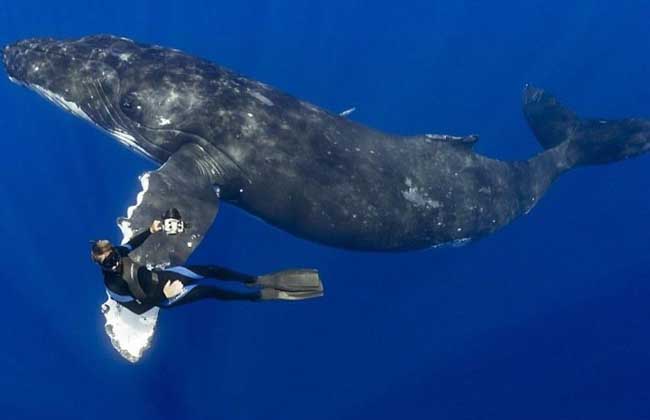
The humpback whale is a type of whale, also known as the big-winged whale, humpback whale, giant-arm whale, saw-arm whale, etc. It is a marine mammal of the genus Megaptera in the family Balaenopteridae, famous for its breaching posture, extremely long front flippers and complex calls, and inhabits all major oceans of the world. In China it is distributed in the Yellow Sea, East China Sea and South China Sea, being relatively rare in the northern Yellow Sea and more common in the southern waters off Taiwan, China. Let's take a look below at what information there is about the humpback whale!
Physical characteristics of the humpback whale
Although the humpback whale is not the largest whale in the world, it is still a veritable giant of the ocean, with a bulky and stout body. The average body length of an adult humpback whale is 12.9 m for males and 13.7 m for females, with a maximum recorded length of 18 m for females, and a weight of 25 to 30 tons. The head is relatively small, flat and broad, with a wide snout and a large mouth. Around the mouth there are 20 to 30 tumor-like protrusions, and interestingly each protrusion has a hair growing on it, while the rest of the body has no hair at all. The baleen is short and wide, with more than 200 plates on each side. The dorsal fin is relatively low, short and small, and the back is not as straight as that of other whales, but arches upward, forming a graceful curve, hence the name "humpback whale," also called "arched-back whale" or "hunchback whale."
Feeding habits of the humpback whale
The humpback whale mainly feeds on krill, a small crustacean less than 1 cm in body length, and also on scale fish, capelin, sand lance and other small fish. When the mouth opens, its special elastic ligaments allow the lower jaw to temporarily dislocate, forming an angle of more than 90 degrees, and the transverse diameter of the mouth can reach 4.5 m, allowing it to swallow a large amount of krill or smaller fish in one gulp, but the diameter of its esophagus appears too small to swallow larger food, which may be one of the reasons it can only eat small animals. During the overwintering period, in order to maintain the energy needed by its body, it must eat a large amount of food in summer, often feeding continuously for 18 hours. Because of abundant sunlight, plankton multiply in great numbers in the bays of the northern glacier zones, nurturing the krill that feed on zooplankton, which are enormous in number and often gather in groups of millions, thus providing an extremely rich food source for the humpback whale.
Social habits of the humpback whale
The humpback whale is a social animal with a very gentle and amiable temperament. Adults often express affection by touching each other, but when fighting enemies they use their exceptionally long flippers or powerful tails to strike the opponent violently, and even butt with their heads, often resulting in torn skin and bleeding. Its swimming speed is very slow, about 8 to 15 km per hour. When swimming slowly at the sea surface, it is like an iceberg, with most of its body sunk underwater, and sometimes like a freely floating small island. People on the coast can also see its body emerging from the sea. Its swimming and frolicking skills are very superb. Sometimes it first swims quickly underwater for a distance, then suddenly breaks out of the water, slowly rising vertically, until the flippers reach the water surface, when the body begins to bend slowly backward, like an acrobat's backward somersault.
Reproductive habits of the humpback whale
The humpback whale is monogamous. The female gives birth once every 2 years, with a gestation period of about 10 months, and gives birth to 1 calf per pregnancy. When the female is with her calf, another male often follows closely behind, whose task is to intercept other invading whales or small boats, though it is powerless when encountering the ferocious and cunning killer whale. Like other mammals, the female feeds the calf with milk, which is automatically squeezed out from the nipples, and the calf suckles in the water. The calf develops very quickly and can gain 40 to 50 kg in body weight per day. Even more impressive is that during lactation the female provides all the nutrition for the calf's growth while she herself goes without eating for a long time, only beginning to look for food after several months. The female and calf are often affectionate with each other, with the calf touching the female with both flippers, sometimes seeming to cling to her body. The lifespan of the humpback whale is 60 to 70 years.
Geographical distribution of the humpback whale
The humpback whale is found in all major oceans, distributed across the vast sea surface from the Antarctic ice edge to 65 degrees north latitude. It has migratory characteristics, living in cool high-latitude waters in summer, but mating and reproducing in tropical or subtropical waters, usually migrating as far as 25,000 km each year, making them one of the best travelers among mammals. However, the humpback whales living in the Arabian Sea are an exception, as they live in those tropical waters all year round. They have not been found in the eastern Mediterranean, the Baltic Sea or Arctic waters. In China they are distributed in the Yellow Sea, East China Sea and South China Sea.