How much does one Osmanthus fragrans 'Semperflorens' plant cost? Market price reference
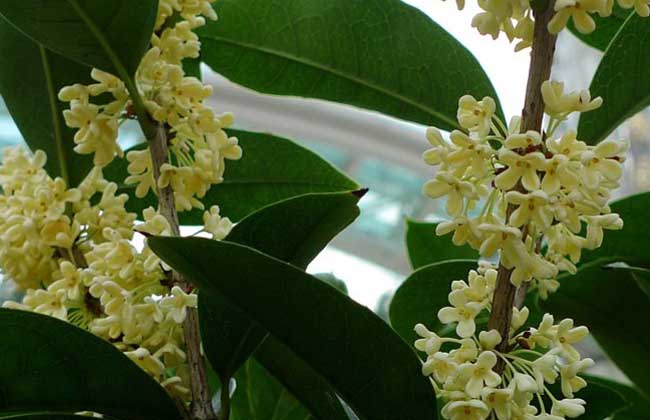
Osmanthus fragrans 'Semperflorens' is an excellent variety of osmanthus. Unlike other osmanthus varieties, it blooms in all four seasons. The flowers are pale yellow when they first open and later turn white, and when in full bloom they give off a fresh, sweet fragrance. Each inflorescence consists of 12 to 20 small flowers, and the flowering period lasts 5 to 7 days. The plant is short and compact, with large, evergreen leaves, making it relatively well suited to home cultivation. Now let us take a look at how much one Osmanthus fragrans 'Semperflorens' plant costs.
How much does one Osmanthus fragrans 'Semperflorens' plant cost?
Variety Ground diameter (cm) Trunk diameter (cm) Height (m) Crown width (m) Price (yuan) Osmanthus fragrans 'Semperflorens' 5 3 2 1.5 20 Osmanthus fragrans 'Semperflorens' 7 5 4 3 50 Osmanthus fragrans 'Semperflorens' 8 8 5 4 100 Osmanthus fragrans 'Semperflorens' 11 12 7 8 400 Osmanthus fragrans 'Semperflorens' 12 12 8 8 600 Osmanthus fragrans 'Semperflorens' 20 15 10 11 4000Note: Osmanthus fragrans 'Semperflorens' blooms in all four seasons, but its fragrance is the faintest among the many osmanthus varieties, so faint that the floral scent can hardly be detected. It has a certain resistance to harmful gases such as hydrogen fluoride and sulfur dioxide, and can reduce the degree of environmental pollution. Whether planted in public places or in home courtyards, it delivers the beneficial effects of greening, beautification, fragrance and purification, which is why flower and garden experts all advocate its wider cultivation.
The cultivation value of Osmanthus fragrans 'Semperflorens'
1. Industrial value: The leaves and fruit of Osmanthus fragrans 'Semperflorens' contain aromatic oil. The leaves contain 0.3 to 0.5% oil, and the fruit contains about 1% oil. The main components are linalool, eugenol, geraniol and cineole, which are used in food and soap fragrances. The leaves can be used as a seasoning spice or as a flavoring agent for canned foods. The seeds contain about 30% vegetable oil, and the oil is used for industrial purposes. In addition, osmanthus wood is hard, glossy and beautifully grained, making it an excellent material for carving.
2. Ornamental value: Osmanthus fragrans 'Semperflorens' blooms in all four seasons and is fragrant in all four seasons. It can be cultivated on balconies or in courtyards, and is often planted in gardens, along both sides of roads, on lawns and in courtyards. It is the best greening tree species for government offices, schools, the military, enterprises and institutions, streets and homes. Paired with mountains, rocks, pavilions, terraces, buildings and towers, it appears even more dignified and elegant, pleasing to the eye and delightful to the mood. At the same time, it is also an excellent material for potted plants. Once made into a bonsai, it offers the shape to admire, the flowers to view and the fragrance to enjoy, truly "three benefits in one."
3. Purifying the environment: Osmanthus fragrans 'Semperflorens' has a certain resistance to harmful gases such as hydrogen fluoride and sulfur dioxide, and can reduce the degree of environmental pollution. Whether planted in public places or in home courtyards, it delivers the beneficial effects of greening, beautification, fragrance and purification, which is why flower and garden experts all advocate its wider cultivation.
Propagation methods for Osmanthus fragrans 'Semperflorens'
1. Grafting propagation: The rootstock for grafting Osmanthus fragrans 'Semperflorens' can be privet, small-leaf privet, ash or fringetree. For mass propagation, small-leaf privet is mostly used. Before bud break in spring, cut off the rootstock 5 cm above the ground. Cut a vigorous 1- to 2-year-old osmanthus branch 10 to 12 cm long, and cut both sides of the base into a 45-degree slant. Make a vertical cut about one third of the way along one side of the rootstock, 2 to 3 cm deep. Insert the scion into the cut, align the cambium layers, tie it tightly with a plastic bag, and bury it in soil for cultivation.
2. Cutting propagation: For cutting propagation of Osmanthus fragrans 'Semperflorens', before bud break in spring select a fully developed 1-year-old branch and cut it into 5 to 10 cm lengths. Remove the lower leaves, keep 2 to 3 leaves at the top, and insert into a river sand or loess seedbed at a spacing of 3×20 cm. After inserting, water promptly and shade, maintaining a temperature of 20°C to 25°C and a relative humidity of 85% to 90%. Roots can form in 2 months.
3. Layering propagation: Layering propagation of Osmanthus fragrans 'Semperflorens' is divided into two types, ground layering and air layering. For ground layering, choose a low-branching or clumping osmanthus mother plant. From spring to early summer, use a sharp knife to cut or girdle a bendable 1- to 2-year-old branch on the lower part, cutting down to the xylem, then press it into a 3 to 5 cm deep trench and secure it with a wooden stick. For air layering, in spring select a 1- to 2-year-old branch from the mother tree, girdle it, then wrap the wound with a culture medium and tie a plastic bag tightly around it. During the cultivation process, always keep the medium moist. After roots develop in autumn, cut it away from the mother plant.