How much does a Chinese yew cost now?
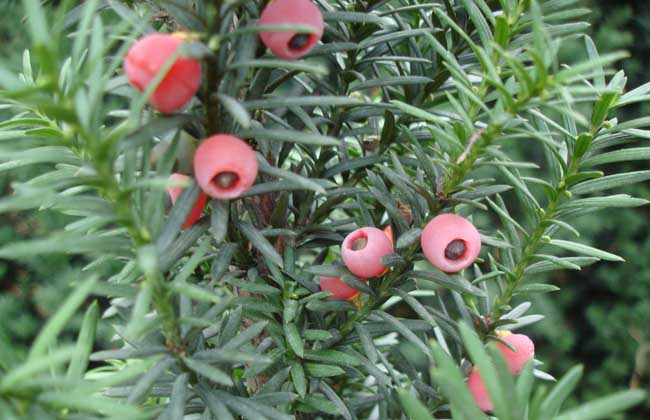
The Chinese yew (Taxus wallichiana var. mairei) is a national first-class key protected wild plant, also known as red bean yew, beautiful yew, etc. It is an evergreen tree of the genus Taxus in the family Taxaceae, distributed in the provinces and regions south of the Yangtze River basin as well as Henan and Shaanxi. Although its distribution area in Guizhou Province is relatively wide, its population is scarce, and if not protected it risks becoming vulnerable. Let us take a look below at how much a Chinese yew costs!
How much do Chinese yew saplings cost?
Specification (height) Price (yuan/plant) Specification (height) Price (yuan/plant) Specification (height) Price (yuan/plant) 20 cm 2 yuan 40 cm 6 yuan 50 cm 7 yuan 80 cm 10 yuan 1 m 15 yuan 1.2 m 18 yuanNote: The Chinese yew is mainly produced south of the Yangtze River basin in China. In Guiyang it is mainly distributed in Huaxi, Wudang, Kaiyang, Xifeng and other places; in Anhui Province it is mainly distributed in Shimen Township, She County, Huangshan City and the Huangshan District area; and it is also widely distributed in the Baishanzu National Nature Reserve in Zhejiang Province, with the largest concentration in the area from Sandui Village, Qingyuan Scenic Village to Jingning.
Propagation methods of the Chinese yew
1. Sowing: The Chinese yew is generally sown in early spring. After the seeds have been stored for 1 year, when 30% of the seeds have cracked and shown white, promptly sieve out the seeds, place them in a 0.2% potassium permanganate solution to disinfect for 10 minutes, then rinse them clean with water. After drying off the surface water, sow them evenly in the furrows. After sowing, dig up yellow soil from under a pine forest that contains mycorrhizae and has been sieved, and cover the seeds with it, to a thickness such that the seeds are no longer visible. During the seedling stage, pay attention to shading, and build a shade shed during the seedling period. The seed germination rate is above 70%.
2. Cuttings: During the tree's dormant-to-budding period, choose a mixed substrate of sand, sawdust and perlite as the cutting soil. Select 1- to 4-year-old lignified seedling branches, cut the cuttings into small sections 10 cm, 15 cm or 30 cm long. When cutting, the cuts must be smooth, with the lower cut in a horse-ear shape, and remove the leaves below 2/3. Choose agents such as ATP, ABT, NAA, IBAA, etc. to treat the cuttings, then insert them and cover with film. The cutting survival rate is generally above 85%.
Cultivation techniques of the Chinese yew
1. Site selection: For cultivating the Chinese yew, it is best to choose loose, humus-rich, neutral or slightly acidic alpine tablelands, and deep, moist brown earth or dark brown earth on both banks of gullies and streams. Deeply plow and level, then open holes at a spacing of 0.4×1.0 m or 0.4×0.4 m, with a hole depth of 40 cm, ready for planting.
2. Land preparation: Generally, adapting to local conditions, raising seedlings under a pine forest and then transplanting is better. Choose a stand of slash pine or masson pine with a canopy density of 0.6-0.7 and no pests or diseases as the nursery site, requiring a gentle slope, deep upper soil layer and good drainage. In August to September, clear the weeds and shrubs in the forest, arrange into level terraces, dig deep 20-30 cm, and in November shallow-plow and harrow finely.
3. Fertilizing: When preparing the land for cultivating the Chinese yew, apply 40-60 loads of decomposed base fertilizer per mu (1 mu = 1/15 hectare), divide into beds, with a bed height of 15-20 cm and a width of 1.2 m. After leveling the bed surface, use a 15 cm wide wooden board to press out sowing furrows 2 cm deep, with a furrow spacing of 20 cm.
4. Transplanting: Generally, seedlings raised from seed take 1-2 years, and those propagated by cuttings take about 1 year. When the seedlings grow to 30-50 cm tall, they can be transplanted. Transplanting is carried out in October to November or February to March before budding, planting 1 seedling per hole, watering, and providing appropriate shading.
5. Management: After the seeds germinate, frequently pull out weeds, and apply topdressing 1-2 times per year. In the rainy season, prevent waterlogging to avoid root rot. After establishment, cultivate and weed 2 times per year. After the forest land is closed, generally only winter cultivation and weeding are carried out, with earthing up 5 times. Combine topdressing with cultivation and weeding, mainly using farmyard manure as the fertilizer source. During the young tree stage, prune off sprouts and tillers to ensure the trunk is straight and grows quickly.