Rambutan is rich in nutrients and is suitable for eating fresh or for making canned goods, candied fruit, jam, jelly and wine.
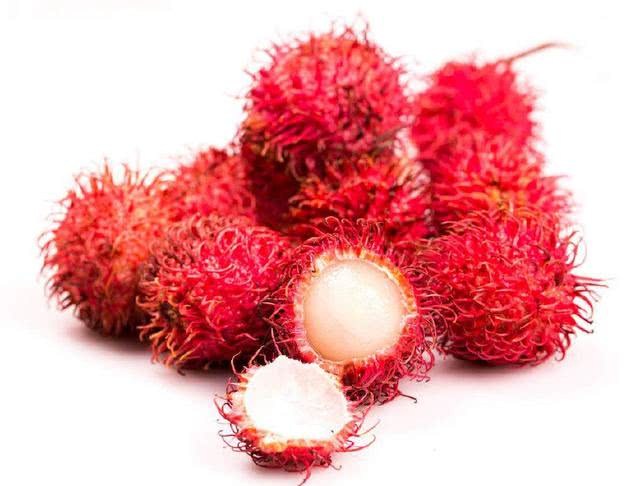
Rambutan
Rambutan (scientific name: Nephelium lappaceum L.), also known as hairy lychee, shaozi, red-haired fruit, red-haired gall; it is a large tropical fruit tree of the Sapindaceae family native to Southeast Asia, called "rambutan" in Malay, meaning "hairy thing".
Ripe rambutan fruits are not all red; there are also yellow fruits.
Some rambutans have seeds about the size of a sesame seed. Rambutan tastes similar to lychee.
Rambutan is planted on a relatively small area in China; at present, only Baoting and Sanya on Hainan Island grow rambutan on a relatively large scale in all of China.
Rambutan is one of the three species of the genus Nephelium produced in China; the other two are Nephelium chryseum and Nephelium hainanense.
Morphological characteristics
Evergreen tree, more than 10 m tall; branchlets cylindrical, wrinkled, grayish brown, only the tender parts covered with rusty fine pubescence.
Leaves 15-45 cm long including the petiole, the rachis somewhat stout, wrinkled when dry;
Leaflets in 2 or 3 pairs, rarely 1 or 4 pairs, thinly leathery, elliptical or obovate, 6-18 cm long, 4-7.5 cm wide, apex blunt or slightly rounded, sometimes nearly short-acuminate, base cuneate, margin entire, glabrous on both surfaces;
Lateral veins 7-9 pairs, brownish red when dry, raised only on the underside, reticulate veinlets somewhat honeycomb-like, visible on both surfaces when dry; petiolules about 5 mm long.
Inflorescences often much branched, nearly as long as the leaves or longer, covered with rusty short tomentum; pedicels short;
Calyx leathery, about 2 mm long, lobes ovate, tomentose; petals absent; stamens about 3 mm long.
Fruit broadly elliptical, red-yellow, about 5 cm long including the spines, about 4.5 cm wide, spines about 1 cm long. Flowering in early summer, fruiting in early autumn.
Growth habits
It likes high temperature and high humidity, no wind damage, and low-altitude mountain environments. An annual average temperature above 24°C and a temperature in the coldest month higher than 17°C are suitable for the growth and development of rambutan. Rambutan seedlings are not drought-tolerant and require appropriately increased water management. The fruit development period has the greatest water requirement. Therefore, the annual rainfall in the cultivation area is required to be above 1800 mm.
The soil should preferably be deep, rich in organic matter, fertile and loose, with good drainage and aeration. The soil pH is between 4.5 and 6.5. Alluvial soil is best; alluvial soil refers to soil developed on river alluvium, generally with a relatively short soil-forming time, indistinct development horizons, and relatively high soil fertility. Mature trees grow slowly, producing new shoots 3-4 times a year. They flower from February to April each year, and June to August is the fruit ripening and picking season. They like to grow in tropical regions.
Geographical distribution
Native to the Malay Peninsula. Southeast Asian countries such as Thailand, Sri Lanka, Malaysia, Indonesia, Singapore and the Philippines produce it, and it is also cultivated in Hawaii in the United States and in Australia. Thai rambutan is known as the "king of fruits". It is planted in Taiwan, China and Hainan, China, and wild rambutan occurs in Xishuangbanna, Yunnan.
Main varieties
Rambutan has two types, red-fruited and yellow-fruited. Through selection and breeding, six varieties have been developed: Baoyan No. 1, No. 2, No. 3, No. 4, No. 5 and No. 7. Among them, Baoyan No. 2 is yellow and elliptical, while the fruits of Baoyan No. 1, No. 3 and No. 4 are all red and elliptical; Baoyan No. 5 and No. 7 are red and round. Baoyan No. 7 has the best yielding ability. Baoyan No. 7 can bear fruit twice a year. It is high-yielding and stable-yielding, with strong cold resistance and drought resistance.
Cultivation techniques
Propagation techniques
Rambutan can be propagated by seedlings or by vegetative propagation. Although seedling propagation is a means of seed selection, it bears late, yields vary greatly, and quality varies greatly. At the same time, seedling rambutan trees are also dioecious fruit trees, with the proportion of male plants reaching 34.2%, so it is not conducive to the regionalization of improved fruit tree varieties. In production, vegetative propagation methods are generally used, including grafting and air layering.
Sowing in sand beds to promote germination:
The cultivation of rootstock seedlings is divided into two stages: germination promotion and seedbed cultivation. First promote germination, then transplant to the seedbed; growth is fast and uniform, and this method is commonly used in production. Germination promotion is best done in early June, using seeds of the high-yielding Baoyan No. 5.
Seed selection: at this time rambutan has harvested the first batch of red ripe fruits; the seeds left after eating the flesh are used for sowing. The first batch of fruits has good quality and the most complete nutrition, so the seed quality is high. The seeds must also be screened to remove the plumpless ones and the spotted ones, because they cannot germinate, or their germination rate is low.
Washing the seeds: after seed selection, the seeds must be washed, that is, manually rubbed clean in clean water to remove the sugar on the seeds. Any flesh remaining on the seeds must be rubbed off, because the remaining flesh and sugar easily attract ants or other underground pests, drawing them to gnaw the seeds and young sprouts. Wash until clean. Generally the water should be changed and the seeds rubbed 2-3 times.
Making the sand bed: the sand bed is built on the land in front of or behind the house, preferably in a shaded place. Coarse river sand should be used, because river sand is good for sprouting. The size of the sand bed depends on the amount of seeds to be germinated. The direction of the seedbed is determined according to the terrain, preferably in a way that facilitates drainage. Where the groundwater level is high, high ridges should be made to avoid seed rot. A sand bed 15-20 cm high is enough, because the seed roots are relatively long. A width of 1.2 m is enough, as this makes management convenient. Once the sand bed is leveled, the seeds can be sown.
Germination promotion: seed germination can be carried out on both sunny and rainy days. Place the seeds on the sand bed with the eye facing down, then press and firm them. This facilitates sprouting, and sprouting is also fast. Do not overlap them; leave a small interval between seeds; sow neatly, and sprouting will also be neat. After sowing, spread a 2 cm thick layer of surface sand on top to retain moisture and increase temperature. Cover the surface sand with a shade net to avoid strong light, which can retain moisture and is favorable for seed germination. Water once through the shade net; this watering should soak the sand bed thoroughly. When the moisture has dried somewhat, spray the sand bed once with an 800-1000 times diluted solution of 80.0% trichlorfon soluble powder, which can kill ants or other underground pests and can also prevent them from gnawing and damaging the seeds.
Sand bed management: the germination promotion period is roughly 15-20 days. During this period, the sand bed must be kept moist frequently; too dry or too wet is unfavorable for germination. On sunny days, water 1-2 times a day, once in the morning and once in the evening. Keep it moist. In rainy weather, pay attention to drainage to avoid seed rot. About 5 days after sowing for germination promotion, the embryo begins to sprout. After 10 days, some small weeds will appear on the sand bed and need to be pulled out by hand. When the sprouts grow to 5-10 cm, before the first pair of heart leaves opens, promptly prepare the nursery bed and prepare to move the sprouts.
Field management
Water and fertilizer management:
Rambutan rootstock seedlings are transplanted into nutrient bags in early to mid-July, and can be grafted when they grow to February-April of the following year; during this period they need to be cultivated in the nursery for half a year.
There are several points to note in management:
In the first month after transplanting the young sprouts, water once a day at a fixed time, to the extent of keeping them moist; water as soon as the soil surface is dry.
In the second month, the young seedlings put out their first flush of new leaves; weed the nutrient bags and loosen the soil between the rows. When weeding, prevent damage to the roots. As for fertilizer, apply a light water-soluble fertilizer once a month.
Add potassium sulfate compound fertilizer with a nitrogen-phosphorus-potassium ratio of 15:15:15.
Dilute it into a 10-fold water solution and pour it over the seedlings. This compound fertilizer has a balanced ratio of the three nutrients, which is favorable for balanced absorption by rambutan.
A fertilizer amount of 5-7 kg per mu of nursery land is enough.
When the leaves are seen growing vigorously, starting at the end of the second month, apply urea once a month by spot application, applying 4-6 granules per nutrient bag.
Calculated this way, about 5 kg of urea is needed per mu of nursery land.
From the third month to the fifth month, the rootstock seedlings grow to 50-70 cm tall. Weeds between the rows also grow quickly, so pay attention to weeding.
Increase the amount of potassium sulfate compound fertilizer water-soluble fertilizer to 15-20 kg per mu of seedling land.
Pest and disease control
During the seedling stage of rambutan, tussock moths mainly harm the leaves. If the number of insects is small, manual killing is best. If the damaged area is relatively large, you can choose 800-1500 times diluted 38% emamectin benzoate·phoxim emulsifiable concentrate as an insecticide; one spray can be effective. Emamectin benzoate·phoxim emulsifiable concentrate has strong penetrating and contact-killing ability; after spraying, it quickly causes extreme excitement and paralysis in the pests, leading to rapid blocking of the pests' nerves and death, killing the pests thoroughly. In the south there is a lot of rain, so choosing an emulsifiable concentrate resists rain washing. One week after spraying, it enters the safe period, and contact by people and livestock is unaffected.
Common diseases of Hainan rambutan include powdery mildew, algal leaf spot and downy mildew, as well as pests such as the black-tailed prominent moth and the brown-edged green slug moth.
Eating guide
Selection and storage
The rambutan, which looks like a small red hedgehog, has its fruit ripening and picking season from June to August each year.
Its name in Malay is rambutan, which literally translated into Chinese means "fruit tied with hair". Because rambutan is distributed only in a few places in Hainan in China and mainly depends on imports from Southeast Asia, the storage and transport cycle is relatively long, and its own freshness-keeping ability is relatively poor.
Selection tips
The rambutan fruit is spherical or ovate, with a carapace-like pattern on the rind surface and a groove, containing seeds inside; the ripe fruit is bright red or slightly yellowish. When selecting rambutan, as with lychee, look at whether its appearance is attractive and whether the skin color is bright red; fruit that looks fresh naturally has good quality and taste. Fruit whose surface soft hairs are red with a touch of green has the best quality. When selecting, choose those with soft, slender, fresh spines, no black spots on the outer surface of the fruit, large and well-proportioned fruit, and thin skin with thick flesh; these are the best.
Storage
Rambutan should be eaten immediately after purchase and is not suitable for long storage; at room temperature it changes color and develops spots after 3 days. If there is too much surplus, it can be sealed in a plastic bag and refrigerated in the fridge, where it can be kept fresh for about 10 days. Because the rambutan fruit is covered with soft spines, it easily traps dirt, so it must be carefully cleaned, wiped dry with a paper towel or air-dried, and then peeled to eat, so as not to contaminate the flesh.
Eating methods
Rambutan can usually be eaten fresh, and in Western cooking rambutan and lychee can be substituted for each other. Rambutan can be made into fruit salad, can be eaten with ice cream, and can also be cooked with various vegetables and meats.
How to eat Hainan rambutan: rambutan is like a hairy lychee. The way to eat it is also very similar to lychee, and the flesh is also very similar. To eat rambutan, use your teeth to slowly and gently bite layer by layer; if you are impatient and use force, the seed will scatter and the membrane will break, and the membrane and flesh will stick together.
1. Fresh rambutan is bright red with a slight green tinge, and the hairs on the shell are soft and tough, while fruit that has been kept a long time has a blackened, darkened shell, and if you touch the hairs on the shell with your hand they feel relatively hard;
2. The shell of rambutan is thicker than that of lychee; peeling it with your fingernails will hurt your fingers and is also unsanitary. The correct method is to hold it with both hands, top and bottom, and twist it open like opening a bottle cap;
3. Although the flesh of rambutan is relatively close to that of lychee, its nutritional value and taste are far inferior to lychee, and likewise it should not be eaten too much at one time; after buying it, eat it as soon as possible to avoid attracting mosquitoes and insects;
5. Rambutan must be stored in a cold storage room or refrigerator, preferably between 0°-5°.
Rambutan shrimp balls
Ingredients: 10 large shrimp, 1 can of canned rambutan, 1 small teaspoon of pepper salt, 1 egg, 1 tablespoon of cornstarch, 200 g mayonnaise, a little white sesame
Method:
1. Remove the intestinal mud from the shrimp and wash them, wipe dry the water, make a cut along the back, add pepper salt, egg and cornstarch and marinate for 10 minutes.
2. Heat oil in a pan, put the shrimp into the pan and fry until cooked, until they change color and form shrimp balls.
3. Arrange the fried shrimp balls and rambutan on a plate, drizzle with mayonnaise and sprinkle with white sesame.
Dietary contraindications
1. Gastritis, peptic ulcer
2. Yang-deficient constitution
3. The rambutan seed has a hard and brittle protective membrane on it, tightly connected to the flesh. This membrane cannot be digested by the human stomach and intestines; once eaten it will scratch the inner wall of the stomach and intestines, so this membrane must be removed cleanly when eating.
Main value
Ornamental value
Rambutan is beautiful in appearance, and the fruit tree can also serve as an ornamental garden tree.
Economic value
Rambutan is a tropical fruit tree with great economic value and enjoys a relatively high reputation on the market, with a high selling price. It has a certain adaptability when planted in Hainan, and the southern and southeastern regions are suitable for planting rambutan, with high yield and excellent quality; it is a tropical fruit tree with great development prospects.
It flowers from February to April each year, and June to August is the fruit ripening and picking season; a 20-year-old tree can produce 100-125 kg of fruit. The fruit shell contains rich pigments and is a good dye; with different mordanting methods it can be dyed yellow, army green or coffee color.
Rambutan fruit is rich in nutrients and is used for fresh eating and for processing into canned goods; in addition, it can also be made into candied fruit, jam, jelly and wine.
Medicinal value
Wash the rambutan fruit shell and boil it in water to drink as tea, which can improve oral ulcers and diarrhea. Wash the roots of the rambutan plant and boil them in water to drink as a daily beverage, which can reduce internal heat and relieve fever; boil its bark in water and drink it as tea, which has a significant effect on inflammation of the tongue.
Other effects:
Enhance human immunity
Long-term consumption can clear heat and detoxify, and enhance human immunity.
Nourish hair and beautify skin
It has the effects of nourishing and strengthening, enriching blood and regulating qi, and beautifying hair and skin.
Improve dizziness
Rambutan also has a high iron content, which helps improve dizziness, low blood pressure and the like.
Nutritional value
The flesh of rambutan contains glucose and sucrose, and is rich in vitamins, amino acids, carbohydrates and various minerals.
Its nature and flavor are sweet and warm; the flesh is fragrant/sweet, thick and juicy, and some people call it the lychee of Lingnan in China, and it has the alias hairy lychee.
Rambutan flesh is yellow-white, translucent, juicy, crisp and refreshing, with a clean sweet taste or a pleasant sweet-and-sour taste, sometimes aromatic.
The flesh accounts for 31-60.2%, total solids 14-22.2%, sugar 3.61-6.25%, citric acid 0.39-1.53%, and vitamin C 0.63-5.5 per 100 g of flesh.
Superior varieties of rambutan have large fruit, thin skin, small seeds and thick flesh, with the flesh separating from the seed, and the flesh is crisp, fragrant and delicious.