How much does aquatic plant agate cost? A detailed analysis of the market
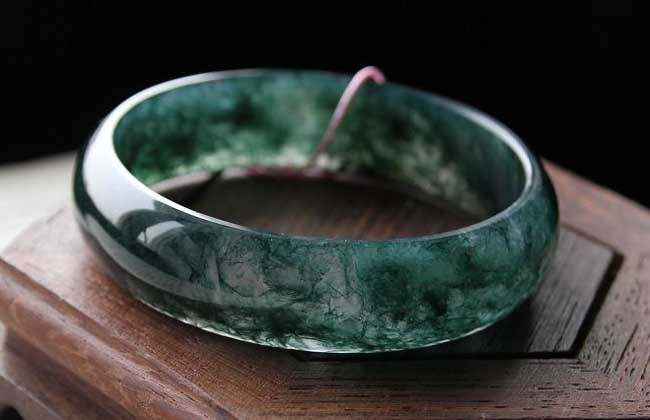
Aquatic plant agate is a type of agate, also known as tiansi agate, feather agate, moss agate, weed agate, etc. Its naturally formed patterns are like aquatic plants drifting in a river pond, graceful and winding. It is not just an ornament; top-grade aquatic plant agate is even a collectible with artistic value. Large pieces of aquatic plant agate are very rare and highly valuable. Let's take a look below at how much aquatic plant agate costs!
How much does aquatic plant agate cost?
The biggest factor in the price of aquatic plant agate is whether the aquatic plant inclusions are clear and complete and how many there are. In addition, the transparency of the crystal is also a basis for judging value. When the beauty of the pattern is about the same, bracelets cost more than pendants, and pendants cost more than bead strands. Ordinary aquatic plant agate bracelets have cloudy, shapeless plant patterns and many cotton-like impurities in the crystal, and the price is usually within 200 yuan. High-grade aquatic plant agate bracelets have dense, clear aquatic plants and fewer cotton-like inclusions, making them relatively transparent, with prices above 3,000 yuan. Collectible-grade aquatic plant agate bracelets have very vivid aquatic plants, an oily and moist material, and a good feel, making them suitable for long-term wear, with prices above 15,000 yuan.
The distribution of aquatic plant agate origins
The origins of aquatic plant agate are relatively widespread. Around the world, the main origins include Brazil, Uruguay, and Mexico, and Idar-Oberstein in Germany is also a fairly famous origin. China's reserves of aquatic plant agate are still relatively small. Laohetu Township in Fumeng County can be regarded as the main origin of aquatic plant agate in China, accounting for the largest proportion of China's total aquatic plant agate reserves, and the quality is excellent, with high material integrity and good surface transparency, greatly surpassing foreign-produced material of the same type in quality.
Methods for identifying aquatic plant agate
1. Luster: Real aquatic plant agate has a bright and vivid luster, while fake aquatic plant agate has a poorer luster because its hardness and density are insufficient.
2. Color: Natural aquatic plant agate has clearly defined colors, and its banded patterns are very obvious, while most imitation fake aquatic plant agate is brightly colored, with a feeling of uniform, floating color.
3. Texture: Fake aquatic plant agate is mostly made of glass imitations and is softer than real aquatic plant agate. Hard objects can leave scratches on fake aquatic plant agate, while genuine pieces cannot be scratched. On the surface, real aquatic plant agate has few flaws, while imitations have slight bubbles.
4. Transparency: Compared with glass-imitation fake aquatic plant agate, real aquatic plant agate is slightly less transparent, but compared with fake aquatic plant agate synthesized from other ingredients, it is more transparent and has more vitality.
5. Weight: Because of different densities, real aquatic plant agate ornaments are slightly heavier than artificially synthesized aquatic plant agate ornaments.
6. Sound: When tapped lightly, real aquatic plant agate makes a crisp sound, giving off a clear, metallic ring, while fake aquatic plant agate sounds muddy.
7. Softness: When gently bitten with the teeth, real aquatic plant agate has a “soft” feeling, while biting fake aquatic plant agate is like biting sand while eating, which is irritating.