How much does a kissing gourami cost on the market?
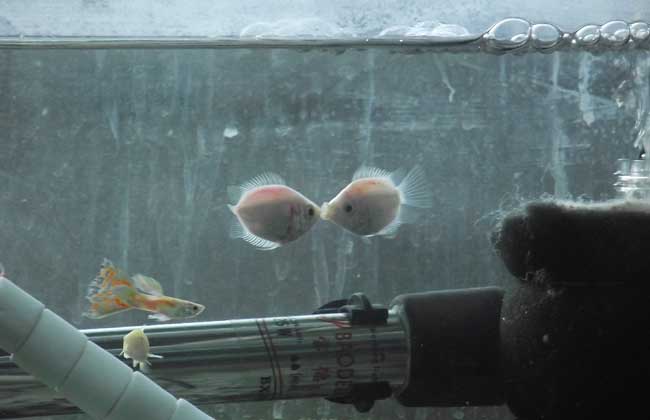
The kissing gourami is famous for its habit of "kissing" each other. Its price is not very high. When bought from fish dealers, they are usually small individuals about 3 to 4 cm, and at most they can generally reach about 20 to 25 cm. It can be considered a medium-sized fish and grows rather slowly; reaching about 20 cm takes a fairly long time. Now let us take a look at how much a kissing gourami costs!
How much does a kissing gourami cost?
The price of kissing gourami is generally between 5 and 10 yuan. Whether they are sold singly or in pairs depends on the specific situation. One type of kissing gourami has a rather special body shape, similar to a peach shape or a heart shape; this kind of kissing gourami is a bit more expensive than ordinary ones, possibly around ten-plus yuan. If purchased online, the price will be relatively cheaper, generally around 2 to 3 yuan. The price of kissing gourami varies by region, so do not generalise.
What food do kissing gourami eat?
The kissing gourami has a gentle temperament, moves in groups across various water layers, can be kept mixed with other fish, and has omnivorous feeding habits. It is not picky at all: breadworms, chopped earthworms and artificial feed are all fine. It eats whatever its owner feeds it. Not only does it grow quickly, but its resistance is also quite good, and it rarely gets sick and multiplies into many offspring. Under artificial rearing conditions, the kissing gourami has no fixed breeding season, and breeding is relatively simple. It is best to keep them in pairs and feed them heavily to favour breeding.
How should kissing gourami be kept to do well?
1. Fish tank: We all know that adult kissing gourami can reach 20 to 30 cm in body length, and smaller kissing gourami can also reach more than 10 cm. Calculating by a tank-to-fish-body-length ratio of 3:1, the tank must be at least 90 cm. However, most kissing gourami that people buy are around 10 cm, so a tank 40 to 60 cm long is enough.
2. Water temperature: Kissing gourami can live in water temperatures of 18 to 30°C, usually with above 22°C being suitable. If keeping them in winter, and if your home has heating, you do not need to install a heater. Installing a thermometer lets you observe the water temperature at any time. If the water temperature cannot be maintained at around 25°C, you need to buy a thermostat. In addition, keeping kissing gourami has no strict requirements for water quality; they like weakly acidic soft water.
3. Feed: Kissing gourami are easy to keep precisely because they are not picky eaters. They eat both animal-based feed and plant-based feed, like eating red daphnia (bloodworms) most, and love eating aquatic plants and algae.
4. Tankmates: Kissing gourami swim relatively slowly and are not suitable for being kept together with aggressive fish species, such as piranhas, flowerhorn cichlids, and three-spot cichlids, etc. It is best to keep some fish species that are smaller than kissing gourami and have a gentle temperament.
5. Male and female: Male and female kissing gourami are not easy to distinguish; juveniles are almost impossible to tell apart by sex. In adults, the male's anal fin is generally wide and long, and the body appears somewhat slender, while the female's anal fin is narrow, the body is broad and thick, and the abdomen is slightly bulging.
6. Breeding: Kissing gourami directly lay floating eggs that float on the water surface. The eggs are amber-coloured; if they turn white, it means the eggs are unfertilised. After spawning is complete, the parent fish can be removed and the eggs artificially incubated. The larvae hatch in 20 to 24 hours. After the larvae can swim in 2 to 3 days, they must be fed large amounts of infusoria (green water), otherwise they will starve to death. After another 2 to 3 days, feed small red worms for 3 to 4 days, then they can be fed large worms. At 15 to 20 days, the rapidly growing larvae should be divided into two or three tanks for rearing to ensure a relatively high survival rate. Sometimes a single brood of larvae can survive more than 9,000 fry.