How much does chicken-blood stone cost? A detailed interpretation of the market
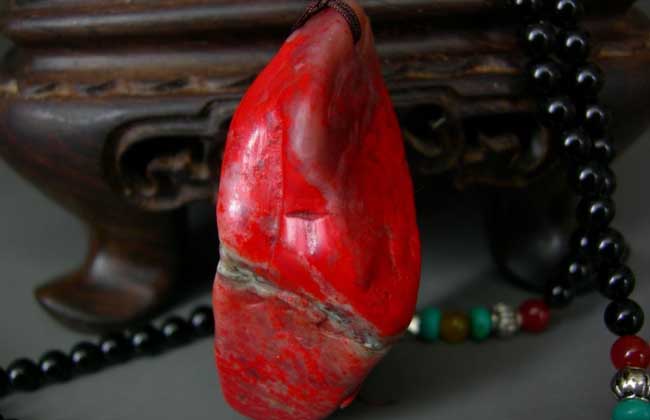
Chicken-blood stone is named for its bright red cinnabar that resembles chicken blood. It has a culture spanning several thousand years and is beautiful, crystalline and rare, and has long been praised as the Queen of Stones, the Princess of Seal Stones and the Empress of Chapter Stones. Unfortunately, the mining of chicken-blood stone has now reached its final stage, so the output of chicken-blood stone is quite limited, making it one of the last remaining things in the world, extremely rare, with a value beyond words. Let us now take a look at how much chicken-blood stone costs!
How much does chicken-blood stone cost?
The price of chicken-blood stone has been rising all the way in recent years, increasing nearly 6-fold within 10 years, and some chicken-blood stone of relatively good quality has even risen to 10 times its former price, once again becoming a focus of collecting. It is said that 10 years ago a piece of chicken-blood stone, when it had just been mined, had a transaction price of 30 million yuan, and could be cut and polished into more than 30 standard Dahongpao seals of 3 cm in size. Calculated at a price of 3 to 5 million yuan per Dahongpao seal, its value was already around 100 million yuan. Today's chicken-blood stone has soared in price, and the speed of the rise has not stopped, staging a new round of "blood stone storm", and the collecting world has once again turned its focus to chicken-blood stone.
The distribution of chicken-blood stone's places of origin
1. Changhua: Changhua chicken-blood stone is produced in Yuyan Mountain at the source of the Zhexi Grand Canyon, 50 km west of Changhua Town, Lin'an City, Zhejiang Province. Here mountains surround it, steep ridges stretch on, and the high mountain canyon has formed unique climatic conditions, which have also provided the conditions for the production of Changhua chicken-blood stone. In the selection of China's national stone, Changhua chicken-blood stone possessed the "four qualities". Uniqueness -- according to investigations by China's geological departments and records in geological literature of various countries, so far no other country in the world has been found to have this kind of mineral deposit. Extraordinariness -- its shape and color are both strange and special, and extremely rare. Ornamentality -- its shape, color, texture and quality are incomparably beautiful, hard to put down no matter how much one plays with it, and one gains from it. Cultural quality -- it holds a place in traditional culture, favored by emperors and treasured by commoners.
2. Balin: Balin chicken-blood stone is produced in Bairin Right Banner, Inner Mongolia. The chicken-blood stone here is warm and moist in quality and rich in color, suitable for seal carving and engraving, and is a very good seal stone as well as an outstanding one among ornamental stones. According to blood color, there are bright red, deep red, dark red and so on. According to form, there are several kinds such as sheet red, strip red and spot red. In general, the higher the degree of blood color coagulation, the more concentrated the distribution, and the larger the area occupied, the higher the quality of the chicken-blood stone.
3. Guilin: Guilin chicken-blood stone is rich in color, mainly red, and also has the white of Hetian jade and the green of jadeite. On the other hand, for chicken-blood stone, red is supreme, and the more vivid the red, the greater the collecting value, so in recent years Guilin chicken-blood stone has been much collected by some high-end people.
Methods for identifying chicken-blood stone
1. Weight: For completely fake chicken-blood stone, the weight is relatively light and buoyant, while real chicken-blood stone is relatively heavy, and the difference in weight between the two is obvious.
2. Blood color: Fake "chicken blood" patterns and colors are unnatural, with a single tone, and the color blocks and color bands are mechanical and dull, while real "chicken blood" color has the characteristics of varying shades and natural, smooth shapes.
3. Burning with fire: Fake chicken-blood stone gives off a burnt glue stench, and immediately changes color, and after cooling does not return to its original color, while when real chicken-blood stone is burned with fire, what is seen on the surface is a small amount of wax oil, and the blood color, after being subjected to high temperature, will turn purple and darken, but after cooling will immediately return to its original color. Note that when burning, the entire chicken-blood stone should be heated evenly. You can also place a piece of smooth iron sheet on an electric stove, then put the chicken-blood stone on the iron sheet to heat, and turn the chicken-blood stone. When the chicken-blood stone is heated to a high temperature, observe carefully the changes in blood color. This method is relatively reliable, but for spliced chicken-blood stone, one can only rely on careful observation and experience.
4. Luster: Because fake chicken-blood stone is coated with resin or 502 glue, abnormal luster reflection can be seen, especially obvious when turning it under light, while real chicken-blood stone, because it is waxed and polished, has soft brightness and an obvious waxy luster.
5. Knife scraping: For completely fake chicken-blood stone made entirely of synthetic resin, scraping produces curled flakes, and fine grinding with sandpaper also produces no stone powder, while for real chicken-blood stone, scraping the waxed surface produces wax, and scraping the texture produces stone powder. This method can only identify fake chicken-blood stone made of synthetic resin.
6. Touch: Synthetic completely fake chicken-blood stone does not have the icy cool feeling of stone, while real chicken-blood stone has an obvious icy cool feeling.