What is the market price situation for Canna lilies?
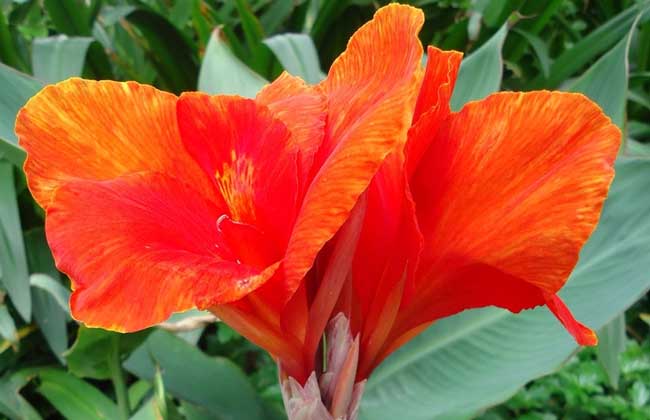
Canna lilies are flowering plants commonly used in subtropical and tropical regions, native to tropical areas such as tropical America, India and the Malay Peninsula. They not only beautify people's lives but can also absorb harmful substances such as sulfur dioxide, hydrogen chloride and carbon dioxide. Many people like to grow them. Let's take a look at the market price of Canna lilies below!
The market price of Canna lilies
The market price of Canna lilies is very cheap, and the price is usually measured by height and variety. A common Canna about 50 cm tall costs about 0.65 yuan per plant, a Canna 'Golden Vein' 60 cm tall costs 3.5 yuan per plant, a variegated-leaved Canna 50 cm tall costs about 0.38 yuan per plant, and a variegated-leaved Canna 100 cm tall costs about 0.6 yuan per plant.
Propagation methods for Canna lilies
1. Sowing: Before sowing Canna seeds, first file the hard seed coat with a file, then soak them in water at 25°C for 24 hours, then sow them in single spots in plain sandy soil. The covering soil should preferably not be too thick, ideally 1-2 times the diameter of the seed. After sowing, keep the soil moist at a temperature of around 20°C, and they will germinate after 1 week. When the seedlings are 5 cm tall, they can be transplanted.
2. Rhizomes: Rhizome propagation of Canna is usually done in early March each year. Cut the rhizomes stored from the previous year into pieces, remove the rotten parts, and make sure each piece has two or three buds, then plant them directly in flower pots or bury them in plain sand. Be careful to keep the soil moist and maintain the temperature between 10-15°C. After about 20 days, when the shoots are 4-5 cm long, they can be divided into pots.
3. Division: Division propagation of Canna is generally done in June-July on rainy days or in the evening. For plants or clumps with a spacing of more than 4-5 cm that have not yet produced flower spikes, use a sharp tool to cut vertically downward between the plants, quickly dividing the plants or clumps. Be careful to keep plenty of original soil and not damage the branches and leaves, then plant them directly into the planting holes. Water thoroughly promptly after planting. If the environment is relatively dry, provide appropriate shade to increase humidity. After about 10 days of care, the new plants can develop into complete plants.
How to grow Canna lilies
1. Soil: Canna lilies are not demanding about soil. They grow best in loose, fertile, well-drained sandy soil, and also adapt to fertile clayey soil.
2. Sunlight: During the growing period, Canna lilies require sufficient light and must receive at least 5 hours of direct sunlight every day. If the environment is too shady and the light is insufficient, the flowering period will be delayed.
3. Temperature: Canna lilies like warmth and fear severe cold. The suitable growing temperature is 16-30°C. Growth stops at 5-10°C, and cold damage occurs below 0°C. When flowering, to extend the flowering period, they can be placed in a low-temperature spot without sunlight, but the ambient temperature should not be lower than 10°C.
4. Watering: After planting Canna lilies, before the rhizomes have grown new roots, water less. The potting soil should preferably be moist. Soil that is too wet easily causes root rot. After the flower stems grow out, water frequently to keep the potting soil moist. If water is lacking, the phenomenon of “flowers hidden among the leaves” easily appears after flowering. In winter, watering should be reduced, following the principle of “water when dry, dry when wet”.
5. Fertilizing: In addition to applying sufficient base fertilizer before planting, Canna lilies should be given 3-4 applications per month of thin cake liquid fertilizer during the peak growing season. If flower stems have not yet emerged 20-30 days before the scheduled flowering period, spray the leaves once with a 0.2% potassium dihydrogen phosphate aqueous solution to force flowering.
6. Pests: Canna lilies are highly adaptable and relatively easy to manage. They are not delicate, and pests are also few. From May to August each year, pay attention to leaf-rolling pests to avoid damaging the tender leaves and flower spikes. They can be controlled by spraying with 50% dichlorvos at 800 times dilution or 50% fenitrothion emulsifiable concentrate at 1000 times dilution.